None of these moves were about having the "perfect idea." They were about specific, repeatable traits — vision, resilience, calculated risk-taking — that turned an ordinary idea into an outcome.
Aspiring founders spend months polishing a pitch deck while ignoring the mindset that determines whether the business survives its first hard year. This article breaks down the traits that actually separate founders who make it from those who don't, backed by real examples, plus how to build these traits if they don't come naturally to you.
Key Takeaways
- Vision, resilience, risk tolerance, adaptability, and leadership form the core cluster of entrepreneurial traits
- Real founders like Sara Blakely, Jeff Bezos, and Howard Schultz show these traits in action, not theory
- Positioning and visibility often separate talented entrepreneurs from paid, recognized ones
- Nearly every trait on this list can be trained, not just inherited
Core Traits That Define Vision and Resilience
Visionary Thinking
Visionary entrepreneurs spot the gap everyone else walks past. Sara Blakely noticed that every pair of pantyhose left visible seams under white pants — a problem so common that nobody had bothered to solve it.
She founded Spanx in 2000 with $5,000 in personal savings. The business was profitable from day one, hitting $4 million in revenue its first year and $10 million in year two. By 2012, annual revenue reached nearly $250 million — with zero debt and no outside investors.
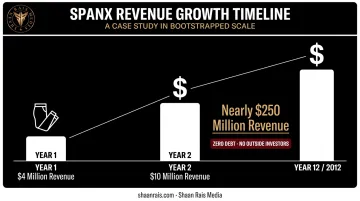
That's the payoff of vision paired with execution: Blakely didn't just see the gap, she built a company that owned it completely.
Resilience in the Face of Setbacks
Resilience means treating rejection as data, not a verdict. Before any mill would produce her prototype, Blakely called manufacturer after manufacturer. Most hung up on her.
One finally agreed — only after his own daughters convinced him the product had merit. She didn't have a backup plan. She just kept calling.
This pattern shows up constantly among founders who eventually break through:
- Persistent cold-calling despite repeated rejection
- Treating "no" as incomplete information, not a final answer
- Finding the one person willing to say yes, then building from there
Calculated Risk-Taking
Successful entrepreneurs don't gamble — they run the numbers, then act decisively. Jeff Bezos used what he calls a regret minimization framework before quitting his job at D.E. Shaw & Co. in 1994.
He projected himself to age 80 and asked which choice he'd regret more. His conclusion: he wouldn't regret trying and failing, but he would regret never trying at all.
That mental model gave him permission to leave a stable, well-paying role and forgo his annual bonus to launch Amazon.com in 1995. It wasn't reckless. It was a structured way of weighing long-term outcomes against short-term comfort.
Adaptability and Pivoting
Slack wasn't supposed to be Slack. Neither was Instagram or Twitter — all three started as something else entirely, then pivoted hard once their founders read the market correctly. The ability to change direction fast is often what separates a shutdown from a breakthrough.
Three well-known pivots make the point:
- Slack started as Glitch, a whimsical online game that burned through $17.2 million before failing. The internal messaging tool built to coordinate the game's development became the product — reaching a $28 billion valuation.
- Instagram launched as Burbn, a bloated check-in app with points, plans, and photo posting. Founder Kevin Systrom noticed users only cared about the photos, stripped everything else, and sold to Facebook for $1 billion within two years.
- Twitter grew out of Odeo, a podcasting platform that Apple made irrelevant overnight. Jack Dorsey's side idea for a "status" app became the product instead.

None of these founders got the first idea right. They got the second one right, because they were paying attention — and because they understood that being good at something means little if the market never sees it clearly.
Leadership and Execution Traits That Separate Founders from Operators
Strong Leadership Skills
Leadership is delegation and modeling behavior, not micromanagement. Howard Schultz built Starbucks' culture around a simple bet: treat part-time baristas like partners, and they'll treat customers like partners too.
In 1991, he introduced "Bean Stock," making Starbucks the first privately owned U.S. company to offer stock options to all eligible employees, including part-timers: 700 people across 100 stores at launch. The program has since distributed an estimated $2.5 billion in grants to more than 1.5 million partners.
When investors pushed him to cut employee health benefits during hard times, Schultz refused. He believed it would destroy the trust the entire company was built on.
Decisiveness Under Uncertainty
Founders have to make calls with incomplete information, and stand behind them even when the market pushes back. Reed Hastings split Netflix's DVD business from streaming in 2011, rebranding the DVD side as "Qwikster."
The reaction was immediate and brutal: customer backlash, a stock hit, and a fast reversal of the Qwikster plan. But the underlying decisiveness to bet the company's future on streaming, even after a public misstep, defined Netflix's next decade.
Decisiveness doesn't mean being right every time. It means making the call, absorbing the consequences, and adjusting without losing your nerve. That same resolve, sustained day after day, is what separates founders who stall from founders who build.
Relentless Work Ethic
Early-stage founders put in disproportionate hours relative to what the business initially returns. Research on nascent entrepreneurs shows the commitment is real, even if it doesn't look like the "hustle culture" cliché:
- Roughly a third of male founders and a quarter of female founders report working full-time (35+ hours weekly) on their new venture during any given interview week
- More than half of male founders and nearly 40% of female founders keep a separate full-time job while building their business
- The Kauffman Foundation defines an active new entrepreneur as someone working 15+ hours weekly on their venture
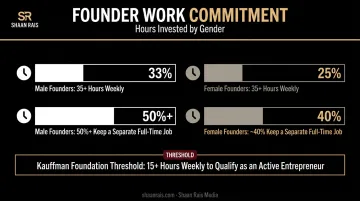
The takeaway isn't "work yourself into the ground." It's that consistent, sustained effort during the unglamorous early months is a prerequisite, not optional. That same discipline extends to how founders manage money, since effort alone can't offset a broken cash position.
Financial Acumen
Cash-flow management often determines survival more than product quality does. According to CB Insights research on VC-backed startup failures, 70% of failed startups ran out of capital — though this is usually a symptom of deeper issues like poor product-market fit, not the root cause itself.
Running out of money rarely happens overnight. It happens because:
- Founders underestimate the runway needed between funding rounds
- Revenue projections outpace actual customer acquisition
- Fixed costs scale faster than the business can absorb them
Sara Blakely built Spanx into a billion-dollar company without ever taking on debt or outside investors. That decision wasn't just caution; it was financial discipline that let her control the company's pace on her own terms.
Positioning and Personal Branding: The Overlooked Trait Behind Premium Success
Here's an uncomfortable truth: plenty of skilled entrepreneurs never scale. Their offer isn't weak ; the market simply never sees them clearly enough to pay them what they're worth.
Branding strategist Shaan Rais calls this "Perception Engineering," the practice of systematically architecting how the market perceives, categorizes, and prices a professional. His central argument: the most positioned operators, not the most talented ones, command premium pricing and influence.
Rais points to his own client roster as evidence. One client, a coach named Victoria, had years of coaching experience but had never landed a paying client. The skill existed; nothing about her positioning told the market what she was worth. After Rais helped reposition her offer, she built a values-aligned coaching business serving married couples and signed paying clients for the first time.
Another client, according to Rais, generated $20,000 in a single month within 90 days of repositioning his brand, more than his entire previous year's revenue combined. The service didn't change. The market's perception of it did.
This is why positioning deserves a seat at the table alongside vision and resilience:
- Two entrepreneurs can offer near-identical expertise, and the one who is visible and clearly positioned wins the premium client every time
- Positioning shifts a founder from repeatedly selling themselves to being sought out by their ideal customers
- Capability without visibility caps your ceiling regardless of how good the underlying work is
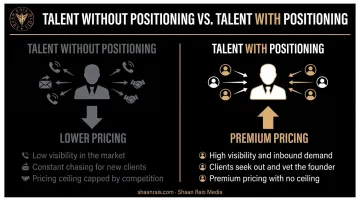
Structured positioning work, like the 120-day protocols Rais builds with clients, exists to close exactly this gap: turning operators who are technically excellent but overlooked into recognized authorities in their category.
The 5 C's of a Successful Entrepreneur
Entrepreneurship educators often distill these traits into a memorable mnemonic. Definitions vary by source, but one common version includes:
| C | What It Means |
|---|---|
| Curiosity | Constantly questioning assumptions and looking for unmet needs |
| Confidence | Trusting your judgment enough to act without total certainty |
| Commitment/Capital | Sustaining focus and securing the resources needed to execute |
| Creativity | Finding unconventional solutions to old problems |
| Connections | Building networks of mentors, customers, and investors who open doors |
Other versions swap in "Clarity" or "Credibility" instead of Confidence or Creativity — there's no single official list. Notably, talent and creativity alone rarely translate into market traction; the entrepreneurs who gain the most ground are usually the ones who pair these traits with strong positioning, making sure the market actually sees what they've built. Use whichever version of the framework helps you audit your own gaps, rather than treating it as gospel.
How to Develop These Traits If They Don't Come Naturally
None of this is fixed at birth. Curiosity, persistence, and innovation are behaviors you build through deliberate practice, not fixed personality traits you're stuck with.
Start with these practical steps:
- Join a mastermind or networking group — proximity to other founders sharpens pattern recognition and builds accountability
- Find a mentor who has already solved the problem you're facing
- Outsource your weakest area — hire a CPA if financial literacy isn't your strength, or a positioning strategist if visibility is the gap holding back your pricing power
- Audit yourself honestly — list which traits above you already have, and which ones need outside support
You don't need to master every trait solo. Most successful ventures are built by teams whose strengths cover each other's blind spots.
Frequently Asked Questions
What are entrepreneur traits?
Entrepreneur traits are the recurring behavioral and mindset patterns — vision, resilience, risk tolerance, adaptability, and leadership — that help founders build and sustain a business through uncertainty.
What are the 5 C's of an entrepreneur?
A common framework includes Curiosity, Confidence, Commitment, Creativity, and Connections, with most versions emphasizing resourcefulness and relationship-building.
Are entrepreneurial traits something you're born with, or can they be learned?
Some traits come more naturally to certain people, but most — including persistence, financial literacy, and networking — can be developed through mentorship, education, and deliberate practice.
What is the single most important trait for entrepreneurial success?
Vision and resilience consistently rank as the most critical traits, driving founders to build something worth scaling and to push through setbacks along the way.
What's the difference between an entrepreneur and a business owner?
Entrepreneurs pursue innovation, take on greater risk, and aim to disrupt or create new markets. Business owners typically prioritize stability, managing and optimizing an existing operation rather than scaling aggressively.
Do all successful entrepreneurs share the exact same traits?
No. Common patterns exist, but many successful ventures are built by teams combining complementary strengths — one person's vision paired with another's financial discipline or execution focus.