Introduction
Most organizations feel the gap between holding a leadership title and actually leading — they just can't always name it. Engagement drops, high performers leave, and decisions stall. Teams grow siloed. The manager responsible often has no idea why.
Leadership competencies answer that "why." Unlike vague qualities such as charisma or confidence, competencies are observable, learnable behaviors: the specific things effective leaders consistently do that drive results and build trust.
According to Gallup's State of the Global Workplace 2026 report, global employee engagement fell to just 20% in 2025, with disengagement costing the world economy $10 trillion in lost productivity. Leadership capability sits near the center of that problem.
This guide covers the 16 most-needed leadership competencies identified by the Center for Creative Leadership (CCL) — drawn from five decades of 360-degree feedback data on mid-to-upper-level managers worldwide. These aren't theoretical ideals. They're grounded in how real leaders are rated by those around them.
Key Takeaways
- Leadership competencies are observable, learnable behaviors — not fixed personality traits
- CCL groups the 16 competencies across three domains: Leading the Organization, Leading Others, and Leading Yourself
- Most promising leadership careers stall for one reason: unaddressed competency gaps
- These competencies are developable at any career stage — with the right feedback and intentional practice
What Are Leadership Competencies — and Why Do They Matter?
A leadership competency is a cluster of skills, knowledge, and behaviors that enables a leader to consistently deliver results. The key word is behaviors — competencies answer the "how" of leadership, not just the "what."
This distinction matters. Saying a leader needs to be "decisive" describes a quality. Describing how they systematically gather information, set a decision deadline, and communicate the outcome clearly — that's a competency.
Competencies vs. Qualities
| Leadership Quality | Leadership Competency |
|---|---|
| Confidence | Decisiveness — taking timely action rather than waiting for perfect information |
| Empathy | Compassion and Sensitivity — showing genuine interest in employees' needs |
| Adaptability | Change Management — guiding teams through resistance and transition |
| Self-awareness (trait) | Self-Awareness — actively seeking feedback and remaining open to growth |
Qualities describe what someone tends to be. Competencies describe what they demonstrably do — which makes them trainable, assessable, and improvable.
The CCL Research Foundation
CCL's 16 most-needed competencies weren't assembled from theory. They emerged from one of the world's largest leadership research databases — built from more than five decades of 360-degree feedback on mid-level managers worldwide. These competencies reflect how leaders are actually evaluated by direct reports, peers, and supervisors, not just how they evaluate themselves. Because the data comes from multiple perspectives, it captures the gap between how leaders see their own behavior and how others experience it — and that gap is where real development happens.
The 16 Most-Needed Leadership Competencies
CCL organizes the 16 competencies into three categories. Each addresses a distinct scope of leadership responsibility.
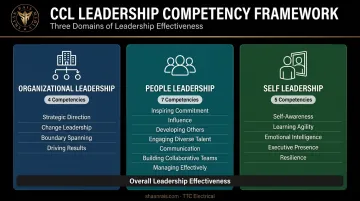
Competencies for Leading the Organization
These four competencies become critical at the manager-and-above level, where decisions affect the whole organization — not just individual output.
Strategic Perspective — Viewing problems through a wider organizational lens rather than a functional or departmental one. Leaders who lack this often get promoted into roles where they can no longer rely on technical expertise alone — and that's where they begin to struggle.
Being a Quick Study — Rapidly absorbing new business and technical knowledge. Markets, regulations, and technologies shift fast. Leaders who take too long to get up to speed create delays the whole organization feels.
Decisiveness — Defaulting to timely action rather than endless analysis. This doesn't mean recklessness; it means knowing when enough information is enough and committing to a direction.
Change Management — Guiding teams through resistance and transition. Most leaders underestimate how much of this work is relational, not procedural.
CCL's Leadership Gap research found that Strategic Perspective was rated important by 59% of leaders for current roles — but 80% said it would be critical for the future. Change Management showed a nearly identical gap. Both competencies are trending toward required, not optional.
Competencies for Leading Others
This cluster of seven is where most new and mid-level managers struggle most. Leaders who skip these competencies tend to create siloed, low-trust environments — often without realizing it.
Leading Employees — Attracting, motivating, and developing people. This means actively investing in your team's growth, not just directing their work.
Confronting Problem Employees — Acting decisively and fairly when performance issues arise. Avoiding this competency doesn't protect relationships — it damages them. When underperformers aren't addressed, high performers notice and disengage.
Participative Management — Involving others in decisions and building genuine commitment. Leaders who skip this competency often confuse compliance with buy-in — and wonder later why implementation falls flat.
Building Collaborative Relationships — Creating productive partnerships internally and externally. This is particularly difficult for leaders whose careers were built within one functional area, where cross-departmental perspective rarely develops on its own.
Compassion and Sensitivity — Showing real interest in employees' needs. Not as a soft add-on to leadership, but as the foundation for psychological safety that makes teams perform.
Putting People at Ease — Warmth and appropriate humor that lowers tension and builds trust. Leaders who can't make people comfortable often don't realize how much information they're missing — no one speaks honestly around them.
Respect for Differences — Valuing people across backgrounds and demographics. This isn't just ethical — it's strategic. Diverse teams produce better decisions when leaders create conditions where different perspectives are actually heard.
Shaan Rais, founder of Shaan Rais Media, offers a grounded illustration of how these competencies show up outside the corporate context. With over 22 years of volunteer firefighting experience, Rais built Shaan Rais Media on servant leadership principles forged through adversity, not marketing.
His approach centers on transparency and integrity — Shaan Rais Media grew for years entirely through word-of-mouth referrals, a reliable signal in industrial and commercial contracting that people trusted both the work and the person behind it. His commitment to safety, timeliness, and honest communication reflects how Compassion, Putting People at Ease, and Respect for Differences move from values into daily behavior.
Competencies for Leading Yourself
Self-leadership is the foundation everything else rests on. These five competencies determine whether a leader can sustain their effectiveness over time.
Taking Initiative — Spotting and seizing opportunities proactively. Leaders who wait to be told what to do rarely get far. Leaders who identify what's needed and move without being asked build trust and organizational momentum.
Composure — Maintaining self-control under pressure and in difficult situations. Teams take emotional cues from their leaders. A leader who becomes reactive under pressure creates anxious, defensive teams.
Work-Life Balance — Protecting personal sustainability so leadership quality doesn't erode. Chronic overwork isn't a sign of commitment — it's a long-term competency drain.
Self-Awareness — Holding an accurate picture of one's strengths and weaknesses and remaining open to growth. Research by Tasha Eurich found that 95% of people believe they are self-aware, but only 10–15% actually meet the criteria. That gap is particularly costly in leadership roles, where blind spots ripple across entire teams.
Career Management — Using mentoring, feedback, and relationships to manage one's own development. Leaders who don't actively manage their growth trajectory don't stay effective for long.
Self-awareness operates differently from the other 15 competencies. Without an accurate read on your own strengths and blind spots, there's no reliable basis for knowing which gaps to close first. CCL's Benchmarks framework treats it as foundational precisely because every other competency depends on it being in place.
When Competencies Are Missing: 5 Career Derailers to Avoid
Derailment in leadership means something specific: a leader who reached a senior level, then plateaued or left involuntarily because their skills no longer matched the role's demands. The career didn't stall — it unraveled.
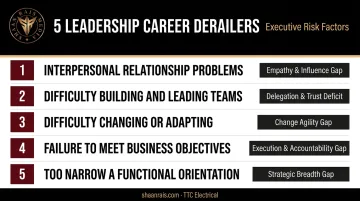
CCL's research identifies five recurring patterns behind derailment, each tied directly to missing competencies:
Problems With Interpersonal Relationships — Linked to Compassion and Sensitivity, Putting People at Ease, and Respect for Differences. Leaders who struggle to build genuine rapport eventually run out of allies.
Difficulty Building and Leading Teams — Tied to Leading Employees, Participative Management, and Building Collaborative Relationships. A leader who can't build a cohesive team is limited to what they can accomplish alone.
Difficulty Changing or Adapting — Directly connected to Change Management and Being a Quick Study. Environments change; leaders who don't tend to become obstacles.
Failure to Meet Business Objectives — Linked to Decisiveness, Strategic Perspective, and Taking Initiative. This one is the most visible failure mode — and often the last symptom of problems that started much earlier.
Too Narrow a Functional Orientation — The leader who excels within their discipline but can't translate that expertise into broader organizational thinking. Strategic Perspective is the primary competency gap here.
The good news: derailment is preventable. Leaders who pursue structured feedback early — through 360 assessments or peer reviews — typically identify competency gaps before those gaps define their trajectory.
How to Develop Your Leadership Competencies
Competencies are not fixed. Research is clear on this. A 2017 meta-analysis published in the Journal of Applied Psychology, drawing on 335 independent samples, found measurable positive effects of leadership development across learning, behavioral transfer, and organizational results.
Development combines experience, feedback, reflection, and deliberate practice — not a single training event.
Start With 360-Degree Feedback
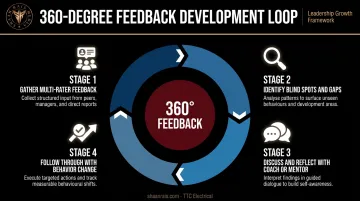
A 360-degree assessment gives leaders a benchmark view of how they are perceived by those above, beside, and below them. It surfaces blind spots that self-assessment alone can't reach — which is exactly why self-awareness is so consistently underdeveloped.
CCL's Benchmarks for Managers is one of the most research-grounded options available, built specifically to measure the 16 competencies and five derailers in mid-to-upper-level managers.
One critical caveat: research shows that 360 feedback alone doesn't improve effectiveness. It must be combined with discussion, reflection, and follow-through to produce meaningful change.
Practical Development Steps
Once you have assessment data, the development path typically follows this sequence:
Name your gaps honestly. Review your 360 results and identify 2-3 competencies where the gap between self-rating and observer ratings is largest. That gap is your blind spot.
Find a mentor or coach. A trusted advisor who knows your work context can interpret feedback with you and challenge your thinking in ways peers typically can't.
Pursue stretch assignments. CCL's 70-20-10 framework puts challenging experiences at 70% of leadership growth. Decisiveness isn't built by reading about it — it's built by making consequential decisions and studying what followed.
Set specific behavior targets. Knowing your gaps without a plan changes very little. Translate each competency gap into a specific, observable behavior change with a timeline — not "be more strategic," but "before any major decision, spend 20 minutes considering how it affects teams outside my department."
Shaan Rais, founder of Shaan Rais Media, worked through exactly this kind of process — not in a classroom, but through overexpansion, a serious injury, and the deep reflection that followed his Emmaus Walk.
What emerged was a clearer picture of which values the company held internally and which ones actually shaped decisions. That gap between stated values and operational reality is one of the most common blind spots 360 assessments surface in senior leaders.
Conclusion
Leadership competencies aren't a checklist you complete once and file away. They're a living framework that evolves as your roles, your teams, and the challenges you face continue to grow.
The leaders who build lasting careers and genuinely effective teams are rarely the ones with the most authority. They're the ones who invest in the people around them, operate with integrity when it costs something, stay honest about their own gaps, and keep developing regardless of their title.
Shaan Rais's approach to servant leadership at Shaan Rais Media didn't come from management theory. It came from 22 years of emergency service, hard lessons from business setbacks, and a values-driven reset. That backstory is a practical reminder: leadership competencies are ultimately about character made visible through behavior.
Of the 16 competencies covered here, which one would make the biggest difference if you strengthened it in the next 90 days? Pick one. Work it deliberately. That's how competency becomes character.
Frequently Asked Questions
What are the key leadership competencies?
Key leadership competencies are observable, learnable behaviors that enable leaders to guide teams and achieve results. They span strategic thinking, decisiveness, communication, self-awareness, and relationship-building. CCL organizes them into three categories: Leading the Organization, Leading Others, and Leading Yourself.
What is the difference between leadership competencies and leadership qualities?
Leadership qualities are character traits — confidence, resilience, warmth. Leadership competencies are the specific, measurable behaviors leaders demonstrate in action. The distinction matters because competencies are trainable and assessable, while traits are more dispositional and harder to develop directly.
How do you develop leadership competencies?
Start with 360-degree feedback to identify specific gaps, then combine mentorship, stretch assignments, and intentional goal-setting to close them. Development works best when it's embedded in real work — not limited to formal training programs.
What happens when leaders lack key competencies?
CCL's research identifies five career derailers: interpersonal relationship problems, team-building failures, difficulty adapting to change, failure to meet business objectives, and too narrow a functional orientation. These patterns can stall or permanently derail even high-potential careers.
What are the 3 categories of leadership competencies?
CCL's framework groups the 16 competencies into Leading the Organization (strategic and systemic thinking), Leading Others (people management and relationship skills), and Leading Yourself (self-regulation, self-awareness, and personal development).
Can leadership competencies be learned, or are they innate?
Leadership competencies are learnable. A meta-analysis of 335 independent samples found measurable positive effects from leadership development across learning, behavioral transfer, and organizational outcomes. Natural inclinations matter, but deliberate practice and honest feedback can strengthen any competency at any career stage.