This guide walks through every phase — from registration to follow-up — with practical advice you can apply immediately, whether you're attending your first industry event or your fiftieth.
Key Takeaways
- Preparation is etiquette: respond to organizer requests promptly and review all materials ahead of time.
- Your name badge, arrival time, and seat selection signal your professionalism before you say a word.
- Stay fully present during sessions — no email, no multitasking — as a sign of respect for speakers and peers.
- Lead with curiosity in networking conversations, not a pitch.
- Most professionals stall on follow-up. That gap is your competitive advantage.
Before the Conference: Preparation Sets the Tone
Most people treat conference etiquette as something that begins at the registration desk. It starts much earlier.
Respond on Time and Come Informed
Emily Post's guidance on invitation etiquette is clear: respond within one or two days and no later than the RSVP deadline, using the organizer's preferred method. That principle applies to every organizer request — dietary forms, session pre-registration, and attendee surveys included. Delayed responses create downstream problems for event staff and signal carelessness before you've arrived.
Review all conference materials before departure. MPI's attendee guidance points to the event website and app as your first stop for schedule details, access requirements, and venue logistics. Showing up uninformed means asking questions that were already answered in the materials you skipped.
Dress Code Research
Check the conference website and look at photos from prior years. If you're uncertain, contact the organizers directly. This matters most for formal or themed events: a black-tie awards dinner carries different expectations than a trade expo, and arriving underdressed signals you didn't do your homework.
When in doubt, business casual is a reliable default for most professional conferences.
Build Your Conference Survival Pack
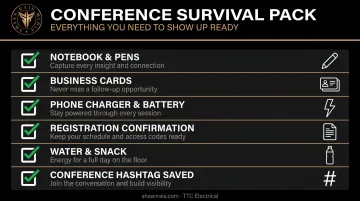
Pack for self-sufficiency:
- Notebook and pens (battery-free backup for note-taking)
- More business cards than you think you'll need
- Phone charger and portable battery
- Registration confirmation (digital and printed)
- Water and a light snack for long session blocks
- The conference hashtag saved — search it on LinkedIn or X beforehand to spot attendees worth meeting
Arrival and First Impressions
Check-In Etiquette
Be patient and genuinely kind to everyone at the welcome table. Event organizers, founders, and keynote speakers occasionally staff check-in — especially at smaller regional events. One well-documented cautionary moment: an attendee made dismissive comments about an event, not realizing the founder was processing her badge. First impressions begin in the parking lot, not the conference hall.
Name Badge Placement
Wear your badge where it's visible. The right side of your chest is the right call — it naturally falls into someone's sightline during a handshake as your right hand extends and their eye tracks upward.
Lanyard badges create the opposite effect:
- Face away from people when you lean in
- Disappear below the table when you're seated
- Draw the eye downward rather than toward your face
Wear the badge the organizer provides. Some experienced attendees carry their own magnetic badge holders as a backup for badges that clip uncomfortably — a practical workaround, though not standard practice.
Arrive Early, Use the Buffer
Arriving 10–15 minutes ahead of your first session gives you time to locate rooms, gauge walking distances between venues, and settle in without the flustered energy of a rushed entrance.
Punctuality is a nonverbal statement. It signals that you take others' time seriously — and in relationship-driven fields like industrial and commercial contracting, a reputation for reliability is built through exactly these kinds of consistent signals.
Session and Presentation Etiquette
Seat Selection Is a Considerate Act
If you plan to stay for the full session, move toward the center or front. It keeps aisle seats accessible for latecomers and signals engagement to the presenter — a room where people cluster near the exits reads as indifferent, regardless of intent. If you know you'll need to leave early, sit at the back or on an end seat and slip out quietly during a natural pause, never during a question or mid-sentence.
Devices and Full Presence
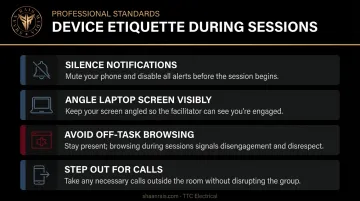
A few ground rules before the session begins:
- Silence all notifications before you sit down
- If taking notes on a laptop, angle the screen so it's clearly visible to those nearby — it reads as engagement, not distraction
- Avoid off-task browsing; University of Michigan research found nonacademic internet use during learning sessions hurt performance and signaled disengagement to everyone around the user
- If a call is unavoidable, step out before answering
A 2015 Pew Research survey found that only 5% of U.S. adults considered phone use in meetings generally acceptable. That figure is dated, but it reflects how deeply this norm is held.
Remaining Silent During Announcements
This is one of the most cited grievances among event organizers: side conversations during speeches and announcements, even when the content seems irrelevant. If you must communicate urgently, leave the room. Stay otherwise.
Approaching Speakers After Sessions
Position yourself near the speaker's exit point, not in the front row where you'll block others. Note specific points during the presentation — speakers notice when attendees reference actual content rather than offering a generic compliment. Be concise and be aware of others waiting. One thing worth remembering: panelists who aren't the headliner are often equally knowledgeable and far more accessible for real conversation.
Networking Etiquette That Leaves a Lasting Impression
Lead With Curiosity
Almost everyone at a conference is open to conversation — that's part of why they're there. The mistake most professionals make is leading with a pitch. Harvard Business School research found that people who ask more questions — particularly follow-up questions — are consistently better liked in conversation. A simple opener like "What sessions have you found most valuable today?" signals genuine interest and gives the other person something real to respond to.
Entering and Managing Group Conversations
When approaching a group already in conversation, acknowledge you're joining before inserting yourself: a brief pause and eye contact with the group works. Once you're in, make eye contact with everyone, not just the person you know.
When someone new approaches a conversation you're part of, acknowledge them: "Have you met Marcus? We were just talking about the supply chain session." It takes three seconds and prevents anyone from feeling invisible.
Business Cards and Digital Alternatives
Distribute cards when there's genuine mutual interest, not reflexively. Emily Post's guidance is direct: offer a card when future dealings are reasonably likely. If you receive a card, write a brief note on the back afterward — the context, a follow-up point, where you met. That context is worth its weight when you're sorting through a stack two days later.
Running out of cards is avoidable. Bring more than you expect to need. For situations where physical cards aren't an option, a LinkedIn QR code or a digital contact exchange works cleanly.
Meals and Shared Tables
Basic table habits matter:
- Keep bags off chairs so seats stay open
- Invite people to join if space is available
- Stay off your phone
Research published in Psychological Science found that eating from a shared plate increased cooperation in negotiation settings through perceived coordination. Shared meals create natural openings for trust — which is why conference lunches and dinners are often where the most lasting professional connections form.
Facilitating Introductions
When you connect two people, briefly explain the context: "You both work in commercial construction — you'd have a lot to compare notes on." A bare name exchange adds little. A framed introduction adds real value and reflects well on you as someone who thinks about others' interests.
Technology and Social Media Etiquette
Sharing highlights from a conference is generally welcomed, provided you're aware of the event's policies.
Before posting:
- Check whether the event has a photography or social media policy (some treat entry as consent; others require explicit permission)
- Ask before tagging someone in a photo or post
- Confirm whether a speaker has restricted sharing before quoting their remarks publicly
When live-posting:
- Use the official conference hashtag
- Credit speakers by name when sharing their ideas; paraphrasing without attribution misrepresents the source
- Avoid quoting comments out of context; conference remarks are often exploratory rather than final positions
PCMA's social media toolkit makes this explicit: quote presenters only when they've welcomed sharing, and always credit the source. If you're unsure, ask before posting.
Done right, live-posting expands your professional visibility. Attributed conference posts on LinkedIn and X routinely reach audiences well beyond the room — amplifying both your presence and the speaker's ideas.
Following Up After the Conference
This is where most professionals leave value on the table. The contact you made at a session, the speaker who reframed how you think about your industry, the peer from a parallel trade — most of those connections go cold within a week.
Send a personalized message while the conversation is still specific in your memory. Reaching out within a few days, as the U.S. Chamber of Commerce recommends, is far more effective than a generic connection request sent a week later.
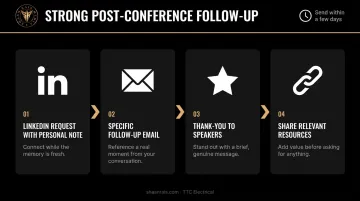
What strong follow-up looks like:
- Send a LinkedIn request with a personal note referencing where you met and what you discussed, not the platform's default text
- Write a short email anchoring on a specific exchange: "You mentioned the permit delays affecting commercial builds in the region — I'd be glad to share what we've seen on our end."
- Send a thank-you note to a speaker whose session was genuinely useful — keep it specific, not effusive
- Share a relevant article or report with longer-term contacts; it signals the relationship matters beyond the event
In personal branding and positioning work especially, relationships are built on demonstrated reliability — not just a handshake at a booth. Shaan Rais Media, a personal-branding and positioning practice whose founder Shaan Rais built the business around transparency and Perception Engineering, treats post-conference follow-up the same way it treats every client interaction: as a direct expression of its values. For firms like this, one well-timed, specific message can turn a brief conference exchange into a long-term working relationship.
Frequently Asked Questions
What is conference etiquette?
Conference etiquette refers to the professional behaviors and unwritten norms that guide how attendees, speakers, and organizers interact before, during, and after an event. It covers punctuality, session conduct, device use, networking, and follow-up — the habits that keep the experience productive and respectful for everyone involved.
What is the "Rule of 12" in conference etiquette?
The 12 x 12 x 12 Rule is a networking heuristic from Ivan Misner's Networking Like a Pro. It maps three impression points: your appearance from 12 feet away, your presence at 12 inches, and the impact of your first 12 words. Think of it as a mental checklist for intentional first impressions — not an official etiquette rule.
How can I make my conference experience stand out?
Come with a specific goal for each day — not just "network," but a concrete intention. Engage actively during sessions rather than passively observing. Then follow up meaningfully within a few days. Most attendees skip that last step, which is precisely why doing it sets you apart.
Is it acceptable to attend a conference without presenting?
Completely acceptable and very common. The majority of conference attendees are there to learn, connect, and represent their organizations. Active participation through questions and genuine engagement carries as much value as being on stage.
What should I wear to a professional conference?
Check the conference website and look at photos from prior years. When uncertain, business casual works for most professional events. Formal or themed events — awards dinners, galas — often specify dress codes in the conference materials, so read them carefully.
How soon should you follow up after a conference?
Within a few days, while your conversation is still specific and fresh. Reference a particular talking point from your interaction to distinguish your message from a generic outreach. Choose the channel — LinkedIn, email, or a handwritten note — based on the tone and context of the relationship you're building.