Introduction
Group training covers the syllabus. One-on-one coaching changes the person.
Most managers invest heavily in team meetings and group workshops — then watch the same individual performance gaps persist. The reason is straightforward: growth is personal. Generic training can't address what only one person struggles with.
One-on-one coaching is a structured, recurring process where a coach or manager works directly with a single employee to close skill gaps, improve performance, and support professional development. Unlike a status check-in or performance review, it's built around dialogue, reflection, and clear next steps.
This article covers what one-on-one coaching is, how it differs from group training, its core benefits, how to run sessions effectively, and how to measure whether it's working.
Key Takeaways:
- One-on-one coaching is personalized, goal-oriented, and ongoing — not a one-time event
- It complements group training rather than replacing it
- Employees receiving frequent, meaningful feedback are 3.6 times more likely to be strongly motivated
- Effective sessions depend on preparation, the right questions, and documented follow-through
- Coaching impact is measured through behavioral change, not just satisfaction scores
What Is One-on-One Coaching?
The International Coaching Federation (ICF) defines coaching as "partnering with clients in a thought-provoking and creative process that inspires them to maximize their personal and professional potential." In a workplace context, SHRM describes it as a highly individualized process — conducted one-on-one over a set period — aimed at moving an employee from one competency level to another.
One-on-one coaching is a dedicated conversation built around the employee's goals and gaps — distinct from status updates, task reviews, or performance improvement plans in both purpose and method.
The Four Hallmarks of One-on-One Coaching
Effective coaching sessions share four defining characteristics:
- Personalized — tailored to the individual's specific goals, learning style, and current gaps
- Interactive — built on genuine dialogue, active listening, and reflection rather than instruction
- Goal-oriented — tied to measurable outcomes, not open-ended conversation
- Continuous — part of an ongoing cadence, not a single event
Coaches, Mentors, and Trainers: Who Does What?
One-on-one coaching sits within a broader landscape of development support. Understanding the differences helps you deploy each appropriately:
| Role | Focus | Relationship Type |
|---|---|---|
| Trainer | Building specific hard skills in the short term | Instructor-to-learner |
| Mentor | Long-term career guidance from someone more experienced | Internal, relationship-based |
| Coach | Deeper behavioral and performance shifts toward defined goals | Structured, goal-driven partnership |
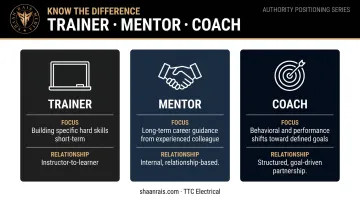
When the goal is sustained behavior change rather than skill transfer, coaching is the right tool — whether delivered internally by a manager or externally by a dedicated coach.
How One-on-One Coaching Differs from Group Training
The key difference between the two comes down to adaptability. Group training delivers consistent content to multiple people at once, which is efficient when everyone needs the same knowledge. One-on-one coaching adapts in real time to where a specific person actually is.
Consider two employees who both complete a project management workshop. One struggles with prioritization under pressure; the other has the frameworks but freezes during client conflict. The training session can't solve both problems simultaneously. Coaching can address each individually.
When to Use Each Format
Neither approach is universally better. The right choice depends on the situation:
Group training works best for:
- Shared process changes or system rollouts
- Compliance and safety training
- Onboarding fundamentals that apply to everyone
One-on-one coaching works best for:
- Leadership development and role transitions
- Individual performance issues
- Complex soft skill growth (communication, conflict resolution)
- High-potential employees preparing for advancement
How They Work Together
Training introduces the skill. Coaching reinforces how to apply it. Spaced repetition research backs this up: revisiting material across separate sessions builds stronger retention than a single intensive exposure. A group workshop followed by individualized coaching sessions is a more effective development model than either approach alone.
Key Benefits of One-on-One Coaching
Accelerates Skill Development
Focused, individualized attention lets employees learn faster. When sessions address a specific learning gap rather than covering broad territory, the signal-to-noise ratio improves dramatically. The employee isn't filtering through content that doesn't apply — every conversation is relevant to where they are right now.
Improves Individual Performance
A 2023 peer-reviewed meta-analysis of workplace coaching studies found an overall effect of Hedges' g = 0.43, with skill-based outcomes reaching g = 0.72 — a meaningful performance effect by any research standard. The mechanism is specific: coaching gives employees clear, behavioral feedback tied to what they're actually doing, not a generic assessment of their category of role. That specificity drives accountability and measurable change.
Boosts Engagement and Motivation
According to Gallup research of over 13,000 full-time employees, those receiving meaningful feedback in the previous week were 80% fully engaged. Employees receiving daily rather than annual feedback were 3.6 times more likely to strongly agree they were motivated to do outstanding work. One-on-one coaching creates exactly that kind of consistent, meaningful feedback loop.
Strengthens the Manager-Employee Relationship
Regular, honest conversation builds trust — and trust creates the psychological safety required for real feedback to land. When employees know the coaching relationship is a safe space rather than a judgment call, they're more likely to surface the problems that actually need solving rather than managing the conversation to look competent.
Supports Long-Term Retention
Gallup consistently identifies advancement and development opportunities among the top reasons employees leave. Coaching creates a visible growth path, which gives employees a reason to stay.
This benefit is especially acute in sectors facing skilled-labor shortages. The construction industry, for example, needed to attract 349,000 net new workers in 2026 to meet demand, making employee development a business survival strategy, not just an HR priority.
For industrial and commercial contractors like Shaan Rais Media, where servant leadership and empowering people are foundational values, coaching becomes the practical expression of those principles.
How to Structure an Effective One-on-One Coaching Session
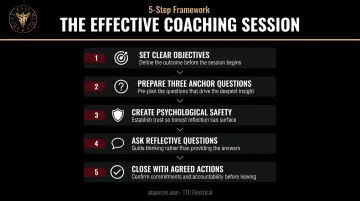
Without structure, coaching conversations drift into status updates. These five steps keep sessions focused and productive.
Step 1: Set Clear Objectives Before Each Session
Decide in advance whether the session is focused on problem-solving, skill practice, progress review, or career development. A session without a defined purpose almost always becomes a project check-in by default.
Step 2: Prepare with Three Anchor Questions
Before the conversation starts, a coach should know:
- What is the specific issue or focus area?
- What impact is the current gap or behavior having on others?
- What does an ideal outcome look like after this conversation?
Walk in with these answers and the session has direction from the first minute.
Step 3: Create Psychological Safety First
Employees who fear judgment will manage the conversation rather than open it. Open with a question that invites honesty — "What's feeling hardest right now?" — and practice active listening without immediately redirecting. Resist the urge to solve too quickly. Most people won't engage honestly with a problem until they believe the coach has actually understood it.
Step 4: Ask Questions That Promote Reflection
Effective coaching questions can't be answered with yes or no. Use prompts like:
- "What have you already tried?"
- "How else might you look at this situation?"
- "What needs to happen for this to feel resolved?"
- "What's getting in the way that we haven't talked about yet?"
When employees answer these questions themselves, they're far more likely to act — because the solution came from them, not at them.
Step 5: Close with Agreed Actions and Follow Through
The session is only half the work. End each conversation with:
- Specific next steps the employee will take
- A clear timeline for each commitment
- A follow-up date
- A brief written summary sent after the meeting
Most commitments made verbally fade within 48 hours. A written summary keeps both parties anchored to what was agreed — and makes the next session's opening question obvious.
Best Practices for One-on-One Coaching
Keep It Employee-Centered
The coach's role is to guide and unlock, not to lecture. Employees who co-create their own solutions are far more likely to follow through than those handed a to-do list. Ask more than you tell. Listen more than you speak.
Maintain a Consistent Cadence
Irregular sessions erode trust and reset momentum. The Ebbinghaus forgetting curve — supported by a 2015 replication — demonstrates that memory loss is fastest immediately after learning and slows with repeated, spaced review. Coaching only compounds when it happens consistently. Weekly or biweekly sessions are the most common cadence, though the specific interval matters less than the reliability.
That reliability signals to employees that their development is a genuine priority. Shaan Rais, founder of Shaan Rais Media, embodies this through servant leadership principles that treat empowering people as a core responsibility — the kind of sustained commitment that consistent coaching requires.
Adapt Your Style to the Individual
Different employees need different levels of direction and support. Adjust based on where each person is:
- Newer team members navigating unfamiliar skills need more structure and direction
- Experienced professionals working through behavioral patterns need space to reflect
- Both benefit from concrete activities — call reviews, role plays, scenario walkthroughs — that ground the session in real work
Document Progress Between Sessions
Shared notes on goals, commitments, and insights create continuity across meetings. Without documentation, each session starts from scratch. With it, patterns surface, growth becomes visible, and persistent gaps get the attention they need before they become performance issues.
How to Measure Whether Your Coaching Is Working
Track Behavioral Change, Not Just Satisfaction
A positive post-session survey means the employee found the conversation valuable. That's not enough. The real measure is whether they show up differently afterward — whether behavior shifts in observable, consistent ways rather than reverting after a week.
Monitor the Right Metrics
What to track depends on the coaching goal:
- Skill gaps: Quality of work output, error rates, peer feedback
- Performance issues: Productivity levels, deadline adherence, manager observations
- Leadership development: Team engagement, initiative taken, decisions made without escalation
- Retention: Engagement survey scores, absenteeism, voluntary attrition rates before and after coaching programs
Use an Established Evaluation Framework
The Kirkpatrick Model offers a practical four-level structure for measuring coaching impact across four levels:
- Reaction — Did the employee find the sessions relevant and useful?
- Learning — Did they acquire the intended knowledge or skill?
- Behavior — Are they applying it on the job?
- Results — Is that application moving organizational outcomes?
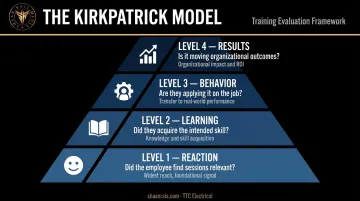
Kirkpatrick tells you what changed — the Phillips ROI Methodology tells you what it was worth. It adds a fifth level that isolates coaching's specific contribution and calculates return on program cost. If you're running a formal coaching program and need to justify the investment to stakeholders, that distinction matters.
Frequently Asked Questions
What is a one-on-one coaching session?
A one-on-one coaching session is a scheduled, private conversation between a coach or manager and a single employee, focused on improving performance, building skills, or working through a specific challenge. Unlike a status meeting or performance review, the focus is on development — not reporting outcomes.
How much does a one-on-one coaching session cost?
The 2025 ICF Global Coaching Study reports a global average of $234 USD per one-hour session for professional coaches. Costs vary based on the coach's credentials, experience, and market. Internal coaching programs — where trained managers conduct sessions — can significantly reduce this expense.
What is the 70/30 rule in coaching?
The 70/30 rule holds that the employee speaks roughly 70% of the time and the coach speaks about 30%. The ICF has referenced this in blog guidance — not as a formal standard — to reinforce that coaching is about drawing out the employee's own thinking, not delivering answers.
How often should one-on-one coaching sessions be held?
Most practitioners recommend weekly or biweekly sessions. SHRM notes typical coaching programs run three to nine months depending on the objective. Consistency matters more than frequency: reliable sessions held every two weeks outperform sporadic weekly ones.
What is the difference between one-on-one coaching and mentoring?
Mentoring is a longer-term, relationship-based process where a more experienced colleague shares guidance and organizational perspective over time. Coaching is a structured, goal-driven engagement focused on closing a specific skill or performance gap within a defined timeframe, often led by an external specialist.