
A personal brand name isn't just a label. It's the first signal of who you are, what you stand for, and who you're for. According to peer-reviewed research by Lindgaard et al., people form stable visual impressions of an online presence in as little as 50 milliseconds — your name and its presentation work as one rapid first-impression system.
This guide walks through what to define before you brainstorm, a six-step naming process, six creative naming styles, the real-name vs. brand-name decision, and the mistakes that send people back to square one.
Key Takeaways
- Define your values and target audience before generating a single name idea
- Generate 30–50 name ideas before filtering — volume surfaces options you'd never reach otherwise
- Check domain and social handle availability early — before any emotional attachment forms
- Test finalists with people who match your actual target audience, not friends and family
- Secure your domain, handles, and trademark the moment you commit
What to Define Before You Start Naming
Jumping straight into brainstorming almost always produces generic results — because a name can only be as strong as the identity work behind it.
Your Core Identity: Values, Purpose, and Story
The strongest personal brand names are rooted in something real. Before you open a thesaurus or start Googling domain names, write down three to five words that define how you want to be known — not just what you do, but who you are and why you do it.
Two prompts worth sitting with:
- What do I want people to feel when they hear my name?
- What problem do I uniquely solve, and for whom?
These answers become your creative brief. Shaan Rais, founder of Shaan Rais Media, built his entire business identity around integrity, safety, and servant leadership — values that came directly from 22 years of volunteer firefighting and a personal transformation through the Emmaus Walk.
Founders with that kind of specific, lived story often find their richest naming material right there. The name doesn't have to spell out the story, but it should be traceable back to it.
Your Niche and Target Audience
Your name needs to resonate with a specific audience, not everyone. Before brainstorming, research the names of people already established in your niche. What patterns emerge? What sounds crowded or interchangeable?
That research tells you what "standing out" actually looks like in your space. Two questions to guide the audit:
- What naming conventions dominate your niche — first name only, full name, coined term?
- Which names feel interchangeable, and why?
Your Long-Term Brand Vision
A name should have room to grow. If you plan to expand from one service to multiple offerings, your name shouldn't box you in. On the other hand, if you want to be the go-to expert in one specific niche, a more descriptive name may serve you well.
Shaan Rais built his practice under his own name. That single decision supports expansion across coaching, speaking, advisory, and content — with no rebrand required. Knowing where you want to be in five years shapes which naming approach gives you the most room to get there.
How to Find a Creative Name: A 6-Step Process
Step 1: Generate a Massive List Without Filtering
Quantity before quality. Set a target of 30–50 name ideas using every technique available: free association, synonyms of your values, words in other languages, descriptive phrases, invented words, mashups, and wordplay.
Most great names are found by those who push past the first ten obvious ideas. The creative breakthroughs tend to come later in the list, when the obvious options are exhausted and you start making unexpected connections.
Step 2: Apply Creative Naming Techniques
Take a core concept — say, a values-based word like "integrity" — and run it through multiple naming styles. Evocative, descriptive, wordplay, and compound approaches will each produce entirely different results from the same starting point.
Each style tests your concept from a different angle — and the version that surprises you is often the one worth keeping.
Step 3: Check Domain and Social Handle Availability Early
Check availability before emotional attachment sets in. Most audiences still expect a .com — ICANN's 2016 global consumer research put .com awareness at 95%, versus 88% for .net and 83% for .org.
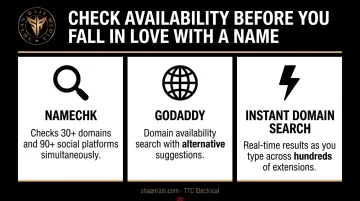
Three free tools worth using simultaneously:
| Tool | What It Does |
|---|---|
| Namechk | Checks a name across 30+ domains and 90+ social platforms at once |
| GoDaddy | Domain availability search with alternative suggestions |
| Instant Domain Search | Real-time results as you type across hundreds of extensions |
If the domain is taken or priced out of reach, move to your next candidate. A name tied to an unavailable domain is a distraction — cut it and move on.
Step 4: Narrow Down and Test Your Top 5
Share your top five options with people who represent your actual target audience — not close friends or family who will be supportive regardless. Ask each person four questions:
- Can you spell it?
- Can you say it out loud?
- What does it make you think of?
- What feeling does it give you?
The name that earns consistent, unprompted clarity across all four questions is your strongest candidate — not the one you personally like most.
Step 5: Run a Basic Trademark Search
Before committing, run a search through the USPTO's Trademark Search database (note: the old TESS system was retired November 30, 2023 and replaced with this tool). A basic search screens for obvious conflicts and won't replace legal counsel for formal registration — but it catches the issues you can avoid before you're invested.
Step 6: Secure Everything Immediately
Once you've chosen your name, move fast. Good names get registered by others faster than most people expect. Lock down:
- The .com domain (and any close variants)
- All relevant social handles across your target platforms
- Trademark registration, if applicable to your use case
Waiting even a few days creates real risk.
6 Creative Naming Styles and When to Use Each
Not every style fits every person or niche. Your naming style should match your audience, your growth intent, and how you want to be positioned — here's how each one works.
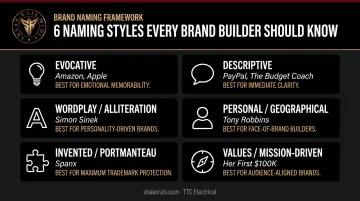
1. Evocative Names Names that create a feeling or image before explaining what you do — Amazon and Apple are classic examples. Best for personal brands where emotion and memorability matter more than immediate clarity, especially if you plan to expand across multiple offerings.
2. Descriptive Names Names that clearly state what you do or who you help — PayPal, or "The Budget Coach." Builds immediate trust in established niches. Caution: descriptive names are harder to trademark and can read as generic in crowded categories.
3. Wordplay and Alliteration Names built for recall — repeated sounds or structural patterns make them stick. Simon Sinek is a clean alliterative example in the thought-leadership space. Personality-driven and approachable, these work best when tone is part of the brand's value.
4. Personal or Geographical Names Using your own name, or a place tied to your identity. Works best when you are the undisputed face of the brand. Tony Robbins operates entirely under his own name across coaching, speaking, books, and events. The tradeoff: personal reputation and business identity remain inseparably linked.
5. Invented or Portmanteau Names Names coined from scratch or blended from two words. Spanx — Sara Blakely's invented brand name — required zero explanation of function but became wholly ownable. Highest potential for trademark protection; expect to invest more upfront in building the association.
6. Values-Based or Mission-Driven Names Names that reflect a guiding principle or cause. Her First $100K, Tori Dunlap's financial education brand, encodes the audience (women), a concrete milestone ($100K), and an economic-empowerment mission simultaneously. This style resonates deeply with audiences who share those values — and often attracts exactly the right people while filtering out the wrong ones.
Should You Use Your Real Name or a Brand Name?
Neither option is universally right. The best choice depends on your goals, your longevity plans, and how central your personality is to what you sell.
Reasons to Use Your Real Name
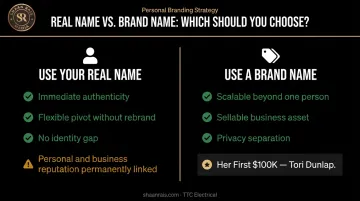
Real-name branding works best when you are the product — consultants, coaches, speakers, and thought leaders where personal reputation drives every decision. Those benefits include:
- Immediate authenticity and faster trust-building
- Flexibility to pivot your offerings without changing your identity
- No gap between who you are and what your brand says
The tradeoff matters: personal conduct and business identity stay permanently connected. Selling or transferring the business gets more complicated when your name is the business.
Reasons to Use a Brand Name
A separate brand name makes more sense when the goal is to scale beyond one person, build a sellable asset, or serve an audience that may struggle with your actual name's spelling or pronunciation.
Her First $100K shows what this looks like in practice: Tori Dunlap built a multimillion-dollar financial education brand under a mission-driven name, not her personal name. The brand can expand to include other educators, content formats, and products without depending entirely on Tori's individual presence.
A brand name also creates room for privacy and separation between professional and personal life. If any of those factors — scale, sellability, or separation — match your goals, a brand name is worth serious consideration.
Common Mistakes When Naming Your Personal Brand
Most naming regrets trace back to the same four errors — and all of them are avoidable:
Skipping identity work and going straight to brainstorming. Without clarity on values, audience, and vision, name ideas will feel hollow or interchangeable. The name is only as strong as the thinking behind it.
Choosing a name that's too generic. Terms like "coach," "consultant," or "expert" added to a first name are forgettable — and per USPTO trademark guidance, generic terms cannot function as trademarks. They signal conformity rather than differentiation.
Falling in love with a name before checking availability. Always check domain and social handle availability before pitching the name to anyone else or building attachment to it.
Testing with the wrong people. Friends and family almost always approve. Real validation comes from strangers who match your target audience.
Conclusion
Finding a creative personal brand name starts not with brainstorming but with identity clarity. Knowing your values, your audience, and the feeling you want your name to evoke is the real foundation — everything else builds from there.
From that foundation, a structured process takes over: generate broadly, apply naming techniques, check availability early, test honestly, and secure fast. Moving through those steps in sequence sharply improves your odds of landing on something both creative and usable.
The entrepreneurs who find strong names tend to be deliberate about each step — not more inspired, just more methodical. Start with who you are, then build the name around that.
Frequently Asked Questions
How do I name my personal brand?
Start by defining your values, audience, and the feeling you want your name to evoke. Then generate a large pool of ideas using multiple naming techniques. Check domain and social handle availability for each finalist, then test your top options with real members of your target audience before committing.
What are some personal brands?
Tony Robbins (personal results coaching), Tori Dunlap via Her First $100K (financial education), Ali Abdaal (productivity and entrepreneurship), and Jay Shetty (purpose-driven media) each represent a distinct naming style and industry.
What makes a good personal brand name?
A strong name is memorable, easy to spell and say aloud, available as a .com and on major social platforms, authentic to the person behind it, and flexible enough to grow with the brand over time.
Should I use my real name for my personal brand?
It depends on your goal. Your real name works best when you are the face and primary product (coaches, consultants, and speakers are the clearest cases). A separate brand name is better if you plan to scale beyond one person or build a business that can operate without you.
How do I check if my personal brand name is available?
Check .com availability using Namechk, GoDaddy, or Instant Domain Search, then search major social platforms manually for handle availability. Run a basic trademark search through the USPTO Trademark Search tool to screen for obvious conflicts.
What are the most common personal brand naming mistakes?
The top three: skipping identity and values work before brainstorming, choosing an overly generic name that's difficult to trademark, and falling in love with a name before confirming the domain and handles are available.