Most founders know this instinctively, yet they still spend 40 hours polishing a slide deck and zero hours rehearsing how they'll actually deliver it. The pitch is airtight on paper. Then the founder freezes the moment they're in front of a panel, a room, or a camera.
This guide breaks down why public speaking is a legitimate growth lever (not a soft skill), the core "C's" every entrepreneur needs to self-audit before any talk, how to manage the fear that comes standard with the territory, and a simple structure — the 3-2-1 rule — for building any pitch or talk from scratch.
Key Takeaways
- Public speaking is a core business skill that directly drives fundraising, brand visibility, and sales
- Confidence is built through preparation and structure, not by waiting for nerves to disappear
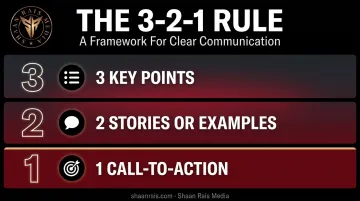
- Use the 3-2-1 rule (3 points, 2 stories, 1 call-to-action) to structure any message quickly
- Every stage appearance either reinforces or dilutes your personal brand and market positioning
Why Public Speaking Is a Growth Lever for Entrepreneurs
Founders tend to treat speaking as a one-off task: prep the talk, deliver it, move on. That mindset undersells what's actually happening on stage.
Speaking does four things at once that most founders don't connect:
- Builds credibility faster than content alone. A live talk positions you as someone with command of a subject, not just an opinion about it.
- Extends your reach past the room. A single talk can generate media coverage, social shares and clips from attendees, and word-of-mouth referrals from people who weren't even there.
- Opens doors that cold outreach can't. Panels and stages put founders in physical proximity to investors, partners, and customers who'd otherwise ignore a cold email.
- Moves the revenue needle, with tact. Speaking converts without a hard sell.
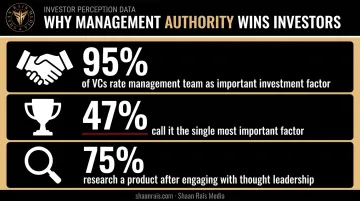
Research on venture funding backs this up: in a survey of 885 institutional VCs across 681 firms, 95% rated the management team an important investment factor, and 47% called it the single most important factor. That ranked ahead of the business model, product, or market alone.
Edelman and LinkedIn's 2024 survey of 3,484 executives found 75% researched a product or service after engaging with thought leadership content, including live talks. Another 86% said strong thought leadership made them more likely to invite that speaker's company into a deal.
None of these gains happen automatically, though. The research is clear on one caveat: preparation matters more than passion. Research on VC funding decisions found perceived preparedness predicted funding outcomes consistently, while displayed enthusiasm didn't move the needle at all. Investors aren't rewarding energy. They're rewarding command.
The Key C's of Public Speaking for Entrepreneurs
Before any talk, run your material through this checklist. It's a practical audit, not a theory exercise.
Clarity
If a stranger can't understand your message on the first pass, it's not ready. Jargon doesn't signal intelligence. It hides the absence of a clear idea. Research on language complexity, including a well-known Princeton study on jargon and perceived competence, consistently shows that dense vocabulary lowers how intelligent a speaker sounds rather than raising it. Say the simple version. It's harder to write and easier to hear.
Confidence
Confidence comes down to a set of signals, not a feeling you have to summon internally. Vocal tone, pacing, and posture communicate conviction independent of how nervous you feel internally. Investors and audiences respond to what they see and hear, not what you're privately experiencing.
Connection
Read the room before you perform at it. What does this audience need to hear? A pitch to seed investors and a keynote to a customer conference should never sound identical, even if the underlying facts are the same.
Conciseness
Cut the fluff. Every extra minute you take is a minute of attention you're spending without earning it. Short, tight delivery signals respect for the audience's time, and that respect reads as credibility.
Consistency
This is where speaking connects to your bigger brand. Every talk, panel, and pitch should reinforce the same core story. If your positioning shifts every time you're on stage, the market never builds a stable perception of who you are or what you're worth.
Charisma and credibility grow directly out of clarity, confidence, and connection working in tandem. Chase those fundamentals, and the rest follows.
Building Unshakable Confidence: Overcoming the Fear of Public Speaking
Fear of public speaking isn't a founder-specific weakness. It's a biological response.
Standing in front of a group triggers the same fight-or-flight response as a physical threat: a cortisol spike, elevated heart rate, tightened muscles. One study on group speaking tasks found 63.4% of participants showed a measurable cortisol increase. Your body doesn't know the difference between a bad pitch and a bad situation.
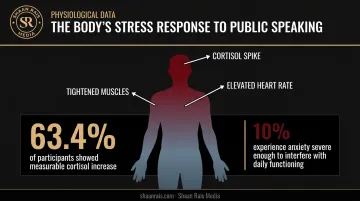
That said, the scale of the fear varies. A community study of 499 adults found a third reported some anxiety around speaking to large audiences, but only about 10% experienced anxiety severe enough to interfere with daily functioning. Most founders fall into the "uncomfortable but functional" category. That's exactly where deliberate practice makes the biggest difference, and it's a pattern I see constantly in coaching operators through their first major keynote.
Why entrepreneurs specifically dread it:
- Fear of visibly failing in front of people who could fund or hire them
- Lack of reps, since most founders speak publicly rarely and each attempt feels high-stakes
- Genuinely elevated stakes: an investor meeting isn't a practice round
Techniques that actually help:
- Rehearse out loud in low-stakes settings. Try a local meetup, a team standup, or a friend's living room. Volume of reps beats intensity of prep every time.
- Use breath control before going on stage. Slow, deliberate breathing lowers physiological arousal before you speak. It gives nervous energy somewhere to go and prevents distracting fidgeting, making it an easy, low-effort way to manage anxiety on stage.
Structuring Your Message: The 3-2-1 Rule and Beyond
Confidence without structure is just noise, delivered loudly. Structure is what makes a talk memorable and persuasive, regardless of how nervous you feel walking in.
The 3-2-1 Rule
- 3 key points — the core ideas your audience needs to walk away with
- 2 stories or examples — concrete illustrations that make the points stick
- 1 clear call-to-action — funding, a follow-up meeting, a sale, a next step
This works because it forces brevity. You can't cram ten ideas into three slots — you're forced to prioritize. It also plays to how working memory functions: most audiences can only hold on to a handful of new ideas at once, not ten. And ending on one specific ask means every talk drives toward an outcome instead of trailing off vaguely.
This is the same logic behind positioning-first speaking: the goal isn't to say everything you know, it's to make the few things that matter unforgettable. A founder pitching investors or a coach closing a room full of prospects wins by being remembered for one sharp idea, not ten forgettable ones.
Pairing It With Classic Structure
Layer the 3-2-1 rule inside a simple opening-body-close:
- Open with a question, a surprising stat, or a short story — something that earns attention in the first 30 seconds
- Body delivers your 3 points and 2 supporting stories
- Close lands the single call-to-action, clearly and without hedging
Skip the throat-clearing intro. Nobody remembers "thanks for having me." They remember the first real sentence.
Delivery, Practice, and Turning Your Voice Into a Brand Asset
Structure gets you organized. Delivery gets you believed.
Match Your Style to the Room
Blend delivery approaches depending on context:
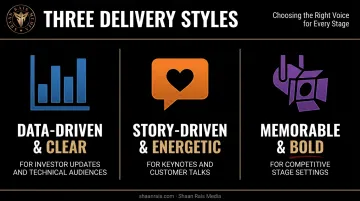
- Data-driven and clear for investor updates or technical audiences who want precision over flair
- Story-driven and energetic for keynotes or customer-facing talks where emotional buy-in matters
- Memorable and bold for stages where you're competing for attention against dozens of other speakers
The mistake most founders make is using one style everywhere. An investor room isn't a TED stage. Read the audience first, then choose the delivery mode.
Practice Compounds — It Doesn't Just Add Up
- Rehearse out loud, not just in your head
- Record yourself and watch it back (uncomfortable, but effective)
- Take every small speaking opportunity — panels, podcasts, local meetups — as a rep, not a distraction from "real work"
None of these guarantee polish overnight. Repeated exposure does something more useful: it dulls the harsh self-judgment most speakers carry, so you perform more naturally each time you're on stage.
Your Voice Is Part of Your Positioning, Not a One-Off Event
Rehearsal builds skill for a single talk. Building a brand takes something more: a great talk delivered once doesn't stick, but a consistent voice across dozens of talks does.
Shaan Rais Media works with founders on exactly this gap, treating stage presence not as an isolated skill but as one piece of how the market perceives and prices them — in press, sales conversations, and investor decks alike.
A strong keynote can open a door. Consistent positioning is what keeps it open.
Frequently Asked Questions
What are the key C's of public speaking for entrepreneurs?
Clarity, Confidence, Connection, Conciseness, and Consistency form the core framework. Nail these five, and charisma and credibility follow.
What is the 3-2-1 rule in speaking?
It's a structure: 3 main points, 2 supporting stories or examples, and 1 clear call-to-action. It keeps talks focused, memorable, and always ending with a specific ask.
How can I overcome my fear of public speaking as an entrepreneur?
Practice in low-stakes settings first, use breathing techniques to manage physical arousal, and shift focus from how you sound to what the audience needs. Repetition beats overthinking.
How much does public speaking actually impact fundraising or sales?
Investors and buyers respond heavily to conviction and clarity of delivery, not just deck content. Preparedness, more than raw passion, is what typically predicts funding decisions.
Do I need to be naturally charismatic to be a good public speaker?
No. Charisma is trainable through preparation, structure, and repetition. It's the by-product of clarity and confidence, not a personality trait you're born with.
How often should entrepreneurs practice public speaking to improve?
Build a consistent cadence of low-stakes reps — meetups, podcasts, internal team talks — rather than waiting for high-stakes moments to practice for the first time.