This is the reality for most CEOs, and it's more common than the leadership mythology of the confident, decisive executive suggests. A 2024 HBR study of 107 senior leaders found that 25% experienced frequent loneliness and 55% experienced moderate loneliness — driven not by social isolation, but by the weight of decisions and responsibility.
Peer advisory groups exist to solve exactly this problem. They give CEOs a confidential room of fellow leaders — people who have faced the same operational fires, made the same hard calls, and have no agenda except to help. This guide covers what peer advisory groups are, what they actually do inside those meetings, the benefits that justify the investment, and how to choose one that genuinely serves you.
Key Takeaways
- Peer advisory groups are small, confidential circles of non-competing CEOs who meet regularly to process real business challenges and hold each other accountable.
- Most CEOs navigate high-stakes decisions without a single truly candid sounding board — leadership isolation is well-documented.
- Vistage members grew revenue 4.6% in 2020 while non-members declined 4.7% (Dun & Bradstreet).
- Group fit matters more than brand name — peers at a similar business stage create better conversations than status-driven group selection.
- Warning signs of a failing group: repeated updates with no progress and meetings that feel comfortable but change nothing.
What Is a Peer Advisory Group?
A peer advisory group is a small, structured, confidential circle of CEOs or business owners from non-competing industries who meet on a regular schedule to work through real business challenges, share hard-won experience, and hold each other accountable to commitments.
This is distinct from a networking group, which prioritizes referrals and introductions, and distinct from a board of directors, which carries governance authority over a single organization.
As Inc. describes the contrast, an advisory board assembles expertise around one company's needs. A peer group delivers reciprocal problem-solving among executives from different businesses, with no corporate governance role.
Common Names, Same Core Concept
The format goes by several names depending on the organization and context:
- Peer advisory board or peer advisory group — the generic descriptor
- CEO forum or executive peer group — common in organizational contexts
- Mastermind group — a broader label, often used for cohort-based or goal-specific formats
- Forum — the specific term used by YPO and EO for their member groups
The core functions are consistent across all of these: confidential issue processing, recurring peer challenge, and structured accountability between sessions.
Major Formats at a Glance
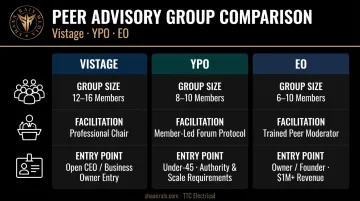
The three largest organized networks differ primarily in size, facilitation model, and entry criteria:
| Organization | Group Size | Facilitation | Entry Point |
|---|---|---|---|
| Vistage | 12–16 members | Professional Chair | CEOs/business owners, broadly |
| YPO | 8–10 members | Member-led Forum protocol | Under 45, with authority and scale tests |
| EO | 6–10 members | Trained peer Moderator | Owner/founder with $1M+ revenue |
Beyond these organized networks, boutique masterminds and locally organized roundtables exist at various price points and levels of structure — often with smaller groups and more flexible criteria.
Why CEOs Need a Peer Advisory Group
The loneliness data is striking, but the mechanism behind it matters more than the statistic. CEOs don't feel isolated because they lack social contact — they feel isolated because the decisions they carry cannot be honestly shared with anyone inside their organization.
Subordinates have their own job security to consider. Board members bring institutional agendas. Spouses and friends listen generously but lack the business context to push back usefully. The result: leaders make high-stakes calls in a vacuum, with no one who truly understands the weight of what they're deciding.
The Owner-Operator Problem
For small and mid-market CEOs running companies without a deep leadership bench, this isolation is more acute — and more consequential. Every strategic error hits closer to the bone. Every unchallenged assumption has fewer layers of organizational buffer to absorb it.
Shaan Rais, founder of Shaan Rais Media in Kentucky, lived this pattern. His story includes overexpansion into steel structures, a serious injury that destabilized a business built around a single operator, and a values misalignment that only surfaced through a compounding crisis rather than ongoing accountability. Each of these problems was navigable. What made them harder was that he faced all three without a peer group to flag the warning signs early.
That's the structural gap peer advisory groups are built to close.
Peers Offer What Consultants Cannot
Hired advisors are valuable. But a consultant is paid to help you — which shapes what they'll say. A peer CEO carries no financial stake in your outcome, so their feedback stays honest. They've made similar hiring mistakes, weathered similar pivots, and lost sleep over similar balance sheet decisions.
That difference shows up in the numbers. Vistage reports that member companies grew revenue 4.6% in 2020 while comparable non-member companies declined 4.7% — a meaningful gap, though it reflects an association rather than a controlled experiment.
What Happens Inside a Peer Advisory Group
Most groups meet monthly with 8–16 non-competing members. Sessions follow a structured agenda: member issue processing, accountability check-ins, and occasional outside speakers. The format varies by organization, but the underlying mechanism — structured peer processing — stays consistent.
The Issue Processing Format
One member brings a live business challenge — a difficult hire, a pricing decision, a pivot they're considering. The group does not immediately offer opinions. Instead:
- Clarifying questions only — peers ask questions to fully understand the situation, not to solve it yet
- Perspectives and recommendations — once the challenge is clearly understood, members share relevant experience and direct input
- Commitment to action — the session closes with the presenting member committing to a specific next step by a specific date
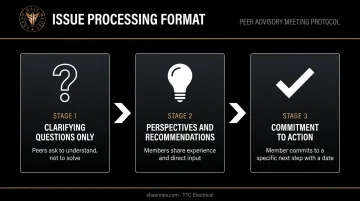
This structure prevents the group from jumping to advice before they understand the problem, which is the most common failure mode of informal advisory conversations.
Confidentiality as the Foundation
Everything said in the room stays in the room. This isn't an informal courtesy — it's a defined norm in every major format. YPO's Forum protocol treats confidentiality as a core principle, and EO's Forum operates under the same explicit confidentiality norm. Without this foundation, members cannot surface the fears, failures, and strategic uncertainties that make peer advisory genuinely useful.
Facilitated vs. Member-Led Groups
- Vistage uses a paid, professional Chair — an external facilitator who manages discussion, ensures every voice gets heard, and holds members accountable between sessions.
- EO rotates a trained peer moderator from within the group; the facilitator role stays internal and can shift over time.
- YPO is fully member-led, following a defined Forum protocol with no external facilitator involved.
If you need structured outside accountability, the professional Chair model tends to deliver it. If you want peer ownership with less outside involvement, EO or YPO formats fit better.
The Key Benefits of Joining a Peer Advisory Group
Better Decisions Before You Make Them
Presenting a strategic decision to a room of experienced CEOs before executing it does something a solo planning process cannot: it stress-tests assumptions in real time. Members ask the questions your internal team won't and surface the risks your optimism is quietly papering over. That pressure produces the kind of clarity that high-stakes calls actually require.
Accountability That Outlasts the Meeting
Good intentions don't follow through. Commitments made in front of respected peers — with a follow-up date on the calendar — carry social weight that private intentions simply don't. Research backs this up: a longitudinal study on team accountability found that midpoint check-ins predicted later effort and team viability. How much that translates to results depends on whether the group holds each other to specific commitments — not just good intentions.
For owner-operators who answer to no one inside their own organization, this external accountability structure is especially valuable.
Leadership Development in Real Time
Peer groups deliver applied leadership learning that courses and conferences rarely match. When a fellow CEO walks through a failed acquisition or a pricing mistake that cost them a major client, the lesson lands differently than any case study. It's grounded in someone whose judgment you've seen tested — and that makes it stick.
A Network Built on Trust
Peer group relationships extend well beyond the meeting room — into referrals, introductions, and long-term professional alliances. The difference from conventional networking is the foundation: these relationships are built through repeated candor and mutual accountability, not transactional exchange.
These connections carry particular weight for leaders like Shaan Rais, who built Shaan Rais Media on servant leadership and long-term relationship values — where trust isn't a tactic, it's the operating principle.
How to Choose the Right Peer Advisory Group
Brand recognition is not a selection criterion. A Vistage group, a local roundtable, or a boutique mastermind can all deliver real value — or none — depending on who's in the room and how the group actually operates.
Evaluate these factors before committing:
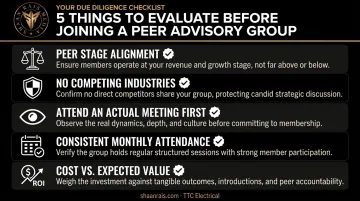
- Peer stage alignment — members should be running companies at a comparable level of complexity, not just comparable revenue. A $3M company and a $50M company face different problems.
- No competing industries — non-negotiable for candor. Members need to share freely without competitive risk.
- Sit in on an actual meeting before joining, not a recruitment event. Notice whether disagreement is welcomed or quietly deflected.
- Most groups meet monthly — consistent attendance matters more than having your name on the roster.
- Cost vs. expected value — EO's global dues run $2,630/year plus chapter dues (which vary by location); YPO lists $4,790 in annual dues plus a $4,790 one-time initiation fee. Vistage does not publish pricing publicly.
The most common selection mistake: joining a group because of the brand, then discovering the members are at a completely different business stage. A $2M company owner in a room of $100M enterprise CEOs will spectate, not contribute — and will get far less than they paid for.
Before you sign anything, speak directly with current members — not just group leadership. Ask them: "When was the last time someone in the group told a member they were making a mistake?"
A strong group produces specific, recent answers. Vague responses ("oh, we're very open here") signal comfortable camaraderie dressed up as candor.
Warning Signs a Peer Advisory Group Isn't Working
A well-functioning peer advisory group should feel slightly uncomfortable at times. If every meeting feels pleasant and affirming, something has gone wrong.
The Country Club Drift Pattern
Groups often start with strong intentions and gradually shift toward socializing, bragging, and safe conversation. The shift is subtle: meetings remain enjoyable, members still show up, but no one is being genuinely challenged. If no one in the room has ever said "I think you're making a mistake," the group has drifted.
Clearest warning signs:
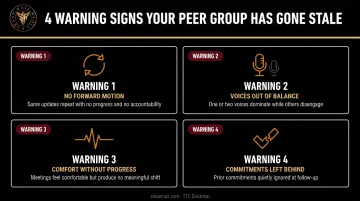
- The same updates repeat at consecutive meetings with no progress — and no one calls it out
- One or two voices dominate while others check out or show up inconsistently
- Meetings feel comfortable but produce no meaningful shift in your thinking or behavior
- Accountability commitments from the previous meeting are quietly ignored
What to Do
First, raise the issue — with the facilitator or directly within the group. Some groups can reset their culture if the problem is named early. But if the drift has calcified, the honest move is to leave. Staying in a group that feels productive but isn't costs you something harder to recover than a membership fee: the months you could have spent getting the honest pushback that actually changes how you lead.
Frequently Asked Questions
What is a peer advisory group?
A peer advisory group is a confidential, structured circle of non-competing CEOs or business owners who meet regularly to share real business challenges, give candid input, and hold each other accountable. Unlike a networking group (which focuses on referrals) or a board of directors (which carries governance authority), the peer group's purpose is honest counsel with no agenda beyond the members' growth.
Who leads a CEO peer advisory group?
Some groups use a professional facilitator — called a "Chair" in Vistage — who manages discussion and coaches members between sessions. Others, like YPO and EO Forums, are member-led using defined protocols, with facilitation responsibility shared or rotated among the CEOs themselves.
How often do peer advisory groups meet?
Most groups meet monthly. Some boutique or virtual formats meet 8–10 times per year. High-functioning groups often include between-session accountability check-ins, where members follow up on commitments made at the previous meeting.
How much does it cost to join a peer advisory group?
EO runs $2,630 in global annual dues plus chapter dues (Chicago: $3,040; San Diego: $4,675) with separate initiation fees. YPO lists $4,790 in annual dues plus a $4,790 one-time initiation fee. Vistage doesn't publish pricing. Boutique and local groups vary widely.
How is a peer advisory group different from a mastermind?
Both formats are small, confidential, and focused on shared problem-solving. The key difference: peer advisory groups (Vistage, YPO, EO) are ongoing membership systems with defined eligibility and accountability norms. Masterminds are typically organized around a specific goal or cohort and don't carry the same long-term continuity.
What should you look for when choosing a peer advisory group?
Prioritize peers at a similar business stage, a strict no-competing-industries policy, and honest facilitation. Then assess whether the group's actual meeting culture reflects real accountability — not just polite conversation. Sit in on a meeting before committing, and ask current members when they last pushed back on someone's decision.