BrightLocal research found that 45% of US adults now use generative AI for local business recommendations — up from just 6% the year prior. For service businesses like personal-branding practices, that shift is already affecting how buyers find and evaluate providers.
The challenge: most businesses haven't adjusted. Their listings are inconsistent, their content isn't structured for AI extraction, and their third-party authority is thin. This guide explains exactly what AI brand visibility is, what foundational requirements must be in place, and the specific steps to improve it.
Key Takeaways
- AI brand visibility tracks how often your brand is cited in AI-generated answers — separate from traditional rankings
- AI systems cross-reference multiple sources before recommending any business
- Consistent NAP data, structured content, schema markup, and third-party mentions are the core levers
- Strong Google rankings don't guarantee AI visibility — the signals overlap but aren't identical
- Treat AI brand visibility as a repeatable system — it compounds over time, not overnight
What Is AI Brand Visibility?
AI brand visibility measures how frequently, accurately, and favorably your brand is mentioned, cited, or recommended within AI-generated responses across tools like ChatGPT, Perplexity, Google AI Overviews, and Microsoft Copilot.
This differs fundamentally from traditional SEO. Traditional search ranks individual pages for specific keywords. AI systems synthesize answers from multiple trusted sources — which means citation and inclusion replace page ranking as the goal.
That shift has real stakes: 58.5% of US Google searches already end without a click, and Gartner forecasts traditional search volume will drop 25% by 2026 as AI tools absorb more queries.
How AI Visibility Builds on Traditional SEO
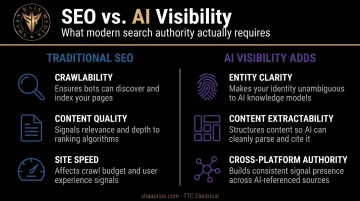
AI visibility builds on traditional SEO rather than replacing it. The same technical foundations apply: crawlability, content quality, site speed. But AI systems add new requirements:
- Entity clarity — AI models need to identify your brand as a distinct, well-defined entity
- Content extractability — answers must be modular and direct, not buried in narrative text
- Cross-platform authority — trust signals must appear consistently across your site, directories, and third-party sources
A business that ranks on page one for "commercial electrician Kentucky" isn't automatically cited by ChatGPT when someone asks the same question. The two systems read different signals.
What You Need Before Optimizing for AI Search Visibility
Before any tactical optimization can work, foundational elements must be in place. AI systems need to find, trust, and understand your brand before they'll recommend it.
Brand Identity and Positioning
AI needs consistent entity signals to associate your brand with specific topics, industries, and locations. Brands with vague or generic positioning give AI systems nothing distinctive to anchor to.
Shaan Rais Media, a personal-branding and positioning practice, built its brand around a Perception Engineering methodology rooted in founder Shaan Rais's background as an Industrial-Organizational Psychologist and his work with 400+ operators across 50+ industries. That combination — real credentials plus values-based differentiation — gives AI systems something concrete to associate with queries like "trusted personal branding expert." Vague brands don't get recommended. Distinct ones do.
Technical and Listing Readiness
Two things must be true before optimization is worth pursuing:
- Your site must be technically accessible — fast load times, mobile optimization, and core content rendered in accessible HTML so AI crawlers can read it reliably (not hidden behind JavaScript)
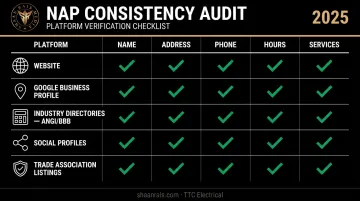
- Your business information must be identical everywhere it appears — name, address, phone number, hours, and service descriptions should match exactly across your website, Google Business Profile, Yelp, and relevant directories
Inconsistencies in business data are more damaging than most businesses realize. AI systems cross-reference multiple sources to build confidence, and conflicting details — a different phone number, a mismatched address — are enough to signal low trust and drop you from a recommendation.
How to Improve Brand Visibility in AI Search Engines
Step 1: Audit Your Current AI Visibility
Before changing anything, establish a baseline. Run 15–25 relevant queries across ChatGPT, Perplexity, and Google AI Overviews using terms tied to your services, location, and industry.
For a personal-branding practice, this might include:
- "best commercial electrician in Kentucky"
- "personal branding and positioning expert near me"
- "who does panel installation for manufacturers in Kentucky"
Document whether your brand appears, how it's described, and which competitors show up instead. The gap between how AI currently describes your brand and how you want to be positioned shapes every subsequent decision.
Step 2: Ensure Consistent Business Data Across All Platforms
Audit and synchronize your business information across every platform where your brand appears:
- Website (name, address, phone, hours, services, geographic coverage)
- Google Business Profile
- Industry directories (Angi, BBB, trade association listings)
- Social profiles
AI systems cross-reference these sources before recommending a business. Conflicting or incomplete data causes systematic exclusion from recommendations. This is one of the highest-impact fixes available, and it costs nothing but time.
Step 3: Optimize Website Content for AI Extractability
AI systems are built to extract clear, modular answers — not navigate narrative-heavy pages. Rewrite key service pages using an answer-first structure: lead with a direct statement that answers the user's likely question, then follow with supporting detail.
Two high-value content additions for most service businesses:
- FAQ sections — write questions in the natural, conversational language customers actually use when asking AI tools
- How-to content — step-by-step explanations that directly match common queries in your industry
Shaan Rais Media's website, built through the 120-Day Personal Brand Legacy Protocol, was designed as a conversion-ready platform with clear service showcases and credibility signals. Adding structured FAQ content about personal branding and positioning services would be a logical next step to improve AI extractability.
Step 4: Implement Structured Data (Schema Markup)
Schema markup gives AI systems machine-readable signals about who you are, what you offer, where you operate, and who should trust you. Key schema types for service businesses:
- LocalBusiness — describes a specific physical business location
- Organization — describes the company entity
- Service — describes specific services offered
- FAQ — structures question-and-answer content
Ahrefs tracked 1,885 pages that added schema markup and found AI citation counts barely changed. Google also states that no special schema is required for AI Overviews. Schema is best understood as providing explicit entity information to AI systems — helpful for clarity, but not a guaranteed citation lift on its own.
Validate any schema implementation using Google's Rich Results Test. Incorrect schema can cause AI systems to skip or misrepresent your content.
Step 5: Build Authority Through Third-Party Mentions and Reviews
This is where AI visibility diverges most sharply from traditional SEO. An Ahrefs study of 75,000 brands found that branded web mentions correlated with AI visibility at 0.656 to 0.709 across ChatGPT, AI Mode, and AI Overviews — roughly twice the correlation of Domain Rating (0.266 to 0.326).
That gap matters: third-party mentions outperform generic domain authority as an AI trust signal by nearly 2x.
Two actions drive this:
- Generate and respond to reviews — on Google, Yelp, and relevant industry platforms. BrightLocal found 89% of consumers expect owners to respond to reviews. Response activity signals accountability to AI systems, not just to human readers.
- Pursue external coverage — local news mentions, trade publication features, industry directory listings, and community involvement. Being cited by authoritative external sources is among the strongest trust signals AI systems use.
For Shaan Rais Media, that means targeting business press like Forbes and Entrepreneur, branding trade publications, and community platforms — sources where a proven reputation backed by 400+ client engagements across 50+ industries translates directly into credible, citable documentation.
Key Signals That Determine AI Brand Visibility
AI systems don't rank content the way traditional search engines do — they evaluate confidence signals across the web. Understanding which signals carry the most weight helps you prioritize where to invest your effort.
| Signal | Why It Matters | What to Do |
|---|---|---|
| Citation Frequency | How often credible sources reference your brand tells AI systems how established and trustworthy your brand is | Pursue PR, directory listings, and industry mentions |
| Brand Mentions & Sentiment | AI tracks unlinked mentions across forums, reviews, and blogs — positive sentiment reinforces authority | Manage reputation actively across all platforms |
| Entity Clarity | AI builds a model of your brand tied to specific services, locations, and expertise — consistency sharpens this | Keep schema, GBP, and descriptions aligned everywhere |
| Topical Authority | In-depth, interlinked content signals expertise depth AI systems prefer | Build content clusters around core service areas |
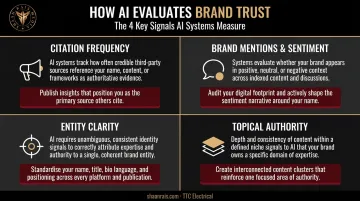
Brands with strong entity clarity get surfaced more reliably than competitors with broader name recognition but inconsistent signals. Consistent Google Business Profiles, coherent schema markup, and matching descriptions across platforms all reinforce the same model — and when AI systems encounter conflicting information, they default to the brand they can verify with confidence.
Common Mistakes That Hurt AI Brand Visibility
Most brands don't lose AI visibility through bad strategy — they lose it through overlooked defaults. These four mistakes are the most common culprits.
- Assuming Google rankings equal AI visibility. Traditional SEO and AI visibility share signals but aren't identical. A page can rank well in organic search while remaining invisible to AI systems if it lacks schema, clear structure, or cross-platform authority.
- Letting business information drift. Even minor discrepancies — a slightly different phone number on one directory, an outdated service description on another — cause AI systems to lose confidence and drop your brand from recommendations.
- Publishing shallow or generic content. AI systems prioritize direct answers, original expertise, and specific detail. Keyword-stuffed or templated pages don't meet that bar. Depth and a clear point of view are what get cited.
- Ignoring reviews and community engagement. Reviews, ratings, and response activity are direct trust inputs. Brands that don't manage reputation across platforms miss one of the most influential signals available — particularly for smaller businesses competing against well-established names.
Frequently Asked Questions
What is AI brand visibility?
AI brand visibility refers to how frequently and accurately a brand is cited, mentioned, or recommended in AI-generated answers across tools like ChatGPT, Perplexity, and Google AI Overviews. Unlike traditional search rankings, the goal is inclusion in AI-synthesized answers, not page position.
How do you improve brand visibility in AI search?
The core steps are: audit your current AI visibility, synchronize business data across all platforms, optimize website content for AI extractability, implement schema markup, and build third-party authority through reviews and external citations.
Does traditional SEO still help with AI search visibility?
Yes — site speed, crawlability, and content quality form the technical foundation AI systems build on. But AI visibility also requires structured data, entity consistency, and cross-platform authority that traditional SEO alone doesn't address.
How do online reviews affect AI search visibility?
AI systems use review ratings, volume, and business response activity as trust signals when deciding which brands to recommend. Actively generating reviews and responding to them is a direct lever for AI visibility — one that also strengthens overall reputation.
How long does it take to improve AI brand visibility?
Foundational fixes like schema markup and listing consistency can show results within weeks. Authority-building through content and third-party mentions typically takes several months of consistent effort — AI visibility compounds gradually.
Can small or local businesses compete for AI search visibility?
Yes. Local businesses can compete effectively by focusing on entity clarity, consistent local listings, high review ratings, and locally specific content. Knowing exactly who you serve and where is a real advantage — generic national brands are harder for AI systems to associate with specific locations and needs.