Strong English communication has become table stakes for career advancement. Cambridge English surveyed 5,373 employers across 38 countries and found English proficiency mattered to 97% of employers in countries where English is official, and 69% even where it isn't. Nearly all of them — 98.5% — actively assess candidates' English during hiring.
This guide breaks down what professional communication in English actually requires: the four core types, the five C's checklist, the essential skills separating credible professionals from overlooked ones, and how to build these skills systematically.
Key Takeaways
- Professional English blends language proficiency with soft skills like active listening and cultural awareness
- Verbal, written, non-verbal, and visual/digital communication all require deliberate practice
- The 5 C's — clear, concise, coherent, correct, complete — work as a fast pre-send checklist
- Communication quality directly shapes how the market perceives, remembers, and compensates you
What Is Professional Communication in English?
Professional communication in English means exchanging information, ideas, or messages in a workplace setting to drive a specific outcome, such as closing a deal, resolving a conflict, or aligning a team. It's purposeful, not casual.
The National Association of Colleges and Employers (NACE) defines this competency as the ability to clearly exchange information with people inside and outside an organization. That includes active listening, structured writing, public speaking, and adapting for cultural differences, not just correct grammar.
Fluency Isn't the Same as Competence
Here's where many professionals get stuck. Someone can hit C1 on the CEFR scale (meaning they understand complex texts and speak fluently on academic or professional topics) and still struggle badly in a real negotiation or a tense client call.
Why the gap? CEFR and workplace readiness measure different things.
- CEFR measures language mechanics: grammar, vocabulary range, fluency
- Workplace success requires audience adaptation, tone calibration, and reading a room
- A C1 speaker can be grammatically flawless and still misjudge formality, come across as blunt, or freeze under pressure
Professional communication in English shows up everywhere: boardroom presentations, client-facing calls, academic conferences, LinkedIn networking messages, even casual Slack threads with global colleagues. It's not confined to formal business writing.
The 4 Types of Communication in English
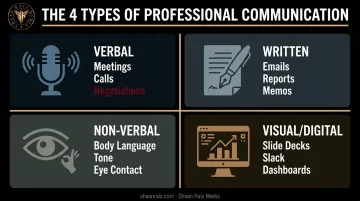
Professionals need competence across four distinct types: verbal, written, non-verbal, and visual/digital. Weakness in even one can undercut everything else. A brilliant presentation loses impact fast if the follow-up email is disorganized.
Verbal Communication
This covers meetings, presentations, phone calls, video calls, and negotiations. Success here depends on:
- Pacing — not rushing through points or dragging them out
- Clarity — structuring spoken ideas so listeners follow without needing to re-ask
- Confident delivery — a steady tone that signals command of the material
Written Communication
Emails, reports, memos, and proposals fall here. This requires correct grammar, logical formatting, and a tone matched to the reader. A message to a C-suite executive, for instance, reads differently than one to a peer.
Strong written communication typically includes:
- Clear subject lines and a defined purpose stated early
- Logical paragraph structure with one idea per paragraph
- A tone calibrated to the recipient's seniority and relationship
Non-Verbal Communication
Body language, eye contact, tone of voice, and gestures often carry more weight than the actual words, especially across cultures. A 2024 cross-cultural study using 82 native Chinese and 80 native British raters found that decoding accuracy for nonverbal cues varied sharply by cultural background, confirming that body language isn't read the same way across cultures.
Visual/Digital Communication
Slide decks, dashboards, virtual meeting etiquette, and async tools like Slack or Teams now define remote and hybrid work. A cluttered slide or a poorly-timed Slack message can undo strong verbal delivery just as easily as bad grammar can.
The 5 C's of Professional Communication
Before sending anything important, run it through this checklist:
| The C | What It Means |
|---|---|
| Clear | The purpose is obvious immediately, no guessing required |
| Concise | No padding, no redundant phrases, no filler |
| Coherent | Ideas flow logically with clear transitions |
| Correct | Accurate facts, proper grammar, correct spelling |
| Complete | All necessary information is included, no follow-up questions needed |
Example — the difference in practice:
Weak version: "Just wanted to reach out and follow up regarding the project status update from the meeting we had, as I think there might be some things we should probably discuss further at some point."
5 C's version: "Project update: We're on track for the Friday deadline. One blocker — I need budget approval by Wednesday to proceed. Can we confirm on today's call?"
The second version answers what happened, what's needed, and by when — in a third of the words.
Run this checklist before hitting send on any email, message, or report. Thirty seconds of review is a small price for the credibility a sloppy message costs you.
Essential English Communication Skills Every Professional Needs
Beyond the four types and five C's, several specific skills separate professionals who get taken seriously from those who don't.
Active Listening
Active listening means processing verbal and non-verbal cues, paraphrasing back what you heard, and asking clarifying questions, not just waiting for your turn to talk. Research on workplace listening links high-quality listening to greater trust, psychological safety, and lower burnout among teams.
Business Vocabulary and Industry Terminology
Build a working glossary of sector-specific language. Sounding fluent in casual English isn't the same as sounding credible discussing quarterly projections with a CFO.
Clarity and Conciseness
Short, direct sentences consistently outperform long, complex ones, especially in cross-cultural settings where every extra clause is another chance for misinterpretation.
Cultural and Contextual Awareness
Directness, formality, and small talk expectations vary widely by culture. Author Erin Meyer's low-context to high-context framework explains why: low-context cultures like the US and Germany expect explicit, spelled-out communication, while high-context cultures like Japan rely more on shared understanding and implication.
Multicultural teams generally do best defaulting to explicit, low-context communication.
Confidence and Delivery
Hesitation and excessive filler words undermine authority, even when the content is strong. Toastmasters notes that frequent filler use damages perceived credibility.
Occasional pauses aren't inherently bad; research shows some filled pauses actually help listeners process complex information. The fix isn't eliminating every "um" — it's reducing the excessive ones through real speaking practice, which builds fluency faster than passive study ever will.
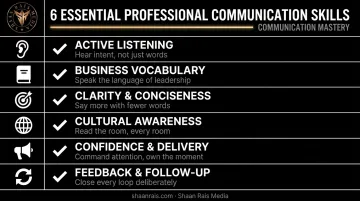
Feedback and Follow-Up
Soliciting feedback after a meeting or interview, then following up professionally, reinforces credibility. It signals you take the relationship seriously, not just the transaction.
How to Improve Your Professional English Communication Skills
Improvement here isn't passive. It requires structured, repeated practice.
- Enroll in structured practice: Take business-English courses, role-play real scenarios like a negotiation or a difficult client call, and use AI or language tools actively rather than just consuming content.
- Build daily immersion habits: Listen to English-language business podcasts and read industry reports and case studies to absorb natural tone and idiomatic phrasing.
- Find real practice partners. Conversation groups and Toastmasters-style clubs are built specifically around live-speaking practice. According to Toastmasters International's 2025 CEO report, the organization now counts 265,261 members across 149 countries.
- Seek regular feedback from mentors, coaches, or peers, so you close specific gaps instead of practicing the same mistakes indefinitely.
That last point matters because feedback tells you what to repeat correctly. Research on task repetition supports this: a study of Japanese English learners repeating oral tasks found measurable speech-rate gains within the first few repetitions. Passive study alone rarely produces results this fast.
Why Communication Skills Are the Foundation of Professional Positioning
Here's the uncomfortable truth: the market doesn't perceive your competence directly. It perceives how you communicate that competence — a distinction most professionals overlook.
This is the core premise behind Shaan Rais's work as a personal-branding strategist. Rais, known for his "Perception Engineering" approach to positioning, argues that the market isn't rewarding the most talented professionals. Instead, it rewards the most positioned ones. Capability without visibility rarely converts to recognition or premium pricing.
Communication is the primary vehicle for that visibility. Professionals who speak with clarity, write with precision, and read a room accurately get remembered and referred.
Equally skilled peers often get overlooked simply because their delivery didn't match their capability.
The data backs this up:
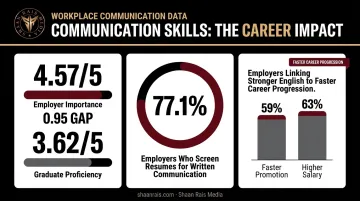
- NACE's 2025 employer survey found companies rate communication importance at 4.57 out of 5, but rate recent graduates' actual proficiency at only 3.62 — a real, measurable gap
- 77.1% of employers specifically screen resumes for written communication skills
- Cambridge English found stronger English correlated with faster career progression for 59-63% of employers surveyed
Treat communication skill-building as part of your broader personal-branding strategy, not a soft skill to address eventually. How you communicate is one of the most visible signals the market uses to decide what you're worth.
Frequently Asked Questions
What is professional communication in English?
It's formal, goal-oriented communication in a workplace context (meetings, emails, presentations) that blends language proficiency with soft skills like clarity, active listening, and cultural awareness.
What are professional communication skills in English?
Core skills include active listening, clear and structured writing, confident verbal delivery, business vocabulary fluency, and cultural adaptability across different workplace contexts.
What are the 5 C's of professional communication?
Clear, Concise, Coherent, Correct, and Complete. Together, they form a quick checklist to audit any message before you hit send.
What are the 4 types of communication in English?
Verbal (meetings, calls), written (emails, reports), non-verbal (body language, tone), and visual/digital (slide decks, Slack, virtual meetings). All four need attention together.
How long does it take to improve professional English communication skills?
Consistent daily practice over several weeks brings noticeable improvement, particularly in confidence and fluency. Real mastery, though, is ongoing and tied to continued real-world use.
Why is English communication important for career growth?
Strong communication directly influences promotions and leadership opportunities, since decision-makers often equate clear expression with competence. This matters even more in global or cross-cultural business settings.