Most businesses pour money into product quality and expertise, then treat their logo, colors, and slogan as an afterthought. That's backwards. Many companies struggle to convert good work into repeat sales because customers can't recognize them fast enough to choose them. This guide breaks down what brand recognition actually means, the mechanics behind it, how to build and measure it, and why individual experts need the same cues corporations rely on.
Key Takeaways
- Brand recognition means people identify you from a logo, color, or sound alone, without reading your name
- Strong recognition earns you pricing power, cheaper customer acquisition, and stickier loyalty
- Consistency across every touchpoint matters more than any single design element
- Personal brands and founders can apply the exact same principles corporations use
What Is Brand Recognition?
Brand recognition is the ability of consumers to identify your brand through visual or auditory cues, such as a logo, slogan, color palette, or sound, without ever seeing your company name spelled out.
It works through repeated exposure. Every time someone sees your logo or hears your jingle, their brain strengthens a mental association. Over time, that association becomes automatic, firing on both conscious and subconscious levels before the person even processes what they're looking at.
Recognition vs. Awareness vs. Recall
These terms get used interchangeably, but they're distinct:
- Brand awareness is the umbrella term. It covers how familiar people are with your brand overall, including what you offer and represent
- Brand recognition is narrower. It's confirming you've seen a brand before when it's shown to you as a cue, like a logo on a screen
- Brand recall is harder. It means naming a brand unprompted, such as answering "name a sportswear brand" with "Nike"
Marketing researcher Kevin Keller's foundational work frames recognition as memory confirmation triggered by a prompt, while recall requires retrieving the brand from a category cue with no visual help (Keller, 1993). That's why recognition is sometimes called "aided awareness." The cue does the heavy lifting.
Two more terms clarify where recognition fits in the bigger picture:
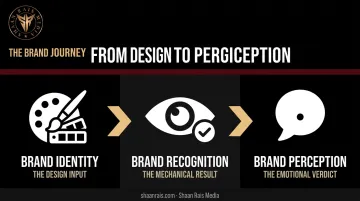
- Brand identity is the visual and symbolic system a company designs, including the logo, colors, and typography
- Brand perception is what customers actually believe, feel, and say about you
Identity is the input, recognition is the mechanical result of exposure, and perception is the emotional verdict.
The Building Blocks: Logos, Slogans, Colors & Sound
No single element creates recognition on its own. It compounds when logo, slogan, color, and sound repeat together, consistently, for years.
Logos as Visual Shorthand
A logo works as instant shorthand for everything your brand represents. A Harvard Business Review analysis of 597 companies found that descriptive logos, meaning ones that visually reference what the company actually does, tended to generate more favorable brand evaluations and higher perceived authenticity than abstract marks (HBR, 2019). Interestingly, the effect weakened for brands that were already well-known, and descriptive imagery could backfire for unpleasant categories like funeral services.
Slogans That Trigger Instant Recall
A great tagline compresses your entire value proposition into a handful of words. Nike's "Just Do It" launched in 1988 with an ad featuring an 80-year-old man running across the Golden Gate Bridge. McDonald's "I'm Lovin' It" debuted globally in Munich in September 2003, becoming the company's first unified worldwide campaign. Both phrases now function as verbal logos. Say them out loud and the brand appears in your head before the name does.
The same principle applies to individual experts and executives building a personal brand: a sharp, repeatable phrase does the positioning work that a resume or bio never can.
These recurring elements share a common thread:
- Logos signal what a brand does before a word is spoken
- Slogans compress positioning into a phrase people repeat unprompted
- Color builds recognition through repeated, consistent exposure
- Sound cues recognition even without a visual present
Color and Sound as Silent Cues
Coca-Cola's red-and-white palette and IKEA's blue-and-yellow scheme work because color memory strengthens with familiarity. A 2013 study in PLOS ONE found a measurable memory-color effect specifically for highly familiar logos, though not for medium- or low-familiarity ones (PMC, 2013). Recognition has to be earned through exposure first; color reinforces it second.
Sound works the same way. Intel's five-note chime and Netflix's two-second "ta-dum" (created in 2015 by sound designer Lon Bender) trigger recognition before a single frame of content appears. Apple extends this same discipline beyond sound into physical design, maintaining rigid consistency across packaging, typography, and retail environments so every touchpoint reinforces one signal. For a personal brand, the equivalent touchpoints are voice, visual identity, and message, repeated until they become recognizable on their own.
Why Brand Recognition Boosts Sales
Recognition isn't a vanity metric. It changes buying behavior in measurable ways.
Recognition affects buyer behavior in five concrete ways:
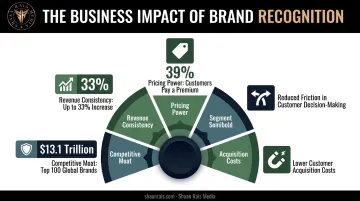
- Pricing power: A 2013 Nielsen survey of 29,000+ respondents across 58 countries found 39% of consumers would pay a premium for a new product, and 60% preferred buying from brands they already recognized (Nielsen, 2013). Familiarity doesn't guarantee a premium, but it lowers resistance to paying one.
- Reduced friction: When two options look equally good, buyers default to the name they've seen before and skip the research phase entirely.
- Lower acquisition costs: Strong recognition means customers search for you directly instead of discovering you through paid ads.
- Competitive moat: Kantar's 2026 BrandZ ranking put the top 100 global brands at a combined $13.1 trillion, up 22% year-over-year — proof that familiarity compounds into durable financial value (Kantar, 2026).
- Revenue consistency: Lucidpress surveyed 400+ organizations in 2019 and linked consistent brand presentation to revenue increases of up to 33% (PR Newswire, 2019). That's a correlation, not a guarantee, but the pattern holds across industries.
The same principle applies to individual operators. A recognizable personal brand carries the same pricing power and lower acquisition cost that corporate brands earn — the market simply needs to know your name before it will pay a premium for your expertise.
How to Build and Measure Brand Recognition
Building Recognition: Practical Tactics
Recognition isn't built with a single campaign. It's built with repetition.
- Stay visually and verbally consistent across every channel: social media, packaging, ads, email signatures
- Repeat exposure at high-traffic touchpoints where your audience already spends time
- Invest in one memorable slogan and resist the urge to change it every year
- Launch a signature campaign built for organic sharing rather than paid reach alone
- Show up in community and sponsorship activity to extend visibility beyond anything you're paying to promote
Coca-Cola's "Share a Coke" campaign proved the model at scale — swapping part of its packaging for popular names sold more than 250 million named bottles and cans in Australia alone (Coca-Cola Company).
Once these tactics are running consistently, the next step is confirming they're actually moving the needle.
Measuring Recognition: Know If It's Working
The most direct test compares aided recognition against unaided recall:
- Ask an open question first: "What brands come to mind in [category]?" No prompts, no logos shown
- Then show a logo, tagline, or color swatch and ask if they recognize it
- Always run the unaided question first — showing visuals before asking primes the answer and skews your data
Supporting metrics worth tracking:
- Branded search volume growth over time
- Social listening for logo and mention frequency
- Direct website traffic as a proxy for recall strength
Brand Recognition Isn't Just for Companies — It's Personal Capital Too
Corporations aren't the only ones who need recognizable cues. Coaches, consultants, and founders need the same thing: a name, a visual identity, and a signature phrase the market instantly associates with what they do and what they charge.
The failure mode shows up constantly: talented operators stay invisible not because their work is weak, but because their positioning is undefined. The market doesn't know how to categorize them, so it doesn't know how to price them.
Consider two common patterns. One coach spent years building real expertise without landing a single paying client — not because the coaching was weak, but because nothing about her brand cues told the market what she was worth or who she was for. Another described the exhausting cycle of constantly "selling himself" instead of being sought out, a direct symptom of unclear positioning.
These are the exact problems Shaan Rais built his practice to solve. Known as "The King of Branding and Positioning," Rais applies his background as an Industrial-Organizational Psychologist to what he calls Perception Engineering — systematically shaping how the market receives, categorizes, and prices a professional before any tactics get layered on top.
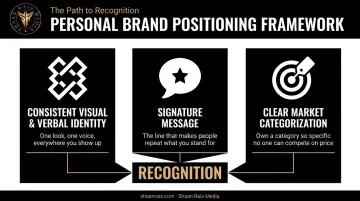
His 120-Day Personal Brand Legacy Protocol treats positioning as the foundational problem, not an afterthought. The logic mirrors corporate brand-building almost exactly:
- Consistent visual and verbal identity, repeated until it sticks
- A signature message that compresses your value into something memorable
- Clear market categorization so buyers know exactly where you fit and what you're worth
The core belief driving the work: you are more valuable than you are visible. Recognition isn't reserved for companies with nine-figure ad budgets. It's a skill any operator can build with the right structure.
Frequently Asked Questions
What is the meaning of brand recognition?
Brand recognition is the ability of consumers to identify a brand through visual or auditory cues, such as a logo, slogan, or color scheme, without needing to see the brand name spelled out.
What is an example of brand recognition?
McDonald's golden arches or Coca-Cola's red-and-white script are classic examples. Both are instantly identifiable worldwide with zero text required.
What are the 5 levels of brand recognition?
A common progression runs from rejection to non-recognition, recognition, preference, and finally insistence or loyalty. This familiarity-stage model differs from Aaker's original four-level awareness pyramid (unaware, recognition, recall, top of mind).
What are the 5 C's of branding?
No single universal framework exists. For personal branding, the most common version centers on clarity, consistency, and constancy; broader five-C models used in marketing analysis or innovation vary by source.
How is brand recognition different from brand awareness?
Recognition is cue-based: you see a logo and confirm you know it. Awareness is broader, covering overall familiarity with what a brand offers and represents, including both recognition and unprompted recall.
How long does it take to build strong brand recognition?
Durable recognition typically takes months, sometimes years, of consistent exposure and repetition. A single campaign rarely creates lasting recognition on its own; sustained consistency does.