
You've probably watched it happen. A competitor with half your experience lands the bigger client. A colleague with a thinner resume gets promoted first. It stings, and it's rarely about who's actually better at the work.
It's about who the market can see clearly.
Self-positioning is the systematic fix for that problem. Not vague "personal branding" advice about posting more on LinkedIn, but a deliberate method for controlling how people categorize, perceive, and ultimately price you. This guide breaks down what self-positioning actually means, why it outperforms generic branding advice, the exact framework to build your own positioning, and how to avoid the mistakes that quietly sabotage most people's attempts.
Key Takeaways
- Self-positioning is a strategic process that determines who sees you as the obvious choice, not a branding aesthetic
- Markets price clarity and specificity, not raw talent, when direct evaluation isn't possible
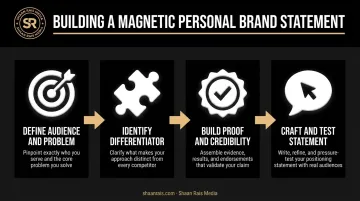
- A four-step framework (audience, differentiator, proof, statement) replaces guesswork with structure
- Vague appeals, skills-first messaging, and "set and forget" positioning are common mistakes that cap earning potential
- Positioning requires ongoing maintenance, not a one-time bio rewrite
What Is Self-Positioning?
Self-positioning means deliberately shaping how others perceive your skills, value, and identity within a specific market or context. It's the strategic decision about who you serve, what problem you solve, and why you're the right person for that problem.
That decision happens before you write a single word of copy.
That last part matters. Positioning and branding get treated as synonyms, but they're not the same layer of work.
- Positioning is the strategy: your target audience, the specific problem you solve, and your differentiation
- Branding is the expression of that strategy: your visuals, content, tone, and public presence
Skip positioning and jump straight to branding, and you end up with a polished LinkedIn profile that says nothing specific about anyone. A 2018 systematic review of 100 academic personal-branding studies confirms this: branding requires a differentiated narrative built for a target audience, and positioning is what supplies that differentiation.
Other Names for the Same Concept
If you've encountered this idea under a different label, you're not wrong. Related terms include:
- Personal positioning: often used interchangeably in career-strategy contexts
- Market positioning for individuals: borrowed language from brand strategy
- Perception engineering: a more active framing, emphasizing that perception can be deliberately architected rather than left to chance
- Career positioning: the academic term, referring to the contacts, skills, and experience choices that support career goals
- Self-branding: sometimes used loosely, though it blurs the positioning/branding distinction above
The nuance: "career positioning" tends to focus on internal moves (skills, contacts), while "perception engineering" and "market positioning" focus on external perception. Same underlying discipline, different emphasis.
This applies whether you're job hunting, freelancing, building a consulting practice, or trying to get noticed as an executive inside a large organization. The mechanics stay the same; only the audience changes.
Why Self-Positioning Determines Your Market Value
Here's the uncomfortable truth: most buyers can't actually evaluate your talent directly. A hiring manager reviewing 200 resumes, a client comparing five consultants, an event organizer scanning speaker reels — none of them have the time or expertise to assess raw skill. So they rely on shortcuts.
Economist Michael Spence described this dynamic back in 1973: employers can't observe productivity directly, so they use observable signals — credentials, track record, clarity of expertise — as a stand-in (Spence, "Job Market Signaling"). Fifty years later, the same logic governs how markets evaluate consultants, freelancers, and executives.
The Commodity Trap
Vague self-descriptions get compared on price. Specific ones get compared on value.
Say "I'm a marketing consultant who helps businesses grow," and you're competing against every other marketing consultant on price — because nothing distinguishes you. Say "I help Series A SaaS founders fix churn before their Series B raise," and you're the only name in that specific conversation.
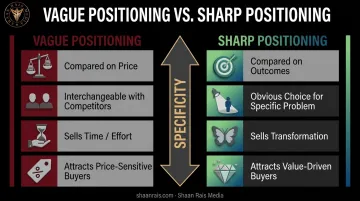
This is the difference between being a commodity and being a specialist:
| Vague Positioning | Sharp Positioning |
|---|---|
| Compared on price | Compared on outcomes |
| Interchangeable with competitors | The obvious choice for a specific problem |
| Sells time or effort | Sells a transformation |
| Attracts price-sensitive buyers | Attracts value-driven buyers |
Does Specificity Always Win?
Not automatically, and the research is honest about that.
A 2022 analysis of over 32,000 Freelancer.com jobs found that for high-skill work, tighter skill-to-job matching reduced the "penalty" of narrow positioning, while excessive breadth hurt contract-winning odds (Fu, Feng & Ye, AISeL). A separate study told a different story: MBA graduates entering investment banking with narrowly focused profiles sometimes received fewer offers and lower bonuses than broader candidates, likely because narrow specialization signaled fewer outside options (Merluzzi & Phillips, "The Specialist Discount").
The two findings in short:
- Freelance platforms: tight skill-to-job matching rewards specificity for high-skill work
- Investment banking hires: extreme narrowness can backfire by signaling limited range
The takeaway isn't "always niche" or "always stay broad." It's this: specificity should match the value of the problem you solve, not the size of your audience. A narrow positioning statement that names a high-stakes, high-frequency problem beats both a vague generalist pitch and an overly narrow one that signals limited range.
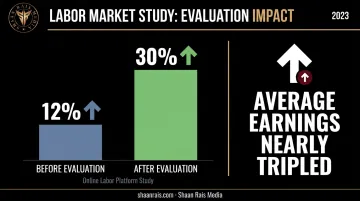
There's also real evidence that visible, credible proof changes outcomes. In a randomized experiment on an online labor platform, workers who received an initial job and a public performance evaluation saw subsequent employment jump from roughly 12% to 30%. Their average earnings nearly tripled (Pallais, "Inefficient Hiring in Entry-Level Labor Markets," NBER). Perception shifts fastest when it's backed by proof, not just claims. That proof is what the next section breaks down.
The Self-Positioning Technique: A Step-by-Step Framework
This framework borrows from company brand-positioning canvases, adapted for individuals. Four steps, in order — skipping ahead produces a weak statement.
This mirrors the "Perception Engineering" logic behind most credible positioning work: identity gets defined before tactics get deployed.
Step 1: Define Who You Serve and Their Core Problem
Get specific about your audience. Not "small businesses" — think "family-owned manufacturing companies with 20-50 employees preparing for a generational handoff."
Then name the recurring problem this audience faces, the one you're uniquely equipped to solve. Not a category of problems — one specific, painful, recurring issue.
Step 2: Identify Your Unique Differentiator
Differentiation can come from several sources:
- Strategy — a distinct point of view on how to solve the problem
- Structure — a unique process, framework, or sequence
- Systems — proprietary tools or methods others don't use
- Shared values — alignment with a specific worldview your audience holds
- Style — a communication approach or personality that resonates uniquely
Pick the lever that's actually true for you, then mine your career history for the specific story that supports it. An unconventional path, an unusual combination of experience, a failure you turned into a system — these become your narrative, and no competitor can copy a true story.
Step 3: Build Proof and Credibility
Before you have a long track record, you still have some proof. Compile it:
- Early client results — even one small transformation counts if it's specific
- Before/after outcomes — quantify change wherever possible
- Third-party validation — testimonials, endorsements, mentions
Forbes contributor William Arruda points to a common failure here: people skip stories and testimonials entirely, leaving decision-makers with claims instead of evidence (Arruda, Forbes). Proof beats polish.
With audience, differentiator, and proof in hand, the final step is synthesis.
Step 4: Craft and Test Your Positioning Statement
Combine those three elements into one sentence you can say out loud in a room. Then test it: could a generic competitor say the exact same thing?
If yes, it's not specific enough yet. Go back and sharpen it.
Positioning Statement Template and Examples
Use this fill-in-the-blank structure as a starting point:
"I help [specific audience] achieve [specific outcome] by [unique method], unlike [generic alternative]."
Weak example: "I help businesses improve their marketing and grow revenue."
Strong example: "I help Fractional CFOs turn their financial expertise into a repositioned brand that attracts CEO-level clients, unlike generic business coaches who focus on tactics before identity."
That second version isn't hypothetical. It mirrors what happened to Bobby Jackson, a Fractional CFO who completed a 120-day brand positioning process built around this same framework. He redefined his identity and messaging around financial intelligence, then posted 400% year-over-year revenue growth. No new credentials were involved. The growth came entirely from closing the gap between what he already knew and how clearly the market could finally see it.
Once your statement captures that same clarity, the next step is getting it in front of the right eyes.
Deploy your finished statement everywhere that matters:
- LinkedIn headline and About section
- Website homepage, above the fold
- Elevator pitch, verbatim
- Proposals and pitch decks
Common Self-Positioning Mistakes to Avoid
Three mistakes account for most weak positioning:
Leading with skills instead of outcomes. Listing tools and certifications sounds replaceable, because it is. Buyers don't hire "Excel skills"; they hire the result those skills produce. Arruda's research on personal branding failures repeatedly flags this same gap: professionals show competence without connecting it to outcomes (Forbes).
Trying to appeal to everyone. Broad appeals dilute perceived expertise and invite price comparison. If your positioning statement could describe half your industry, it's not positioning, it's a description.
Treating positioning as a one-time task. Write it once, forget it, and it fossilizes while your career moves on. Positioning needs the same "reevaluate and adjust" cycle that Harvard Business School's branding framework recommends: define, audit, build, communicate, then check results and revise (Avery & Greenwald, HBR).

A fourth trap deserves its own mention: disguised self-promotion. Research from Harvard Business School found that "humblebragging", dressing up a boast as a complaint or humility, actually reduces perceived competence compared to stating an achievement directly (Sezer, Gino & Norton, HBS). Say what you did. Skip the false modesty.
How to Apply and Maintain Your Positioning Over Time
Writing the statement is the easy part. Living inside it consistently is where most people drift.
Three habits keep positioning consistent once the statement is written:
- Audit what's already public. Review your LinkedIn, website, proposals, and social bios. Flag any language that contradicts your new statement, then fix it.
- Treat positioning as a filter, not a description. Before accepting a new opportunity, ask whether it strengthens your position or dilutes it. A well-paying but off-brand project can undo months of clear signaling.
- Evolve positioning on purpose. As your expertise deepens, shift your positioning deliberately, guided by real feedback and results rather than whatever felt urgent that week.
Inconsistent messaging confuses the exact perception you're trying to build, so treat these checks as ongoing maintenance, not a one-time task.
Structured systems tend to outperform trial and error here. Shaan Rais's 120-Day Personal Brand Legacy Protocol was built for operators who want expert-guided repositioning instead of slow, reactive drift.
Frequently Asked Questions
What does "self-positioning" mean?
Self-positioning means deliberately shaping how the market perceives your value, expertise, and identity so you're seen as the specific solution to a specific problem. It's a deliberate strategic choice rather than a byproduct of visibility.
What is another word for "self-positioning"?
Close synonyms include personal positioning, perception engineering, and career positioning. These terms are used interchangeably, though perception engineering leans more toward active, deliberate market perception design.
How do I position myself strategically?
Define your specific audience and their core problem, identify your unique differentiator, compile proof of results, and condense all four into one clear positioning statement. Test it by asking if a generic competitor could say the same thing.
What's the difference between personal branding and self-positioning?
Positioning is the strategic foundation: who you serve, what problem you solve, and how you're different. Branding is the visual and content expression built on top of that foundation.
How long does it take to see results from repositioning yourself?
Internal clarity can happen within days once you've done the strategic work. Market perception shifts more gradually, though some documented cases show measurable income changes within 30 to 90 days once consistent messaging compounds.
Do I need to niche down to position myself effectively?
Specificity drives premium perception more than permanent narrowness does. You can position sharply now and evolve that positioning as your expertise and audience grow.