Mark Twain understood this pain intimately. Speaking to the Society of the Army of the Tennessee in 1879, he admitted he "never could make a good impromptu speech without several hours to prepare it." If one of history's sharpest wits needed hours of prep to sound spontaneous, the rest of us can stop feeling broken for freezing up in a Zoom call.
Here's the good news: impromptu speaking is a skill, not a personality trait. It can be trained using specific frameworks, breathing techniques, and practice routines. This guide breaks down exactly how.
There's also a bigger stake here than just sounding smooth. How you handle unscripted moments — a panel question, an investor's curveball, a hallway conversation with your boss's boss — shapes how the market perceives your competence. You are more valuable than you are visible, and nowhere is that gap more exposed than in the moments you didn't see coming.
Key Takeaways
- Simple frameworks like PREP, STAR, and What/So What/Now What eliminate the need to invent structure on the spot
- Physical anxiety management (breathing, gestures) comes before crafting your actual message
- Recording yourself or joining a group like Toastmasters builds long-term confidence through repetition
- Every unscripted moment, from an elevator chat to a live Q&A, shapes how others see your professional credibility
What Is Impromptu Speaking (and Why Does It Feel So Hard)?
Impromptu speaking means talking with little to no preparation time. No notes, no outline, no rehearsal. This distinguishes it sharply from extemporaneous speaking, where you know the topic in advance and can plan your main points, even if you deliver the wording conversationally.
The distinction matters because people often say "I'm bad at impromptu speaking" when what they actually struggle with is walking into any unrehearsed moment without a mental toolkit.
And most people do struggle. Chapman University's 2024 Survey of American Fears found that 29% of Americans report a fear of public speaking, based on a weighted national sample of 1,008 adults. That's nearly one in three people you know.
Why This Is Also a Branding Problem
Unscripted moments aren't just performance anxiety triggers. They're what you might call perception moments: split-second windows where colleagues, clients, or an audience form a judgment about your competence.
Think about it:
- A confident, structured answer in a Q&A signals authority
- A rambling, filler-word-heavy response signals uncertainty, even if your expertise is real
- Investors, panel moderators, and hiring managers weight these moments heavily because they can't fact-check your credentials in real time — they're reacting to how you show up
Years of built credibility can get undercut by thirty seconds of scattered thinking. This guide gives you the tools to close that gap, starting with what actually happens in your brain during those unscripted seconds.
Common Types of Impromptu Speeches
Recognizing which kind of impromptu situation you're in helps you pick the right structure and tone faster, instead of fumbling for a generic response.
Toastmasters-Style Table Topics
Table Topics is the classic Toastmasters exercise for building on-the-spot thinking. A Topicsmaster calls on a member with no advance notice, and the response runs 1-2 minutes — the official club standard. The stakes are low by design: this is deliberate practice, not a performance that follows you afterward.
Workplace Cold Calls and Q&A
Someone asks you a pointed question in a meeting, on a call, or worse, from your boss's boss. Brevity matters most here — the room is judging your grasp of the situation, not your storytelling. Nobody wants a three-minute answer to "Are we on track for launch?"
Social and Ceremonial Speeches
Toasts, introductions, remarks at a colleague's retirement or a friend's wedding. Warmth and a personal story carry these moments; corporate polish falls flat.
Media and Public-Facing Moments
Podcast interviews, press questions, networking event small talk. These are pure perception moments — your impromptu answer is the public record of how you think.
Interview and Behavioral Questions
"Tell me about a time you failed." Job interviews and performance reviews are where structured frameworks like STAR earn their keep, since the questions are predictable even when the specifics aren't.
Mindset Strategies for Confident Impromptu Speaking
Message crafting comes second. Mindset comes first, because anxiety physically blocks clear thinking before you've said a word.
Calm the Body Before You Speak
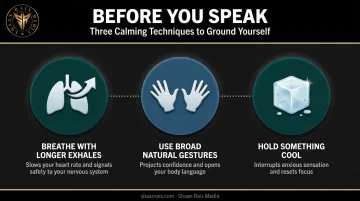
- Breathe with longer exhales. A 2007 study of 156 public-speaking students found that diaphragmatic breathing practice was linked to a significantly greater decline in speech-related anxiety compared to a control group
- Use broad, natural gestures. Research shows gesturing helps you organize thoughts and retrieve words while speaking, which is exactly what you need mid-answer
- Hold something cool. Some speakers find this settles nerves, though the direct evidence here is thin — treat it as a personal experiment, not a guarantee
Dare to Be Dull
This is a genuine mindset shift: stop trying to be impressive. Aim to be clear. Speakers who drop the pressure to sound brilliant almost always sound more composed. Clarity reads as confidence.
Buy Yourself Time
You don't need to answer instantly. Try:
- Repeating the question back ("So you're asking about our Q3 numbers...")
- Saying "That's a good question — let me think about that for a second"
- Pausing silently for two full seconds before speaking
None of these make you look unprepared. They make you look thoughtful.
Listen Before You Respond
That extra time only helps if you use it to listen, not to rehearse. In one-on-one impromptu moments especially, the temptation is to start formulating your answer while the other person is still talking. Resist it. Listen for what they're actually asking, not what you assume they're asking.
Choose Honesty Over Polish
If you don't know, say so. "I don't have that data in front of me, but here's what I'd guess and I'll confirm by end of day" builds more trust than a confident-sounding fabrication. A polished lie eventually costs more than an honest gap.
Proven Frameworks to Structure Your Impromptu Speech
A mental formula removes the hardest part of impromptu speaking: inventing structure and content at the same time. That's the real cause of rambling — not lack of knowledge, but lack of scaffolding.
PREP: Point, Reason, Example, Point
PREP works best for opinion and "what do you think" questions, where you need to land a clear stance fast.
- Point — State your answer directly
- Reason — Explain why
- Example — Illustrate with a specific case
- Point — Restate your position to close the loop
Example: "I think we should delay the launch. [Point] The QA team flagged three unresolved bugs. [Reason] Last quarter, we shipped early and had to issue a hotfix within 48 hours, which damaged trust with early users. [Example] So I'd rather delay two weeks than repeat that. [Point]"
STAR/CAR: Situation, Task, Action, Result
Once you've got PREP down, STAR/CAR handles a different challenge: narrating past behavior. It's particularly useful for interview and performance-review questions.
Example: "In my last role [Situation], I was tasked with cutting onboarding time [Task]. I redesigned the training sequence and automated three manual steps [Action], which cut onboarding from three weeks to eight days [Result]."
What? So What? Now What?
- What — Describe the point or event
- So What — Explain why it matters
- Now What — Suggest the next step
This framework shines in status updates and data reports, where the audience needs context before action items. Example: "Our churn rate ticked up 4% last month [What]. That matters because it's concentrated in our highest-value tier [So What]. I'd suggest we get three exit interviews scheduled this week [Now What]."
Three T's and Pros/Cons/Recommendation
Two more options worth having in your back pocket:
- Three T's: Tell them what you'll say, say it, tell them what you said — a classic structure for narrative or storytelling answers
- Pros/Cons/Recommendation: Lay out the positives, the negatives, then give your call — ideal for evaluative questions like "Should we approve this vendor?"
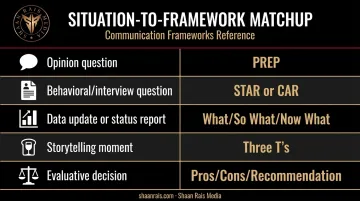
Which Framework Fits Which Situation
| Situation | Best Framework |
|---|---|
| Opinion question | PREP |
| Behavioral/interview question | STAR or CAR |
| Data update or status report | What/So What/Now What |
| Storytelling moment (toast, intro) | Three T's |
| Evaluative decision | Pros/Cons/Recommendation |
How to Practice Impromptu Speaking and Avoid Common Mistakes
Building the Skill Through Practice
Impromptu speaking improves with deliberate, repeated exposure — not by hoping you'll magically be less nervous next time.
- Record yourself. Audio or video review reveals filler words, pacing issues, and posture problems you can't detect in the moment. Watch the playback once for content, then again just for delivery habits
- Start small. Practice short answers on familiar topics with a small, trusted audience before scaling to harder scenarios
- Join a peer group. Toastmasters and similar clubs provide structured, repeated Table Topics practice, the exact kind of low-stakes repetition that builds durable confidence over time
Mistakes That Undermine Your Message
- Rambling without structure. This happens when you try to think and talk at the same time. Pick a framework before you open your mouth
- Overusing filler words. Words like "um," "like," and "so" signal hesitation. Swap them for a silent pause; it feels longer to you than it sounds to your audience
- Reaching for generic answers. A weather comment or a forgettable non-answer wastes the moment. Find the one specific, memorable angle only you would give
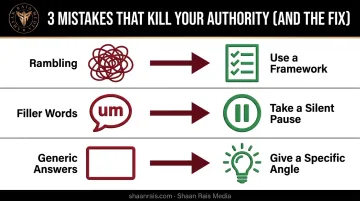
This last point connects directly back to positioning. Executives who master this rarely give the safe answer; they give the specific one, and it's the specific answer people remember and repeat about them later.
Frequently Asked Questions
What are effective impromptu speaking strategies?
The most effective strategies combine physical anxiety management (breathing, gestures), a ready-made structure like PREP or STAR, and regular low-stakes practice. Together, these remove the guesswork from thinking on your feet.
What are the common types of impromptu speeches?
They range from Toastmasters Table Topics and workplace Q&A to social toasts, media appearances, and interview questions. Each requires a slightly different tone and structure, from brevity in meetings to warmth in ceremonial speeches.
How can I overcome the fear of impromptu speaking?
Start with physical techniques like diaphragmatic breathing and natural gestures to calm your body. Then adopt the "dare to be dull" mindset. Aim for clarity over impressiveness, and you'll sound more confident.
How long should an impromptu speech be?
Toastmasters' official standard for Table Topics is 1-2 minutes, which is a solid benchmark for most impromptu situations. Brevity is almost always safer than rambling on past your point.
What is the difference between impromptu and extemporaneous speaking?
Impromptu speaking has no advance preparation time at all. Extemporaneous speaking allows some notice, letting you plan your main points and structure while still delivering the wording conversationally.
How can I practice impromptu speaking at home?
Record yourself answering random prompts using a timer set to 1-2 minutes, then play it back. Listen specifically for filler words, pacing, and whether you followed a clear structure like PREP.