Vocal exercises aren't reserved for singers and actors. They're a learnable, minutes-long skill any professional can use to sound clearer and steadier under pressure. Research on hiring decisions backs this up: candidates whose pitches were heard by evaluators were rated more competent and intelligent than when the identical pitch was only read — and adding video didn't change the result. Delivery, not just wording, shaped the outcome.
This guide covers breathing, articulation, resonance, and a fast pre-speech warm-up routine you can run before your next talk.
Key Takeaways
- A 5-10 minute vocal warm-up sharpens clarity, projection, and steadiness before any speaking engagement
- Breath support, not throat strain, builds a strong, resonant voice
- Daily practice, not occasional warm-ups, builds lasting vocal control
- Your voice shapes how others perceive you before you say a word of substance
Why Vocal Warm-Ups Matter for Speakers (Not Just Singers)
Speaking and singing run on the same machinery: vocal folds, breath, and resonance. When singers warm up, they're preparing that mechanism for controlled, sustained use. Speakers need the exact same preparation, though they rarely get it.
Skip the warm-up and you're asking cold, tight muscles to perform under stress. That's when voices crack, trail off, or flatten into monotone.
The stakes are higher than most professionals realize. A widely cited 2015 study found that job candidates who were heard pitching themselves were judged as more thoughtful and intelligent than when the same words were read on paper, and hiring managers were more interested in hiring them. According to a 2015 study on vocal delivery and hiring judgments, hearing consistently beat reading, even though the content never changed.
That's a strange, useful fact: the words stayed identical. Only the delivery changed. And it moved the outcome.
Your Voice Is Part of Your Positioning
That finding points to something speakers can't afford to ignore: a clear, controlled voice signals authority before you've made your case. It's an audible marker of competence, registered in seconds.
Executives and founders often have more capability than the market credits them with. A confident, well-supported voice won't replace substance, but it stops that substance from being underestimated in the first ten seconds of a pitch, interview, or keynote.
Breathing Exercises: The Foundation of a Strong Speaking Voice
Most shaky, thin voices trace back to one habit: shallow chest breathing. When you breathe high into the chest instead of low into the belly, you're working with a smaller reserve of air. Your voice runs out of support mid-sentence, tightens in the throat, and tires faster.
Diaphragmatic breathing — slower, deeper breaths driven by the abdomen rather than the chest — gives your voice a steady column of air to ride on. Health authorities including the Cleveland Clinic outline the core technique: breathe in through the nose so the belly expands, keep the chest relatively still, and exhale slowly.
Diaphragmatic Breathing
For anyone stepping into a keynote, a pitch, or a high-stakes negotiation, this is the technique that keeps your voice steady when the pressure is on.
- Sit tall, shoulders relaxed, one hand resting on your belly
- Inhale through your nose, letting your belly push outward against your hand
- Exhale slowly through your mouth, feeling the belly fall
- Repeat for 5-6 breaths
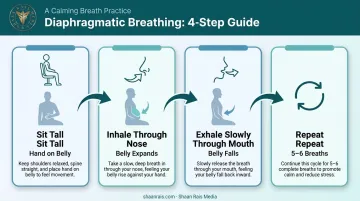
Common mistake: lifting the shoulders on the inhale instead of expanding the belly. If your shoulders rise, you're still breathing shallow.
Counting on One Breath
- Inhale low into the belly
- Count out loud steadily: "1, 2, 3..." aiming for 10-15 counts on a single breath
- Don't rush the last few numbers just to hit a target — pace evenly throughout
This drill builds the breath control that longer sentences demand. It also curbs the urge to gasp mid-thought when you're presenting to a room full of decision-makers.
Pair it with open posture — chest lifted, shoulders relaxed. A slouched frame compresses the lungs and cuts off your air supply before you've said a word.
Articulation & Diction Drills for Clear Speech
Mumbling rarely comes from a vocabulary problem. It comes from underused lip, tongue, and jaw muscles that never learned to move with intention. Toastmasters, which has trained public speakers for decades, prescribes exaggerated articulator movement as the fix — deliberately overworking the mouth in practice so normal speech comes out crisper.
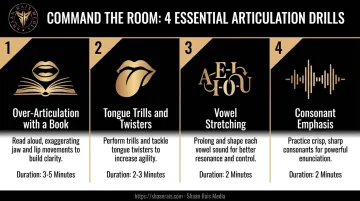
Over-Articulation with a Book
Read a passage aloud for 3-4 minutes, exaggerating every syllable and mouth movement far beyond what feels natural. It'll feel silly. That's the point — you're training range you don't normally use.
Tongue Trills and Twisters
- Roll your tongue rapidly (a tongue trill) to loosen tension
- Move into classic twisters: "Red leather, yellow leather" or "Peter Piper picked a peck..."
- Start slow, articulating every consonant, then gradually build speed
Vowel Stretching and Consonant Emphasis
Stretch each vowel — A, E, I, O, U — for 2-3 seconds, repeating the set 3-4 times to fully open the mouth. Then run consonant-heavy phrases like "sah-say-see-so-soo" to sharpen precision.
The common mistake: speeding through these drills and slurring them, which defeats the purpose. Slow, exaggerated repetition at half-speed is what trains your mouth to move cleanly once you're back at conversational pace.
Resonance, Projection, and Pitch Control
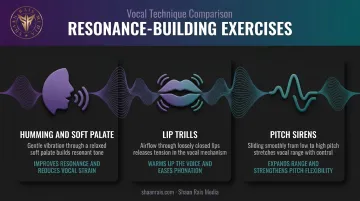
Volume forced from the throat sounds strained and doesn't last. Resonance builds fullness a different way, using open airways and vibration instead of raw force. Voice scientist Ingo Titze studied semi-occluded vocal tract exercises like humming, lip trills, and tongue trills. His research found these techniques improve vocal efficiency and reduce tissue strain by partially closing the vocal tract during practice.
Humming and the Soft Palate
Hum on a comfortable pitch and notice the vibration in your lips and face. Follow with a "yawn into ahh" — start a yawn, then release into an open "ahh" sound. This widens the throat and opens resonance space.
Lip Trills and Sirens
- Lip trills: buzz your lips together (like a motorboat sound) while exhaling steadily. This builds breath control.
- Sirens: slide your pitch from low to high and back, gently, to release tension in the voice box
Pitch Glides and Intonation Practice
Glide from your lowest comfortable pitch to your highest, then back down. Afterward, take one sentence and repeat it with different emotional tones — agreement, surprise, concern. This single habit does more to fix monotone delivery than almost any other exercise.
Posture matters here too. Head stacked over shoulders, chest open, jaw relaxed — this alignment makes projection feel effortless instead of forced up from the throat.
Your 5-Minute Pre-Speech Warm-Up and Daily Practice Habits
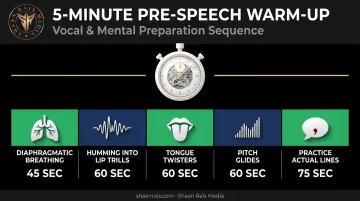
Here's a compact sequence you can run before walking into any meeting or onto any stage:
| Time | Exercise |
|---|---|
| 45 sec | Diaphragmatic breathing |
| 60 sec | Humming into lip trills |
| 60 sec | Tongue twisters |
| 60 sec | Pitch glides |
| 75 sec | Practice a few actual lines from your talk |
For professionals who speak often — client calls, team meetings, panels — a 10-minute daily maintenance routine rotating breath, articulation, resonance, and pitch work builds lasting control. One-off warm-ups help for a single event. Daily reps are what change your baseline voice.
Voice-care habits worth building:
- Stay hydrated throughout the day, not just before speaking
- Avoid habitual throat clearing — it irritates the vocal folds
- Prioritize rest; physical fatigue shows up in your voice
- Go easy on caffeine and alcohol before high-stakes speaking
Consistency is what separates a voice that holds up under pressure from one that cracks at the worst moment. Treat the daily routine like brushing your teeth — skip it occasionally, and you'll still function, but the compounding neglect eventually shows up when you need your voice most.
Frequently Asked Questions
What exercises strengthen your speaking voice?
Diaphragmatic breathing, humming, lip trills, and tongue twisters form the core set. Together they build breath support and articulation, the two pillars of a stronger, clearer speaking voice.
What are the 4 vocal function exercises?
Vocal Function Exercises are a clinical voice-therapy protocol defined by ASHA, involving a sustained warm-up tone, stretching and contracting exercises, and controlled power exercises. They're designed to systematically rebalance the vocal mechanism, typically under guidance from a speech-language pathologist.
What are the 7 vocal techniques?
Speakers commonly rely on breathing, articulation, resonance, projection, pitch and tone variation, pacing, and pausing for emphasis. Mastering these seven gives you full control over how your message lands, not just what it says.
How long should a vocal warm-up take before speaking?
Five minutes is enough for a quick warm-up before a meeting or short talk. Before longer speeches or presentations, a fuller 10-minute routine covering breath, articulation, and pitch work pays off more.
Can vocal exercises help with public speaking nerves?
Yes. Diaphragmatic breathing and humming both calm the nervous system by slowing your breath and easing throat tension, which reduces the shakiness nerves often cause in your voice.
How often should I practice vocal exercises?
Short daily practice — 5 to 10 minutes — beats occasional long sessions. Consistency is what builds lasting vocal control, not intensity in a single session.