The term actually carries two meanings. One is a specific copyright right that determines who can transmit or license your work. The other is the broader practice of managing how you show up publicly — your PR, your visibility, your brand. This guide covers both, because founders and creators need to understand each to protect their work and their market position.
You'll learn the legal definition, the laws that govern it across countries, the different types of public communication, and the practices that turn legal clarity into a stronger personal brand.
Key Takeaways
- "Communication to the public" is a copyright right controlling how creators' work reaches audiences beyond a private circle
- Treaties like the Berne Convention and WIPO Copyright Treaty set the international baseline; national laws like the U.S. Copyright Act apply it differently
- Courts assess audience size, "new public," and commercial intent to decide if a communication counts as public
- Every podcast, keynote, or public post triggers this legal right, whether or not you realize it
- Knowing these rules protects your content and your reputation when you share work publicly
What Is "Communication to the Public"?
At its legal core, "communication to the public" is the exclusive right of a copyright holder to control how their work gets transmitted or made available to an audience. Under the EU's InfoSoc Directive, this includes wire and wireless transmission, plus on-demand access "from a place and time individually chosen" by the user. Streaming a podcast episode whenever a listener wants is a clear example (InfoSoc Directive, Article 3(1)).
Courts apply a two-part test established through cases like Filmspeler:
- An act of communication — someone deliberately intervenes to give others access to a protected work, regardless of whether anyone actually watches or listens
- That communication reaches "the public" — meaning an indeterminate, fairly large number of people unrelated to each other
This second element is easy to underestimate. "The public" doesn't mean your extended family group chat. It means people outside your normal social circle: strangers, subscribers, an audience you don't personally know.
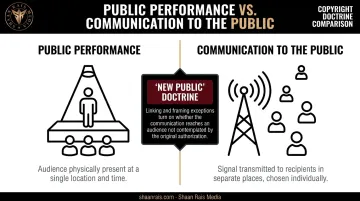
Communication "In Public" vs. "To the Public"
These two phrases sound interchangeable. They aren't.
- Public performance covers a live, in-person audience physically present where the performance happens — a concert, a keynote stage, a comedy set
- Communication to the public covers transmission to people not physically present — broadcasting, streaming, on-demand access
The distinction gets messier once you factor in the "new public" doctrine. In Svensson, the Court of Justice of the EU ruled that linking to content already freely available online didn't infringe copyright. The reasoning: the linked audience was already contemplated by the original rights holder (Svensson, C-466/12).
But when a link circumvents access restrictions or paywalls, it reaches a genuinely new public, and that requires separate authorization. Later cases involving embedded content (framing) applied the same logic. Bypass a restriction, and you've created a new communication event.
The Right to Communication to the Public: Key Laws & Frameworks
Two international treaties built the foundation everyone else works from:
- Berne Convention — Article 11bis covers broadcasting, wireless diffusion, and secondary wire transmission; Article 11 covers public performance rights for dramatic and musical works
- WIPO Copyright Treaty (WCT) — Article 8 grants authors an exclusive right over communication by wire or wireless means, explicitly including on-demand access
Member countries are required to protect these rights, but how they implement them varies significantly.
United States
The Copyright Act's Section 106 grants exclusive public performance and display rights. The "transmit clause" treats a performance as public whether the audience receives it in the same place or scattered across different locations and times.
The Supreme Court applied this standard in American Broadcasting Cos. v. Aereo. It ruled 6-3 that Aereo's subscriber-specific antenna system publicly performed copyrighted broadcasts, since the service functioned too much like a cable system to escape the law's reach (ABC v. Aereo, 573 U.S. 431).
European Union
The InfoSoc Directive governs communication to the public through a multi-factor test the CJEU has refined over a decade of case law. Courts weigh three factors together, with no single one deciding the outcome:
- Whether there was a deliberate act of communication
- Whether the act reaches a "new public" not already accounted for by the rightsholder
- Whether a profit motive is involved
The practical takeaway: rules on what counts as "public" versus "private/family circle" differ by jurisdiction. If you're distributing content internationally, licensing terms, or booking speaking engagements across borders, research the specific rules where your content lands.
This section provides general information, not legal advice. If you're navigating a specific licensing, broadcast, or infringement question, consult an IP attorney.
The 4 Types of Public Communication
Legal frameworks generally group public communication into four practical categories:
| Type | Definition | Modern Example |
|---|---|---|
| Broadcasting | Wireless diffusion of signs, sounds, or images to the public | Satellite or terrestrial TV/radio broadcast |
| Cable/wire transmission | Wire-based communication or rebroadcasting by a separate organization | Cable retransmission of a broadcast signal |
| On-demand/making available | Access at a time and place individually chosen by the user | YouTube videos, podcast streaming, on-demand courses |
| Public performance/display | Live performance or showing before an audience, in person or via transmission | In-venue keynote speaking, livestreamed webinars |
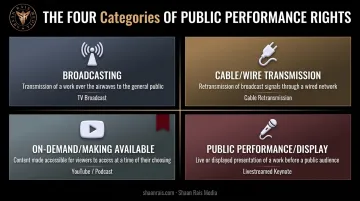
Digital platforms increasingly blur these categories. A hybrid event that's live on stage and simulcast to a virtual audience touches multiple legal categories at once. Different rights and licenses can apply depending on how, and to whom, the content is delivered.
This matters most for anyone who speaks or performs professionally. A keynote delivered live, then repurposed as an on-demand replay, can trigger separate licensing terms for each format — so contracts covering one delivery method don't automatically cover the other.
Why This Matters for Creators, Founders & Personal Brands
Founders and coaches today are their own broadcasters. Every course, framework, and keynote you create makes you a rights holder, and a public communicator. You're distributing that IP across podcasts, YouTube, and stages.
This creates risk. When a platform hosts your content, its terms of service often determine who legally "communicates" that work going forward. Miss the fine print, and you can lose control over royalties, redistribution, or even attribution.
It also creates opportunity, because the creator economy has grown into a serious asset class:
- Goldman Sachs Research valued it at $250 billion in 2023, with a path to $480 billion by 2027, growing 10-20% annually (Goldman Sachs Research, 2023)
- Brand deals alone supplied roughly 70% of creator revenue
- Visa's 2025 Creator Report found 68% of creators consider themselves small-business owners, with 88% expecting revenue growth this year (Monetized: Visa 2025 Creator Report)
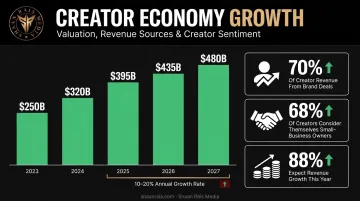
Given those numbers, every public communication event you host is doing double duty. It's a legal transmission of your work, and it's a perception-shaping moment that determines how the market categorizes and prices you.
Once you understand your legal right to communicate publicly, the strategic question shifts from can you communicate to how. This is the core idea behind Shaan Rais's Perception Engineering approach: treating each stage appearance, podcast, or broadcast as a moment that shapes market positioning, not just a one-off performance.
Best Practices for Communicating to the Public
Legal clearance and strategic positioning aren't separate tracks. Handle both, every time you go public:
- Audit licensing terms before you distribute. Before uploading to a third-party platform, check who legally "communicates" your work under that platform's terms. This determines ownership and your ability to control redistribution later.
- Keep messaging and visual identity consistent. Every channel, whether podcast, keynote, or social post, should reinforce the same perception rather than fragment it. Inconsistency dilutes the market's ability to categorize you correctly.
- Document ownership and permissions upfront. Music, quotes, and guest appearances all need clearance before public release, not after a dispute forces the conversation.
- Treat every appearance as positioning, not just visibility. A guest podcast slot or keynote isn't just exposure. It's a chance to align tone, message, and platform with the market position you're trying to occupy — the same principle behind Perception Engineering, where every touchpoint shapes how the market categorizes and prices you.
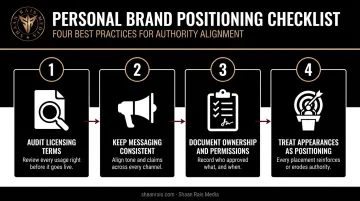
Legal clearance protects you from infringement claims. Strategic positioning makes sure the communication you're entitled to make actually compounds your brand instead of diluting it.
The 7 C's of Public Relations
Legal clearance tells you whether you can communicate. The 7 C's, first outlined in Cutlip and Center's Effective Public Relations, tell you whether that communication actually lands:
- Credibility: the audience must trust your competence and intent before they'll listen
- Context: your message needs to fit the environment; actions should confirm what you say, not contradict it
- Content: the message must be relevant and meaningful to the people receiving it
- Clarity: simple language ensures your message means the same thing to you and your audience
- Continuity and consistency: repetition with variation, not a single message fired once
- Channels: use platforms your audience already trusts and pays attention to
- Capability of the audience: pitch your communication to your audience's actual ability to receive and act on it
A legally cleared message that ignores these principles still falls flat. Positioning and messaging strategy decide whether your audience acts on what you say.
Frequently Asked Questions
What are the 4 types of public communication?
The four types are broadcasting (wireless diffusion), cable/wire transmission, on-demand making available (streaming or downloads), and public performance or display. Each carries different rights and licensing implications depending on the platform used.
What is the right to communication to the public?
It's the copyright holder's exclusive right to control how their work is transmitted to an audience beyond a private circle. This right is protected under international treaties like Berne and the WCT, plus national laws such as the U.S. Copyright Act.
What are the 7 C's of public relations?
Credibility, context, content, clarity, continuity/consistency, channels, and capability of the audience. Together they describe what makes public communication effective, not just permissible.
Is communication to the public the same as public performance?
No. Public performance covers audiences physically present at the original event, while communication to the public covers transmission to audiences elsewhere — via broadcast, streaming, or online access.
Do I need permission to share someone else's content publicly?
Generally yes, unless the work is in the public domain, you have a license, or a legal exception like fair use applies. Content being publicly available online doesn't automatically make it free to redistribute.
How does public communication affect personal branding?
Each time your work reaches an audience through a podcast, keynote, or online post, it counts as a public communication under copyright law and shapes how your audience sees your brand. Managing the legal side properly protects the reputation you're building with every appearance.