That gap is where blind spots grow. Left unchecked, they quietly chip away at trust long before the numbers show it.
Here's the data point worth sitting with: Korn Ferry's analysis of 6,977 professionals across 486 publicly traded companies found that leaders at underperforming companies carried 20% more blind spots and were 79% more likely to score low on overall self-awareness. That's not proof reflection alone drives revenue. It's a strong signal that leaders who skip it are flying with a foggy windshield.
This guide breaks down categorized self-reflection questions, a practical framework for building the habit, and how internal clarity connects to how you're actually perceived in your market.
Key Takeaways
- Self-awareness gaps show up in the numbers, not just in how a leader is perceived
- Reflection questions cluster into four practical categories: vision, accountability, growth, and people
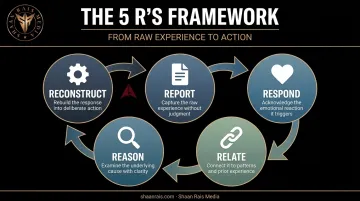
- The 5 R's framework turns raw experience into action: Report, Respond, Relate, Reason, Reconstruct
- Internal clarity means little if your market perception doesn't match your actual capability
What Is Leadership Self-Reflection?
Leadership self-reflection is the intentional practice of examining your decisions, behaviors, values, and impact on the people around you — with the goal of improving how you lead going forward. It's not a feel-good exercise. It's diagnostic work.
Researchers Grant, Franklin, and Langford draw a clear distinction here: reflection is the process of inspecting your own thoughts and actions. Insight is what you get if that process actually works. That distinction matters for leaders trained to spot patterns in behavior — including Shaan Rais, whose background as an Industrial-Organizational Psychologist centers on exactly this kind of process-versus-outcome thinking.
Reflection Is Not Rumination
These two get confused constantly, and the difference matters.
- Reflection is curiosity-driven. It asks "what happened, and what do I do next?"
- Rumination is threat-driven. It circles the same grievance or mistake without landing anywhere.
Psychologists Trapnell and Campbell found these are motivationally distinct — one comes from genuine interest in self-understanding, the other from perceived loss or injustice. Tasha Eurich's research adds a useful warning here too. Leaders who repeatedly ask "why did this happen?" often generate confident-sounding but inaccurate explanations, since people lack direct access to many of their own unconscious drivers. Her most self-aware subjects asked "what" instead of "why" — it kept them focused on next steps rather than stuck in self-justification.
It Doesn't Require a Ritual
Reflection can happen through:
- Journaling at the end of the day
- Guided questions during a commute
- Coaching conversations
- Quiet, unscheduled solo time
The method matters less than the consistency. Fifteen minutes done daily beats an hour done once a quarter.
Why Self-Reflection Matters for Leaders and Executives
Skip reflection long enough, and it shows up as a credibility problem, not just a blind spot. The people you lead notice before you do.
It Builds Trust and Psychological Safety
Google's Project Aristotle research identified psychological safety as the single most important factor in team effectiveness, defined by Amy Edmondson as a shared belief that the team is safe for interpersonal risk-taking. Leaders build that safety through humility, curiosity, and how they respond when someone brings them bad news — all behaviors that get sharper with regular self-examination.
It Improves Decision-Making
A field experiment on structured reflection found measurable performance gains: trainees who spent 15 minutes at the end of each workday writing down lessons learned improved final performance by 22.8% compared to a control group. The study wasn't executive-specific, but the mechanism holds at any level: reviewing what actually happened, rather than what you assumed happened, helps you catch repeating patterns before they cost you again.
The gap between what leaders think they're projecting and what the market actually perceives rarely closes on its own. Regular self-examination is how you find it:
- Where your stated priorities diverge from how you actually spend your time
- Which decisions you're repeating out of habit rather than evidence
- How your team's feedback compares to your own read of a situation
It Keeps You Anchored to Purpose
McKinsey's leadership research notes that CEOs benefit from regularly revisiting who they are and how they show up — not as a vague values exercise, but as a check against getting pulled into reactive, day-to-day firefighting that drifts from long-term vision.
The Essential Self-Reflection Questions Every Leader Should Ask
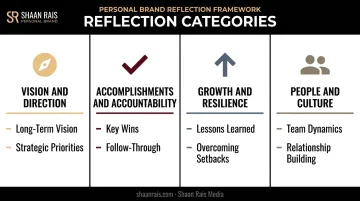
Rotating through different categories of questions prevents the trap of asking the same three things every week and getting diminishing returns. Here are four categories worth cycling through.
Vision and Direction
Clarity here starts with checking whether your daily choices actually serve the destination you've set.
- What is my vision for my team or organization, and have my recent actions moved us closer to it — or further away?
- Am I making decisions based on long-term purpose or short-term pressure?
- If my team described where we're headed, would their answer match mine?
Accomplishments and Accountability
Direction only matters if you're honest about what's working and what isn't.
- What am I most proud of accomplishing this quarter, and what specific actions drove that outcome?
- What didn't work well, why did it happen, and what will I change moving forward?
- Where have I avoided taking full ownership of a mistake or setback?
Growth and Resilience
- Where did I grow the most as a leader recently, and what pushed that growth?
- How do I typically respond under pressure — and is that response serving my team well?
- What feedback have I received but not yet acted on?
People and Culture
- Who on my team deserves recognition right now, and have I given it?
- Am I creating an environment where people feel safe disagreeing with me?
- How well am I listening versus simply waiting to speak?
Building a Consistent Reflection Practice: The 5 R's Framework
Asking good questions is only half the work. Without structure, reflection turns into rumination fast. The 5 R's framework, a well-established model from reflective practice research, gives you a repeatable cycle for moving from raw experience to real action.
- Report — Describe what happened factually, without judgment. No interpretation yet, just the facts.
- Respond — Capture your emotional and instinctive reaction before you analyze it. What did you feel in the moment?
- Relate — Connect this experience to past situations, values, or leadership principles you already hold.
- Reason — Dig into why the situation unfolded this way. What were the root causes? What alternatives existed?
- Reconstruct — Decide what you'll do differently next time, and turn that insight into one concrete action.
This cycle works because it separates emotion from analysis. Skipping straight to "why" without first reporting facts and naming feelings is exactly how reflection collapses into rumination.
From Self-Awareness to Market Perception: Reflecting on How You're Positioned
Here's a blind spot most high-performing leaders don't reflect on: the gap between how good you actually are and how the market perceives you.
You can have flawless self-awareness about your decisions, your growth areas, your leadership style — and still be underpriced, underrecognized, or misunderstood by the people who should be seeking you out.
Shaan Rais calls this gap the Talent Tax — the cost a capable leader pays when their positioning hasn't caught up with their actual capability. His Perception Engineering methodology treats this as a reflection exercise in itself, just aimed outward instead of inward. Rather than asking "am I a good leader," the questions become:
- Does my reputation reflect the value I actually deliver?
- Would someone meeting me for the first time immediately understand what I stand for?
- Am I the obvious choice for the problem I solve, or one of many similar options?
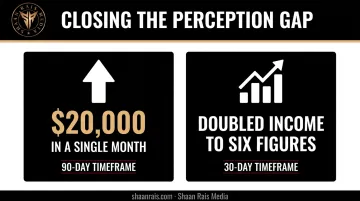
This isn't abstract. Clients who've applied this framework report results like:
- One client earned $20,000 in a single month — more than his entire previous year of business — within 90 days of starting a branding program built on this approach
- Another client doubled her income to multiple six figures within 30 days using the same repositioning logic
Neither result came from working harder. Both came from closing a perception gap that self-reflection alone hadn't touched.
Vision That Matches Reality
Closing that perception gap is one form of external validation. Strong leadership vision works the same way: it isn't just a statement, it's something the market can independently verify. Satya Nadella's Microsoft mission of "empowering every person and organization to achieve more" showed up in changed sales incentives and compensation tied to customer outcomes, not just a slide in a deck. Indra Nooyi's "Performance with Purpose" at PepsiCo reshaped actual product investment decisions for over a decade.
The common thread: internal reflection and external positioning reinforced each other. A vision becomes believable to outsiders only when both are working together.
Frequently Asked Questions
What is a leadership reflection?
Leadership reflection is the intentional practice of examining your decisions, behaviors, and impact on others to build self-awareness and improve future performance. It's structured and forward-looking, not casual self-criticism.
What are the 5 R's of reflection?
Report, Respond, Relate, Reason, and Reconstruct — a five-step cycle for turning a raw experience into a clear, actionable leadership insight. Each step builds on the last, moving from facts to feelings to root causes to action.
What are some good leadership vision examples?
Strong leadership visions are specific, values-driven, and consistently reinforced through action — like Satya Nadella's empowerment-focused mission at Microsoft or Indra Nooyi's "Performance with Purpose" at PepsiCo. Both leaders backed their stated vision with real operating decisions, not just language.
How often should leaders practice self-reflection?
A brief daily check-in, even 15 minutes, paired with a deeper weekly or monthly review works well. Research on structured daily reflection among trainees found meaningful performance gains using roughly this cadence.
What is the difference between self-reflection and overthinking?
Reflection is structured, question-driven, and leads to a decision or action. Overthinking (or rumination) is repetitive, circles the same worry, and rarely resolves into anything concrete.
What tools can leaders use to reflect more effectively?
Journaling, structured question frameworks like the 5 R's, executive coaching, and peer accountability conversations all work. The best tool is whichever one you'll actually use consistently.