That's the part most people miss about communication. We obsess over how we speak, but listening style quietly shapes whether colleagues, clients, and leaders see us as competent, warm, or trustworthy. It happens beneath conscious awareness, and it happens every single conversation.
This guide breaks down the four core listening styles, how each one shapes communication outcomes, and how to spot — then flex — your own default.
Key Takeaways
- Your listening style shapes how your message lands and whether people act on it
- Four dominant styles exist: people-oriented, action-oriented, content-oriented, and time-oriented
- Default patterns create blind spots — most people lean on one style regardless of context
- Flexing between styles based on context is a learnable leadership skill, not a fixed trait
What Is a Listening Style?
A listening style is the habitual, often unconscious way someone attends to, processes, and responds to what they hear. It's a preference, not a fixed personality trait — and it's different from hearing altogether.
Hearing is passive. It's your ears picking up sound waves, no effort required. Listening is active. It requires attention, interpretation, and a response. You can hear every word in a meeting and still miss the point entirely.
This gap matters more than most people realize. Classic communication research from Nichols and Stevens found that listeners typically recall only about half of what they hear immediately after a short talk. Within two months, retention drops to roughly 25%, based on testing across thousands of students and hundreds of business professionals (Columbia University Ombuds Office).
That's a historical benchmark from lab-style testing, not a universal law for every workplace exchange. But it makes a clear point: listening isn't automatic. How you listen determines how much actually sticks — and which parts stick.
The Four Listening Styles and How Each Impacts Communication
Research on workplace listening — most notably the Listening Styles Profile developed by Watson, Barker, and Weaver — identifies four dominant orientations. Each one comes with real strengths and real blind spots, and recognizing which one you default to changes how you show up in every conversation that matters.
People-Oriented Listening
This style tunes into emotion, tone, and relational cues. People-oriented listeners notice when something feels off before anyone says it out loud.
Strengths:
- Builds trust and rapport quickly
- Picks up on morale issues before they escalate
- Makes speakers feel genuinely heard
Where it struggles: In high-stakes technical discussions, this style can get pulled into emotional side-details and lose the thread on facts or deadlines.
Where it shines: HR conversations, coaching sessions, and client relationship management — anywhere the relationship matters as much as the information.
Where people-oriented listeners lean into feeling, the next style leans hard into function.
Action-Oriented Listening
Action-oriented listeners want to know one thing: what happens next. They filter for clarity, structure, and next steps.
Strengths:
- Speeds up decision-making
- Cuts through vague or rambling updates
- Keeps projects moving
Where it struggles: This style can come across as impatient — action-oriented listeners are prone to interrupting speakers who take a winding path to the point.
Where it shines: Project status updates, operational troubleshooting, and any conversation where a decision needs to happen fast.
Content-Oriented Listening
Content-oriented listeners want accuracy and evidence. They ask follow-up questions, test claims, and want to understand the "why" before agreeing to anything.
Strengths:
- Strengthens analytical rigor
- Catches gaps or inconsistencies others miss
- Encourages deeper, more thorough discussion
Where it struggles: This style can slow things down and, at times, come across as overly critical or skeptical — even when that's not the intent.
Where it shines: Technical reviews, strategic planning sessions, anything requiring depth over speed.
The fourth style cares less about depth and more about the clock.
Time-Oriented Listening
Time-oriented listeners prioritize brevity. They're tracking the clock as much as the content.
Strengths:
- Keeps meetings on schedule
- Protects everyone's time
- Forces speakers to get to the point
Where it struggles: Nuance gets lost, and emotionally complex conversations get rushed before they're actually resolved.
Where it shines: Executive briefings, daily stand-ups, any setting where time is the scarcest resource in the room.
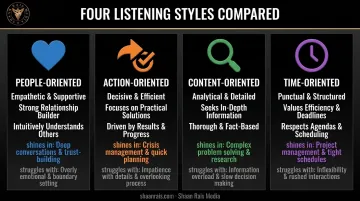
In coaching sessions with executives and founders, mismatched listening styles are often the real reason a pitch, negotiation, or team update falls flat — not the message itself, but who in the room was listening for feeling, facts, action, or time.
How Your Listening Style Shapes Perception, Trust, and Professional Influence
Here's the part people underestimate: listening behavior is visible. Colleagues, clients, and bosses read it constantly, often reading it more closely than they register what you actually said in return.
A 2024 meta-analysis synthesizing 664 effect sizes across more than 400,000 observations found perceived listening correlated with work outcomes at r = .39, and with relationship quality at r = .51 (Journal of Business and Psychology). Even after removing self-report bias, the job performance link held at r = .21 — smaller, but still real.
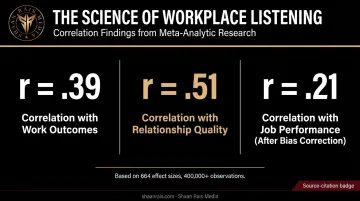
That's a meaningful signal: how you listen shapes how much people trust your judgment.
Listening Style and Decision Quality
Incomplete or mismatched listening leads to weaker decisions. If a content-oriented leader tunes out relational cues during a team conflict, they might solve the wrong problem entirely, landing accurate on paper but off-target in reality.
Listening Style and Conflict
Different styles de-escalate tension in different ways:
- People-oriented listeners defuse conflict through empathy and validation
- Action- and time-oriented listeners resolve it through fast closure and clear next steps
- Content-oriented listeners resolve it by getting to facts
Mismatched styles can actually escalate friction. A content-oriented manager pushing for evidence while an upset employee needs empathy first will often make things worse, not better.
Listening as Part of Your Market Position
This is where listening stops being a soft skill and becomes a positioning issue. Shaan Rais, an Industrial-Organizational Psychologist who works with executives and founders on how the market perceives and prices them, has spent over a decade making one point clear: capability alone rarely determines your value; visibility and perception do the rest.
Leaders who come across as poor listeners are frequently undervalued, regardless of how sharp their actual thinking is. Their communication habits, including how they listen, send a signal the market reads before it ever evaluates their expertise.
Positioning isn't just about what you say on stage or in a pitch. It includes the full pattern of how you engage, especially the moments you're not speaking at all.
How to Identify Your Own Dominant Listening Style
You probably already have a hunch. Here's how to confirm it.
- Reflect on recent conversations. Did you zero in on feelings, next steps, details, or the clock? Your instinctive focus point is a strong clue.
- Ask people who know you well. Self-perception often diverges sharply from how others experience you. A trusted colleague or friend will tell you what you can't see yourself.
- Watch for stress patterns. Most people show a blended style day-to-day, with one dominant tendency that intensifies under pressure or time crunch.
If those three steps still leave you guessing, one direct question can cut through the uncertainty. Ask a direct report or peer: "When I'm listening to you, what do you notice me focus on most?" The answer usually reveals more than any self-assessment.
Adapting Your Listening Style for Stronger Communication
Flexibility, not mastery of one style, is what separates strong communicators from average ones. The goal is matching your listening approach to what the speaker and the moment actually need.
A sensitive one-on-one calls for people-oriented listening, even if you default to action-oriented in every other meeting. A fast-moving status update, by contrast, needs the opposite approach entirely.
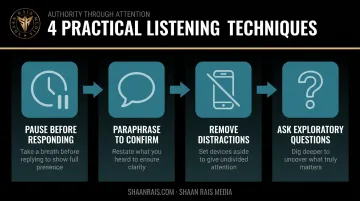
Practical techniques that work:
- Pause before responding. A two-second beat prevents jumping to conclusions too early
- Paraphrase to confirm understanding. Repeating back what you heard, in your own words, increases how understood a speaker feels
- Remove distractions. Close the laptop, put the phone away
- Ask exploratory questions before challenging. This builds psychological safety and room to think out loud
None of this requires abandoning your natural style. It requires noticing when your default doesn't fit the moment, and having a second gear ready.
Frequently Asked Questions
How does listening affect communication?
Listening shapes how messages get interpreted, how much trust builds between people, and how effectively information flows in any exchange. It's just as influential as speaking, even though it gets far less attention.
What are the 4 listening styles in communication?
People-oriented (focused on emotion and rapport), action-oriented (focused on next steps), content-oriented (values accuracy and depth), and time-oriented (prioritizes brevity and efficiency).
What is the difference between hearing and listening?
Hearing is a passive, automatic physical process: your ears register sound without effort. Listening requires active attention, interpretation, and a response to what's being said.
Can you change or improve your listening style?
Yes. People have a natural default, but listening flexibility is a trainable skill. Self-awareness plus deliberate practice — like paraphrasing and pausing before responding — builds range over time.
How do I know what my listening style is?
Reflect on what you naturally focus on in conversations, then ask trusted colleagues for honest feedback. Self-perception and how others experience your listening often don't match.
Why do some leaders struggle with listening?
Time pressure, multitasking, and overreliance on one dominant style (usually action- or time-oriented) push leaders toward rushed or surface-level listening, especially in high-stakes moments.