

You've sat through it: a speaker with genuine expertise, real insight, maybe even great stories — and somehow the message still doesn't land. The information feels scattered. The main point gets lost. By the end, you couldn't summarize what they said if you tried.
That's not a content problem. That's an organization problem.
An organizational pattern is the underlying architecture that arranges a speech's main points into a sequence that's logical, persuasive, or memorable. It's the skeleton holding everything else up. Get it right, and even average content feels sharp. Get it wrong, and expert-level insight feels muddled.
This guide breaks down the core organizational patterns for informative and persuasive speaking, how to pick the right one for your specific speech, and why structure directly shapes how an audience judges your credibility — not just whether they remember what you said.
Key Takeaways
- There are eight to ten widely recognized organizational patterns, each suited to a different speech goal
- Informative speeches typically use chronological, spatial, topical, or causal structures depending on the content
- Persuasive speeches rely on problem-solution, problem-cause-solution, Monroe's Motivated Sequence, or comparative advantages
- The right pattern depends on your purpose, audience, and topic — never personal preference
- Structure shapes how an audience perceives your authority and credibility, not just what they remember
What Are Organizational Patterns in Public Speaking (and Why They Matter)
An organizational pattern determines the sequence of your main points and how those points relate to one another. It's the difference between a speech that flows and one that feels like a list of loosely connected ideas.
Organization does three specific jobs:
- Improves comprehension: audiences follow labeled, grouped ideas far more easily than scattered ones
- Boosts retention, tied to the primacy/recency effect: even strong research can fall flat if it's presented in a jumbled order, while a clear structure makes a speaker sound more competent
Research on free recall confirms that people remember the first and last items in a sequence more reliably than the middle (Glanzer and Cunitz's classic memory study). Applied to speaking, this means your opening and closing carry outsized weight. It's a teaching principle, though, not a guarantee that any structure will make your entire speech memorable.
Here's the trap: a speaker can have brilliant research and zero persuasive impact, purely because the pattern doesn't fit the content. Force a chronological structure onto a comparison topic, and the comparison gets buried. Choose the right architecture, and even complex material feels effortless to follow.
Organizational Patterns for Informative Speeches
Informative speeches prioritize clarity over persuasion. The goal isn't to move anyone toward a decision — it's to make sure they understand and retain what you're explaining. That means the patterns below favor natural, logical sequences over argumentative ones.
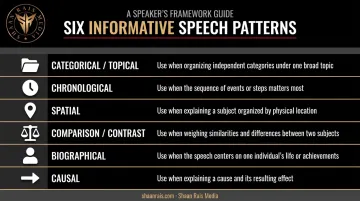
Categorical/Topical Pattern
This pattern divides your subject into natural categories with no built-in sequence: the order is your choice, not the content's requirement.
Example: Explaining "life at a university" by breaking it into dorms, classes, and campus activities. None of those categories has to come before another; you're grouping related ideas, not following time or place.
This is the most flexible pattern available, which is exactly why it's also the most commonly used.
Chronological Pattern
Chronological structure arranges points in time order, either forward or backward. It's the natural fit for historical narratives or step-by-step processes.
Example: Tracing Winston Churchill's writings across different decades of his life, moving chronologically from his early career through his later years.
Use this when your content has a built-in timeline. Forcing chronology onto non-sequential material creates a false sense of progression that confuses more than it clarifies.
Spatial Pattern
Spatial organization moves through physical location, geography, or the parts of an object — wherever "place" is the natural organizing principle.
Example: Describing the Confederate states by geographic region, or walking through the parts of the urinary system from one structure to the next.
This pattern works best when your audience needs to visualize a physical layout or navigate a structure step by step.
Comparison/Contrast Pattern
This pattern highlights similarities and differences between two (or more) subjects, structured either subject-by-subject or point-by-point.
Example: Comparing Drug X to Drug Y across cost, side effects, and efficacy — informing the audience about two competing options without pushing them toward either one.
Biographical Pattern
Biographical structure narrates a person's life or career in stages, almost always chronologically, and works well for tribute speeches or professional profiles.
Example: Walking through distinct phases in a public figure's life and career development.
Reach for this pattern whenever the story of a person's growth, not just their achievements, is the point of the speech.
Causal Pattern
The causal pattern connects cause to effect (or works backward from effect to cause), explaining why something happens rather than just what happened.
Example: Examining the causes and downstream consequences of a specific public health issue within a community.
Quick reference for choosing among these patterns:
- Categorical: subject splits into natural groups with no required order
- Chronological: content has a built-in timeline or sequence of steps
- Spatial: physical layout or location drives the structure
- Comparison/Contrast: two or more options need to be weighed side by side
- Biographical: a person's life or career arc is the core narrative
- Causal: the goal is explaining why something happened, not just what happened
Organizational Patterns for Persuasive Speeches
Persuasive speeches have a different job entirely: moving an audience toward a viewpoint or action. These patterns don't just present information; they build an argument, one step at a time, toward a specific conclusion.
Problem-Solution Pattern
This is the simplest persuasive structure. Establish that a problem exists, then present your solution. Two moves, no detour.
Best for straightforward policy questions, where the audience doesn't need a deep dive into root causes. They just need to see the problem clearly and accept the fix.
Problem-Cause-Solution Pattern
This adds a middle step: after establishing the problem, you analyze why it's happening before proposing your solution.
Example: Rising college tuition (problem) traced to reduced state funding (cause), followed by a proposed policy fix targeting that funding gap.
Best for audiences skeptical of quick fixes, who won't accept a solution until they understand the mechanism behind the problem. Skipping the cause step here often makes the solution feel arbitrary.
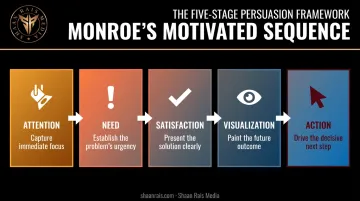
Monroe's Motivated Sequence
Developed by Alan Monroe in the mid-1930s during his time at Purdue, according to Grand Valley State University, this is a five-step psychological progression:
- Attention — hook the audience immediately
- Need — establish why the problem matters to them specifically
- Satisfaction — present your solution
- Visualization — show what life looks like with (or without) the solution
- Action — give a specific, immediate next step
Best for calls to immediate action, such as donation asks, votes, sign-ups, or behavior changes. It's less useful for purely explanatory content, since the "Action" step needs something concrete to point to.
Comparative Advantages Pattern
Use this when your audience already agrees a problem exists but hasn't settled on the best solution. Instead of proving the problem, every main point builds the case for your preferred fix over the alternatives.
Best for audiences past the "is this a problem" stage, where each point should function as a distinct advantage of your proposed solution, not a repeat of the previous point in different words.
Psychological (Causal-Chain) Pattern
Where comparative advantages stack parallel reasons side by side, this pattern links them end to end. Each point flows directly into the next: A leads to B, B leads to C. It's less a formally named textbook pattern and more a description of causal chaining used for persuasive effect, connecting steps so tightly that rejecting the conclusion means rejecting the whole chain.
Best for arguments built on cause and effect, where you want the logic itself to feel undeniable, point by point.
How to Choose the Right Organizational Pattern (and Mistakes to Avoid)
Choosing a pattern isn't about personal preference. It's a decision framework:
- Start with your goal. Are you informing or persuading? That alone eliminates half the options.
- Consider your topic type. Is it historical (chronological), physical (spatial), evaluative (comparison), or explanatory (causal)?
- Factor in audience stance. If they already agree a problem exists, comparative advantages beats problem-solution. If they need convincing the problem exists at all, start there.
Sometimes none of these three steps points to a single clean answer. In that case, patterns can be combined within a single speech. You might use chronological structure for one main point and spatial structure for another, when no single pattern fits the entire topic. Just signal the shift clearly with transitions, or listeners will feel the seams.
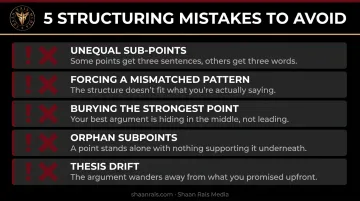
Common Structuring Mistakes
- Unequal sub-points — one main point has five pieces of support, another has none
- Forcing a pattern that doesn't fit — chronology applied to a topic with no real timeline
- Burying your strongest point in the middle — ignoring the primacy/recency effect that makes openings and closings most memorable
- Orphan subpoints — a lone "A" with no "B" to pair it with
- Thesis drift — main points that technically relate to the topic but don't actually advance your specific purpose
Test your outline by asking: could these points be rearranged without losing the logic? If yes, your structure is too loose — you're probably defaulting to topical when the content actually calls for something more specific.
From Organized Speech to a Positioned Speaker
Here's what most speaking advice misses: organization isn't just an academic exercise you forget after the delivery lesson. It's a visibility tool.
How you structure your message shapes how a room — or a market — categorizes your expertise. A founder with deep knowledge who rambles through a keynote reads as less credible than a founder with half the experience who delivers a tight, well-sequenced argument. That's not fair, but it's how perception works.
That perception gap is exactly what Shaan Rais, an Industrial-Organizational Psychologist known as "The King of Branding and Positioning," calls Perception Engineering — the practice of systematically shaping how the market receives, categorizes, and prices a professional's expertise. Structure is one visible piece of that larger picture. A disorganized talk on a stage, podcast, or panel doesn't just confuse an audience; it undersells the very authority the speaker is trying to demonstrate.
Rais has worked with 400+ operators across 50+ industries on this exact problem: translating capability into market visibility. His central argument is direct: you are more valuable than you are visible.
How you organize your message — on stage or anywhere else — is one of the clearest signals the market uses to price your expertise.
Frequently Asked Questions
What are the organizational techniques in public speaking?
The main techniques are categorical/topical, chronological, spatial, comparison/contrast, biographical, and causal for informative speeches. Persuasive speeches add problem-solution, problem-cause-solution, Monroe's Motivated Sequence, and comparative advantages.
What are the 5 C's of public speaking?
There's no single authoritative "5 C's" framework recognized across major speech-communication sources. Versions vary widely depending on the source, so treat any specific list as one interpretation, not an industry standard.
What is the most commonly used organizational pattern?
The categorical/topical pattern is the most common, since it offers flexibility for nearly any topic lacking a natural chronological or spatial order.
Can a speech combine more than one organizational pattern?
Yes. Speakers often blend patterns, using a topical structure for main points while organizing one sub-point chronologically, when a single pattern doesn't fit the entire topic.
What's the difference between informative and persuasive organizational patterns?
Informative patterns (chronological, spatial, topical) prioritize clarity and understanding. Persuasive patterns (problem-solution, Monroe's Motivated Sequence) are built specifically to move an audience toward belief or action.
How do I know which organizational pattern is best for my speech?
Start with your specific purpose statement, then match it to the pattern whose structure naturally fits your content — time-based, location-based, comparative, or argument-based.