Here's the harder truth: many capable professionals feel more skilled than they're recognized or paid for. And undirected effort doesn't close that gap. It just adds hours to it.
This guide gives you 60 ready-to-use professional development goals — 30 short-term, 30 long-term — organized by category. You'll also get a SMART framework to adapt each one to your role and career stage.
Key Takeaways
- Professional development goals are specific, time-bound commitments — not vague aspirations like "get better at leadership"
- Short-term goals (under 12 months) build momentum, while long-term goals (1-5+ years) set overall direction
- Goals written in SMART format stick better when paired with regular feedback and a firm deadline
- Visibility work — making your progress known, not just achieving it — often determines whether a goal translates into recognition
- Limit yourself to 2-3 active goals at a time for stronger follow-through
What Are Professional Development Goals (and Why They Matter)
A professional development goal is a specific skill, credential, relationship, or visibility milestone you commit to building within a set timeframe — with the explicit purpose of advancing your career.
That's different from a to-do list. Tasks are the steps beneath a goal. The goal itself is strategic and outcome-driven.
- Task: "Finish the Q3 report by Friday"
- Goal: "Become the go-to person for financial modeling on my team within six months"
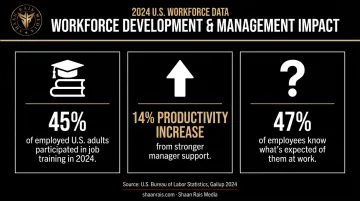
That gap between tasks and goals isn't just semantic — it shows up in the numbers. Only 45% of employed U.S. adults participated in training or education for their current job in 2024, according to Gallup's research on employee development barriers. Gallup also found that stronger manager support for development could lift productivity by 14% and profit by 18%.
Worse, only 47% of employees strongly agree they even know what's expected of them at work. Vague goals compound that confusion. Specific ones cut through it.
30 Short-Term Professional Development Goals Examples (Under 12 Months)
Short-term goals close immediate skill gaps. They also build the track record that makes your long-term goals credible — nobody hands you a director title without evidence you can operate at that level first.
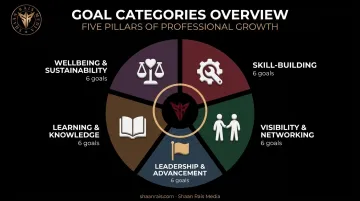
Skill-Building Goals
Start here: closing skill gaps fast creates the proof points every later goal depends on.
- Complete an industry-recognized certification relevant to your role within the next 6 months
- Master one technical tool your team relies on (like SQL, Figma, or a CRM platform) within 90 days
- Strengthen one soft skill — such as conflict resolution — by practicing it in three real workplace situations this quarter
- Improve written communication by drafting and requesting feedback on five key documents over the next 60 days
- Learn one AI or productivity tool and apply it to cut a recurring task's time by 25% within 8 weeks
- Request structured feedback from your manager and two peers, then act on it visibly within 30 days
Visibility & Networking Goals
Skills alone won't get you noticed. These goals put your progress in front of the right people.
- Attend two industry events or conferences within the next 6 months
- Join one professional group or association relevant to your field this quarter
- Refresh your LinkedIn profile with updated accomplishments and a clear positioning statement within 30 days
- Present a project update or key learning at a team meeting within 60 days
- Find and establish a regular check-in with a mentor within 90 days
- Build relationships with two colleagues in different departments over 90 days
Leadership & Advancement Goals
- Lead a team meeting or small project from kickoff to completion within the next quarter
- Document three measurable wins with metrics attached by the end of the next review cycle
- Exceed your assigned KPIs for one full quarter — a track record that speaks louder than any self-review
- Propose a stretch assignment or expanded scope to your manager within 60 days
- Mentor a junior colleague through one specific skill or project over 90 days
- Prepare a documented case for a compensation conversation within the next 6 months
Learning & Knowledge Goals
- Take one relevant course and apply a specific technique from it within 90 days
- Read four industry-relevant books over the next 6 months
- Follow and engage with five expert voices in your field this quarter
- Shadow another department for a half-day to understand cross-functional workflows within 60 days
- Join a mastermind or interest group aligned with your career goals this quarter
- Attend one workshop and implement one takeaway within 30 days of completion
Wellbeing & Sustainability Goals
Development goals only stick if the pace behind them is sustainable.
- Set boundaries that reduce weekly overtime by at least 3 hours within 30 days
- Create a written personal development plan with quarterly milestones this month
- Build a healthier daily routine that includes protected focus time within 60 days
- Improve time management by adopting one system (like time-blocking) for 90 days
- Complete a 30-60-90 day plan for any new responsibility you take on
- Reduce reactive email/Slack checking to three set windows per day within 2 weeks
30 Long-Term Professional Development Goals Examples (1-5+ Years)
Long-term goals define where you're headed, but they only stay realistic when short-term milestones support them. A five-year goal without near-term markers is just a wish with a deadline attached.
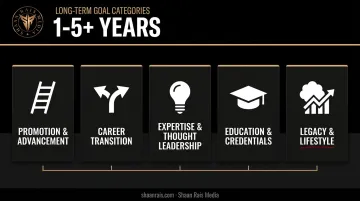
The 30 examples below cover five areas: promotion, career transitions, thought leadership, education, and legacy. Pick the ones that match your trajectory, then work backward to the short-term goals that get you there.
Promotion & Advancement Goals
- Reach senior or lead level in your current function within 2 years
- Become a director or VP within your organization or industry within 4-5 years
- Transition from individual contributor to people manager within 18-24 months
- Reach a C-suite role within 5-7 years through progressive scope expansion
- Secure a specific named promotion within a defined 12-18 month window
- Build a documented leadership track record that supports a title change within 3 years
Career Transition Goals
- Switch functions (e.g., sales to product) within 2 years through internal moves
- Change industries entirely within 3 years while leveraging transferable skills
- Move from operating role into consulting within 2-4 years
- Start an independent business or practice within 3-5 years
- Pursue further education specifically to support a career pivot within 2 years
- Build a portfolio of side projects that validate a new direction before making it full-time
Expertise & Thought Leadership Goals
- Become a recognized subject-matter expert in a defined niche within 3 years
- Publish a book in your field within 4-5 years
- Become a sought-after speaker at industry events within 3 years
- Launch a content platform (newsletter, podcast, or channel) and grow it consistently over 2-3 years
- Build a niche reputation specific enough that people refer work to you by name within 3 years
- Co-author research, a whitepaper, or a major industry report within 2 years
Education & Credential Goals
- Complete an MBA or executive education program within 3 years
- Earn the top-tier certification recognized in your field within 2 years
- Build T-shaped expertise — deep in one area, broad across adjacent ones — over 3-4 years
- Complete a formal leadership development program within 2 years
- Achieve a professional license or advanced credential required for career advancement
- Complete a cross-functional rotation program within 18-24 months
Legacy & Lifestyle Goals
- Build and lead a high-performing team of a defined size within 4 years
- Mentor a set number of professionals (e.g., 10) over the next 5 years
- Achieve financial independence tied to career growth within 5-7 years
- Secure location or schedule flexibility as a permanent condition of your role within 3 years
- Drive one major organizational initiative from concept to measurable impact within 2 years
- Build a body of work significant enough to be recognized as a legacy contribution to your field
How to Turn These Examples Into SMART Professional Development Goals
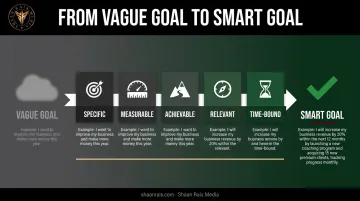
The SMART framework — Specific, Measurable, Achievable, Relevant, Time-bound — turns a vague intention into something you can actually execute against.
Vague: "I want to improve my leadership skills."
SMART: "I will lead one cross-functional project by Q3, gather 360-degree feedback from four teammates, and document two specific leadership improvements by year-end."
The rewrite works because it names the action, the measure, and the deadline. That structure matters: researchers Locke and Latham's decades-long review of goal-setting studies found that specific, challenging goals consistently outperformed vague or absent ones across the vast majority of studies analyzed.
Sequence Your Goals, Don't Isolate Them
Every short-term goal should feed a long-term one. If your long-term goal is "become a director within 4 years," your short-term goals should build the evidence for that:
- Lead a project (builds management reps)
- Exceed KPIs for a quarter (builds performance case)
- Mentor someone junior (builds people-leadership proof)
Limit Yourself to 2-3 Active Goals
Research on goal-shielding shows that commitment to one focal goal suppresses attention to competing ones. Translation: spreading yourself across six goals dilutes all of them. Pick 2-3, and let the rest wait.
Schedule Check-Ins
Gallup's research on performance development found that employees with quarterly progress checks were far more likely to be engaged, and over twice as likely to view their development process as fair. Set:
- Monthly reviews for short-term goals
- Quarterly reviews for long-term direction
Skip this step and even a well-written SMART goal becomes a forgotten note in an old planner.
The Overlooked Goal Category: Positioning and Visibility
Here's what most professional development guides miss: skill-building and credentials alone don't guarantee recognition.
You can be the most capable person in the room and still get passed over, often because your market positioning hasn't caught up to your ability.
Only 22% of employees say they receive the right amount of recognition, according to Gallup and Workhuman's longitudinal research. Well-recognized employees were 45% less likely to leave their jobs within two years.
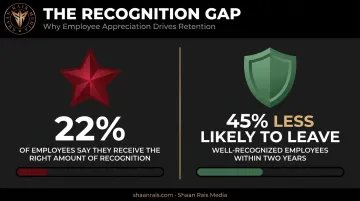
That's not a training gap. It's a visibility gap.
Branding strategist Shaan Rais calls this Perception Engineering : systematically shaping how the market perceives, categorizes, and prices a professional. It's distinct from generic networking or "get on LinkedIn more" advice. It's a deliberate, structured goal category of its own.
Positioning-Focused Goal Examples
- Define a clear professional narrative and niche within 90 days
- Audit and rebuild your external presence, including LinkedIn, bio, and portfolio, within one quarter
- Create one signature piece of content or case study that repositions your value within 90 days
- Identify and build a relationship with one internal sponsor, someone distinct from a mentor, who can advocate for you
Rais, known for his work in personal branding, has applied this approach with operators across dozens of industries, treating positioning as a structured goal rather than an afterthought.
The guiding principle: being more valuable should also mean being more visible. Positioning closes that gap.
Frequently Asked Questions
What are good examples of professional development goals?
Strong short-term examples include earning a certification, finding a mentor, or presenting at a team meeting. Long-term examples include securing a promotion, building recognized expertise, or transitioning industries.
What are the 5 P's of professional growth?
Purpose, Plan, Practice, Performance, and Progression represent the five stages of intentional growth. They move you from knowing your "why" to building measurable, career-advancing momentum.
What is the difference between short-term and long-term professional development goals?
Short-term goals run under 12 months and build immediate momentum, like completing a course or leading a project. Long-term goals span 1-5+ years and set career direction, like reaching a leadership title.
How do I write a SMART professional development goal?
Take a vague goal like "get better at public speaking" and add specifics: "Present at two team meetings and one company-wide event within 6 months." Specificity and a deadline make it actionable.
How many professional development goals should I set at once?
Stick to 2-3 active goals at a time. Spreading focus across too many goals dilutes effort and weakens follow-through on all of them.
What are examples of long-term professional development goals?
Reaching a director or VP title, becoming a recognized subject-matter expert, or transitioning into a new industry within a 3-5 year window are all common long-term examples.