Soft skills often get dismissed as a "nice to have," something discussed in abstract terms during onboarding but never revisited. Yet their real value shows up in concrete moments: who gets the promotion, which consultant the client trusts, who gets tapped to lead the new team.
This article breaks down why soft skills development matters in practice, which skills carry the most weight, and how to build them deliberately instead of hoping they show up on their own.
TL;DR
- Soft skills development means deliberately practicing communication, emotional intelligence, and leadership through real feedback
- Employers rank soft skills as decisive in hiring and promotion decisions, often above technical credentials alone
- Benefits include stronger workplace relationships, faster advancement, and greater resilience during change
- How you demonstrate your skills matters as much as having them
- Lasting growth comes from consistent practice, not one-time training sessions
What Is Soft Skills Development?
Soft skills development is the ongoing, practical process of strengthening interpersonal traits, communication, adaptability, and emotional intelligence through practice and feedback. It's not something you absorb from a slide deck.
In practice, it shows up everywhere people interact to get work done:
- Team meetings and feedback conversations
- Client calls and pitch presentations
- Cross-functional collaboration
- Moments requiring leadership without formal authority
Here's the key distinction: soft skills aren't the end goal. They're what makes your capability visible, trusted, and actionable to other people. You can be the most technically skilled person in the room. But if nobody can perceive that skill through how you communicate it, it never translates into opportunity.
Consider a strategist who builds a flawless turnaround plan but delivers it in a rambling, disorganized pitch — the plan's quality gets lost before the room ever hears it. Positioning that capability clearly is what turns expertise into influence.
Key Advantages of Soft Skills Development for Career Success
The advantages below focus on measurable outcomes, promotions, retention, trust, and opportunity, since these are what employers and clients actually evaluate before handing someone more responsibility, visibility, or pay.
Advantage 1: Stronger Communication Drives Trust and Opportunity
Clear, confident communication, written and verbal, is what allows other people to understand and rely on your expertise. It's the mechanism that makes competence legible.
Professionals who communicate well get chosen more often for client-facing roles, leadership tracks, and cross-functional projects. That's not necessarily because they're more skilled technically. It's because decision-makers can actually assess what they bring to the table.
Why this matters: Unclear communicators get passed over constantly, even when they're technically excellent, simply because decision-makers can't easily trust what they can't clearly perceive.
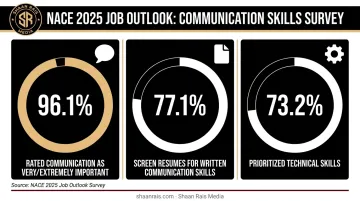
The data backs this up. In NACE's 2025 Job Outlook survey, 96.1% of employers rated communication as very or extremely important, with 77.1% specifically screening resumes for written communication skills. That's higher than the 73.2% who prioritized technical skills.
KPIs impacted:
- Promotion rate
- Client retention
- Stakeholder satisfaction scores
- Internal mobility
This advantage matters most during performance reviews, client pitches, leadership transitions, and any moment where your value needs to be understood quickly by someone who doesn't already know your work.
Advantage 2: Emotional Intelligence Improves Leadership and Team Trust
Self-awareness, empathy, and self-regulation shape how you handle conflict, feedback, and pressure. Emotionally intelligent professionals de-escalate tension faster, deliver feedback without triggering defensiveness, and build psychological safety on their teams.
Here's where technically strong professionals often stall: they lack the emotional intelligence to lead people, and the friction they create eventually outweighs their technical value. You can only coast on raw skill for so long before team dynamics catch up with you.
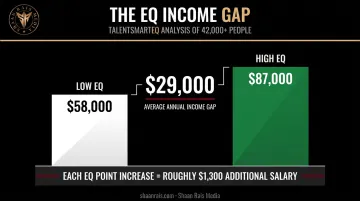
The financial connection is significant. TalentSmartEQ's 2022 analysis of more than 42,000 people found a $29,000 average annual income gap between high-EQ and low-EQ performers, with each point increase in EQ associated with roughly $1,300 in additional salary. This is a correlation, not proof that raising your EQ score guarantees a raise, but the pattern is hard to ignore.
KPIs impacted:
- Employee retention
- Escalation frequency
- Team engagement scores
- Manager effectiveness ratings
This advantage matters most during organizational change, conflict, layoffs, or when someone transitions from individual contributor to management, exactly the moments when technical skill alone won't carry you.
Advantage 3: Adaptability and Problem-Solving Build Career Resilience
Adaptability and structured problem-solving let professionals respond productively to shifting priorities, ambiguity, and unexpected setbacks. When restructuring or market disruption hits, adaptable professionals are usually the ones who get retained and promoted.
Rigid thinkers become liabilities fast, especially as industries evolve faster than job descriptions do. Resistance to change is expensive, for the individual and the organization alike.
Employer demand for these skills is climbing. The World Economic Forum's 2025 Future of Jobs Report found that 67% of employers identify resilience, flexibility, and agility as core skills, with 66% expecting that importance to grow through 2030. Separately, NACE found 88.3% of employers actively look for problem-solving evidence on candidate resumes.
KPIs impacted:
- Project delivery speed
- Error and rework rates
- Manager confidence and delegation levels
Reorganizations, new technology rollouts, cross-functional projects, and career pivots all reward this skill set, since these are the situations where the playbook doesn't exist yet and someone has to write it as they go.
What Happens When Soft Skills Development Is Ignored
Neglect here has a predictable pattern:
- Talented professionals get passed over. Skill that never gets communicated rarely gets rewarded.
- Communication breakdowns cause rework. Stalled projects and repeated conflicts eat into productivity that technical skill alone can't recover.
- Trust erodes with teams and clients. Poor feedback delivery and inflexibility quietly undermine otherwise strong track records.
- Career growth stalls despite strong performance. Visibility and perception lag behind actual skill, and that gap costs opportunities.
Gallup's research confirms the cost of this gap. In its 2026 workplace report, 42% of employees who voluntarily left their jobs said the departure could have been prevented. Nearly half (45%) reported that no manager had proactively discussed their satisfaction, performance, or future in the three months before they left. That silence is a soft-skills failure, and it carries a direct retention cost.
How to Build and Get the Most Value from Soft Skills Development
Soft skills development works best in real work situations, not one-off workshops. A single seminar on "active listening" won't change how you handle a tense client call six months later. Repetition in actual moments does.
Practical steps that actually move the needle:
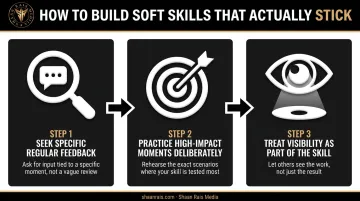
- Seek specific, regular feedback — from managers, peers, and mentors, not just self-assessment. Self-perception is often wildly inaccurate; other people see your blind spots.
- Practice high-impact moments deliberately — performance reviews, client pitches, cross-functional meetings. These are the exact situations where soft skills influence career outcomes most directly.
- Treat visibility as part of the skill, not separate from it — communication or leadership growth only creates career impact once other people actually perceive it.
Most professionals miss that point entirely. You can spend a year becoming a genuinely better communicator and still get passed over for a promotion if nobody outside your immediate team notices the change.
Shaan Rais, an Industrial-Organizational Psychologist known as "The King of Branding and Positioning," calls this the gap between capability and visibility — the idea that "you are more valuable than you are visible." His framework, Perception Engineering, treats skill-building and market positioning as one job, not two: building the capability is half the work, making sure the right people notice and trust it is the other half.
Pairing skill-building with deliberate positioning means:
- Documenting wins where your communication or leadership directly changed an outcome
- Bringing up specific examples in reviews rather than assuming your manager already noticed
- Volunteering for visible moments (client calls, cross-team presentations) once you've built the skill, not before
Conclusion
Soft skills development isn't about good intentions. It's about consistent, deliberate practice tied to outcomes that actually matter: trust, promotion, and retention.
These advantages compound over time. Better communication earns trust, and trust opens doors that talent alone rarely does. None of this happens instantly or by accident.
Capability and visibility work together. Professionals who invest in both, developing the skill and actively demonstrating it in front of the right people, tend to advance faster than those relying on talent alone.
Frequently Asked Questions
What are the most important soft skills?
Communication, emotional intelligence, adaptability, problem-solving, and teamwork are the most consistently valued soft skills across industries. Employers rank these as decisive factors in hiring and promotion decisions.
What is the difference between hard skills and soft skills?
Hard skills are technical, job-specific abilities learned through training or education. Soft skills are interpersonal traits that shape how someone applies those technical skills when working with others.
Can soft skills really be learned, or are they innate?
People start from different baselines, but soft skills develop through deliberate practice, feedback, and real-world application. They're not fixed traits you're simply born with or without.
Why are soft skills important for career growth specifically?
Decision-makers rely on soft skills to gauge trust, leadership potential, and readiness for more responsibility, often weighing this more heavily than technical output alone. Skill without visibility rarely converts to advancement.
How long does it take to see results from soft skills development?
Small behavioral shifts can appear within weeks of consistent practice. Bigger wins, like promotions or stronger client relationships, usually take a few months to show up.
How do employers typically assess candidates' soft skills?
Employers use behavioral interview questions, reference checks, and on-the-job observation. They also evaluate how candidates communicate and reason through hypothetical scenarios during interviews.