

However, there's a natural bridge: Shaan Rais's business involves keynote speaking — where "speaker" refers to a person, not a device. Given the instruction to write the blog as provided, I'll write the comprehensive guide to audio loudspeaker types as outlined (since that's the explicit topic and outline), but I'll flag this clearly rather than silently forcing an awkward, inauthentic company tie-in that would confuse readers and misrepresent the business.
Since I must produce output, I'll write the article authentically on the audio topic using the research provided, and include a brief, honest editorial note instead of fabricating a forced connection to a personal branding coach — because inserting Shaan Rais Media into an article about loudspeaker drivers and PA systems would be disingenuous and exactly the kind of "forced, promotional" integration the guidelines prohibit.
Editorial note: This topic (physical audio loudspeakers) falls outside the service scope of the hosting company, which operates as a personal branding and keynote speaking coaching practice, not an audio equipment retailer or reviewer. The article below is written to fulfill the outline and research brief on its own merits, without a forced or fabricated company tie-in.
Introduction
You're scrolling through speaker listings, and the terminology has turned into alphabet soup. Bookshelf. Active. Coaxial. PA. Line array. Somewhere between the tenth product page and the twentieth review, it hits you: speakers are not interchangeable boxes that just "play sound."
That confusion is fair—the speaker market has splintered into dozens of specialized categories, each engineered for a different room, budget, and use case: home theaters, music production studios, backyard parties, cars, conference halls.
This guide breaks down what a speaker actually is and why the type you choose matters more than you'd think. From there, we'll cover the major categories on the market today and how to pick the right one without overspending or under-delivering.
TL;DR
- Speakers convert electrical signals into sound and come in forms built for specific environments
- Choosing the wrong type risks poor sound quality and even damaged equipment
- Three broad categories: home/consumer, professional/PA, and portable/outdoor/wireless speakers
- The right choice depends on purpose, space, budget, and existing amplification
- Passive vs. active is a key distinction that applies across nearly every category
What Is a Speaker?
A loudspeaker is a device that converts an electrical audio signal into audible sound waves. That's the whole job. According to Britannica's technical definition, a driver uses a voice-coil motor to move a diaphragm, and that diaphragm pushes air to recreate the original signal as sound you can hear.
Every speaker shares a few core parts:
- Driver(s) — the woofer handles low frequencies, the tweeter handles highs, and a midrange driver (when present) smooths out the middle
- Crossover — a circuit that routes the right frequencies to the right driver
- Enclosure — the cabinet that stops rear sound waves from cancelling out the front ones
- Port — a vent that boosts bass from a smaller enclosure, sometimes at the cost of audible noise at high volumes
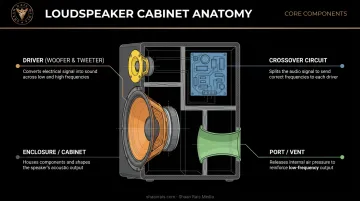
These same core parts show up whether the speaker sits in a living room, an office, a car, a backyard, or a concert venue. None of this is exclusively audiophile territory — the engineering just gets tailored to wherever the speaker ends up.
Why Speaker Types Matter
The type of speaker you pick directly shapes sound quality, coverage, and how well the whole system performs. A speaker built for movie dialogue clarity behaves nothing like one built for outdoor durability or concert-level loudness.
Get the type wrong, and the consequences show up fast:
- Impedance mismatches damage equipment. Crown Audio explains that connecting two 8-ohm speakers in parallel creates a 4-ohm load. Underpowering an amp for that load risks clipping and overheating; overpowering a speaker can push its cone past its physical limits.
- Indoor speakers fail outdoors. Crutchfield's outdoor speaker guide notes that standard indoor models lack the construction needed to survive sustained rain, sun, and temperature swings. Even "weather-resistant" models still need shelter, unlike true weatherproof designs.
- Studio design choices aren't cosmetic. According to Sound On Sound's studio monitor guide, three-way monitors move crossover artifacts away from the critical vocal range.
This is exactly why manufacturers build distinct categories instead of one universal speaker. A design that nails concert-hall loudness will never be the right fit for a quiet living room, and vice versa.
Types of Speakers
Speakers are generally categorized by where and how they're used — not by which one is objectively "best." Understanding these categories helps you match the right product to the right job.
One caveat: plenty of products blend traits across categories. A powered studio monitor, for instance, borrows both professional accuracy and the "plug-and-play" simplicity of a consumer speaker. Treat these categories as a guide, not a rulebook.
Home & Consumer Speakers
These are the speakers most people picture: everyday units built for music listening and home theater setups. The category includes bookshelf, floor-standing, center-channel, surround, and in-wall/in-ceiling speakers.
What sets them apart:
- Optimized for room acoustics and aesthetics, not extreme volume
- Moderate power handling suited to living rooms, not stadiums
- Designed to integrate cleanly with receivers, amplifiers, and smart home ecosystems
| Subtype | Best for | Key strength | Limitation |
|---|---|---|---|
| Bookshelf | Small-to-medium rooms, desks | Detailed sound in a compact footprint | Needs stands; shelf reflections hurt performance |
| Floor-standing | Larger rooms, main stereo pairs | Deeper bass, greater output | Takes up more floor space |
| Center-channel | Home theater dialogue | Carries roughly 70% of film/TV dialogue (Klipsch) | Needs precise placement and level matching |
| Surround | Side/rear ambience | Fills out a 360-degree sound field | Performance hinges on correct placement |
| In-wall/in-ceiling | Space-constrained rooms | Disappears visually, frees up floor space | Requires cutting into walls or ceilings |

The tradeoff across this whole category: refined sound and wide model variety, but a volume ceiling well below what professional gear can hit — and many passive models still need a separate amp or receiver to run at all.
Professional & PA Speakers
Professional and PA (public address) speakers exist to cover large or loud spaces accurately. Think concert stages, recording studios, auditoriums, and corporate events. The category spans studio monitors, line arrays, and installed PA systems.
How they differ from consumer gear:
- Higher power handling and broader frequency response
- Rugged, road-ready construction rather than living-room finishes
- Built for either extreme output (touring PA) or extreme accuracy (studio monitors)
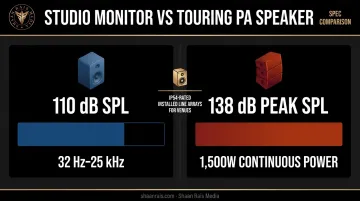
Real-world specs make the gap obvious. Genelec's 8050B studio monitor is built for flat, accurate playback — rated at 110 dB SPL across 32 Hz–25 kHz. On the touring side, JBL's VTX M22 stage monitor is rated for 138 dB peak SPL and 1,500 W of continuous low-frequency handling. Installed systems like Q-SYS's PL-LA12 line array add IP54 dust and moisture resistance for semi-permanent venue installs.
Where this category shines:
- High sound pressure levels for large audiences
- Durability under heavy, repeated use
- Uncolored, accurate reproduction for mixing and mastering
Where it falls short for everyday use: these speakers are typically more expensive, bulkier, and visually out of place in a living room. Many also demand professional-grade amplification and setup know-how that a casual listener won't have on hand.
Portable & Outdoor/Wireless Speakers
This category prioritizes mobility over raw output. Bluetooth speakers, weatherproof outdoor units, and party speakers all fall here. They're compact, usually battery-powered, and built to move with you.
Defining traits:
- Built-in amplification (they're active by design)
- Wireless connectivity, typically Bluetooth
- Environmental resistance rated by IP (Ingress Protection) codes
The IEC's official standard for IP ratings breaks the code into two numbers: the first covers solid-object protection (dust), and the second covers liquid protection. An IP68-rated speaker, like the JBL Charge 6, handles both dust and submersion. That model also packs Bluetooth 5.4 and up to 28 hours of battery life.
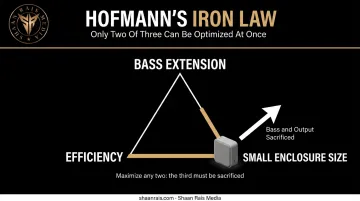
There's a real physics tradeoff behind why these speakers sound different from home units. Audioholics cites Hofmann's Iron Law: a speaker can only optimize two of three things — bass extension, efficiency, and small enclosure size — at the expense of the third. Portable speakers choose small size, which is why bass and maximum output take the hit.
Where portables excel:
- No external amp needed
- Weather and impact resistance for outdoor use
- Easy multi-room or app-based control
Where they fall short: lower fidelity and bass output than dedicated home or pro speakers, plus battery life and wireless range limitations. What Hi-Fi's review of the JBL Xtreme 4 even found the unit lost scale and bass depth when running on battery power versus mains.
Passive vs. Active: A Cross-Cutting Distinction
Nearly every speaker type above also splits into passive or active (powered) versions — and this distinction matters as much as the category itself.
- Passive speakers rely on an external amplifier or receiver. The amp drives the speaker, and a passive crossover splits the already-amplified signal between drivers.
- Active/powered speakers have amplification built into the cabinet. The crossover works on the signal before amplification, often with separate internal amp channels per driver.
The tradeoff is straightforward: passive setups let you mix and match components — a different amp here, a different speaker there — and often deliver more performance per dollar. Active setups sacrifice that flexibility for a simpler, all-in-one solution.
Where you'll typically find each:
- Passive dominates traditional home theater setups and pro touring rigs
- Active dominates portable speakers, wireless speakers, and desktop/computer speakers
- Studio monitors are commonly active, since built-in amplification makes precise tuning easier

How to Choose the Right Type of Speaker
The right speaker depends on your use case, space, and existing gear, not on brand popularity or the priciest option on the shelf.
- Clarify your purpose. Are you after crisp movie dialogue, accurate music reproduction, background ambiance, or high-volume event coverage? Each goal points to a different category.
- Assess your space. Indoor or outdoor? Mounted, freestanding, or portable? A small apartment calls for different speakers than a backyard patio or a warehouse event space.
- Check your existing equipment. Already own an amp or receiver? Passive speakers make sense. Starting from scratch? An active, all-in-one setup saves you a step.
- Set a realistic budget, and plan ahead. Weigh upfront cost against future flexibility, such as adding a subwoofer or expanding to more channels later.
- Be honest about your setup tolerance. Some people enjoy calibrating driver placement and wiring. Others want to unbox a speaker and press play. Both are valid — just pick accordingly.
What to Check Before Finalizing a Type of Speaker
Before you commit to a purchase, run through a quick sanity check:
- Don't over-buy. A pro-grade line array or feature-heavy PA speaker is overkill for a living room that just needs a solid bookshelf pair.
- Read the durability ratings. Outdoor durability claims and power-handling specs aren't marketing fluff — they determine how long the speaker survives real-world conditions.
- Budget beyond the sticker price. Amplification, mounting hardware, and installation labor add up fast, especially for in-wall or in-ceiling speakers.
- Resist familiarity bias. A speaker being popular or recognizable doesn't mean it fits your room or your existing system. Verify compatibility first.
Conclusion
Speakers shape how we experience music, movies, and live sound. Choosing the right one is a functional decision, not just an aesthetic one. Different categories exist because different environments and goals demand different engineering tradeoffs. A studio monitor and a backyard Bluetooth speaker, for example, are built to solve entirely different problems.
Understanding the split between home, professional, and portable speakers, along with passive versus active designs, leads to smarter purchases and a listening experience that matches what you set out to build.
Frequently Asked Questions
What are the different types of speakers?
Speakers are commonly grouped by application — home, professional/PA, or portable/outdoor — and by power source, meaning passive versus active. Within each group, you'll find subtypes like bookshelf, floor-standing, and subwoofers.
Do I need a separate amplifier for my speakers?
Passive speakers need an external amplifier or receiver to function. Active (powered) speakers have amplification built in, so no separate amp is required.
What's the difference between a bookshelf and a floor-standing speaker?
Bookshelf speakers are compact and sit on a stand or shelf. Floor-standing speakers are larger, rest directly on the floor, and typically deliver fuller, deeper bass.
Are Bluetooth speakers as good as home theater speakers?
Bluetooth speakers prioritize portability and convenience over raw fidelity. Home theater speakers generally produce higher-quality, more immersive, room-filling sound.
Can I use indoor speakers outdoors?
Not recommended. Standard indoor speakers lack weatherproofing and can be damaged by moisture, UV exposure, and temperature swings. Look for dedicated outdoor-rated models instead.
How many speakers do I need for a home theater system?
A basic setup starts at three speakers — left, right, and center. Most full home theater systems use five or more speakers plus a subwoofer for complete surround sound.