That's the strange power of a coach's speech. A few minutes of words, and belief shows up where fear used to live.
Great motivational speeches don't stay in sports. They've shaped Super Bowl runs, Olympic upsets, and some of Hollywood's most quoted scenes. Below, we break down the greatest motivational coach speeches ever delivered, real and cinematic, the psychology that makes them work, and how the same principles apply to your career.
Key Takeaways
- Herb Brooks' 1980 "Miracle on Ice" speech ranks as the single greatest motivational speech in sports history
- The list spans real legends (Brooks, Vince Lombardi, Ray Lewis) and iconic film moments (Rudy, Hoosiers, Any Given Sunday)
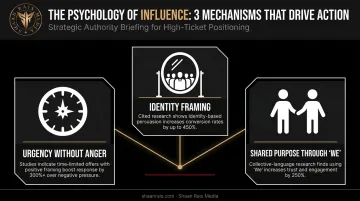
- Great speeches share three triggers: identity framing, urgency, and shared purpose
- Those same triggers shape how top professionals build authority and command influence in their careers
- Applying them deliberately turns raw motivation into lasting personal brand equity
What Makes a Coach's Speech Truly Legendary
A motivational coach speech is a concentrated moment of leadership. It's designed to shift belief, urgency, or identity right before a defining moment. Nothing more complicated than that.
The format's roots trace back to Knute Rockne's Notre Dame teams in the 1920s, whose halftime talks became newsreel material. The surviving 1928 recreation shows Rockne's escalating rhythm: "We're going inside 'em. We're going outside 'em... go, go, go, go!"
That footage is a staged recreation, not a real locker-room recording. Even the earliest examples blur fact and performance.
That blur is part of why these moments last. Sports fans and non-fans alike return to them, not for the final score, but for the feeling right before it. Below, we rank the most iconic examples across real footage and scripted film, chosen for cultural staying power, quotability, and cross-generational relevance.
The Greatest Motivational Coach Speeches of All Time
We ranked these on four criteria: cultural staying power, direct impact on the game or season, iconic quotes, and relevance across generations. Some are verified history. Some are Hollywood. All of them get repeated decades later.
Herb Brooks — "Miracle on Ice" (1980 U.S. Olympic Hockey Team)
A team of college kids faced the four-time defending Olympic champion Soviet squad, a team that hadn't lost an Olympic hockey game since 1968. The U.S. won 4-3 on February 22, 1980, then beat Finland for gold two days later.
The most quoted version of this speech, "Great moments are born from great opportunity," comes from the 2004 film Miracle. Player Jack O'Callahan later confirmed the movie speech was based on his memories of the real talk, but wasn't word-for-word. It's reconstructed dialogue, not a verbatim transcript.
Ranked or not the exact words, why it still lands:
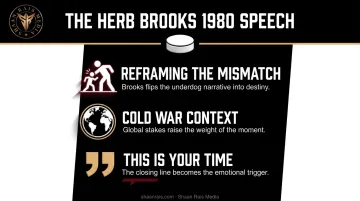
- It reframed an impossible mismatch as a singular, earned opportunity
- Cold War tension from the Soviet invasion of Afghanistan and the Iran hostage crisis gave the win weight far beyond the rink
- The closing line, "This is your time," is now shorthand for any underdog moment
Vince Lombardi — Pregame Speech Before Super Bowl II
By this point Lombardi already had five NFL titles and a 105-35-6 career record. He didn't need theatrics. Packers history describes his method as drilling the same plays "over and over and over," most famously the power sweep.
No verified transcript of his Super Bowl II pregame talk exists. Widely circulated versions online (like "Excellence") aren't authenticated. What's documented is his coaching philosophy: fundamentals, repetition, and preparation that made any pregame words credible because the team had already earned the right to believe them.
Jim Valvano — 1993 ESPY Awards Speech
Valvano gave this speech while dying of cancer, at the inaugural ESPYs on March 4, 1993. His words, "Don't give up, don't ever give up," became a rallying cry that outlived him.
He didn't stop at emotion. He announced the V Foundation for cancer research during the same address. By 2023, that foundation had awarded more than $353 million in grants, including nearly $43 million to 73 research teams that year alone. Few motivational moments in any field convert raw vulnerability into a functioning institution decades later.
Ray Lewis — Locker Room Talks (Stanford Basketball & NFL)
Lewis is an NFL Hall of Famer, but some of his most quoted speeches happened outside football entirely. On March 27, 2012, Stanford's staff brought him in to fire up their men's basketball team before an NIT semifinal. Stanford won 74-64.
His line has become a standalone quote: "I'm pissed off for greatness. Because if you ain't pissed off for greatness, that means you're OK with being mediocre." He paired that intensity with a controllable standard: "Effort is between you and you."
Not every legendary speech comes from a real locker room. Some of the most quoted lines were scripted for the screen — and still shape how coaches talk today.
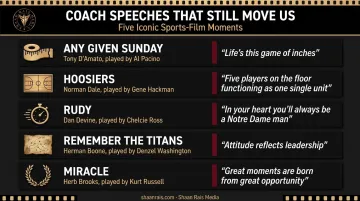
Tony D'Amato (Al Pacino) — "Any Given Sunday"
Context: a fictional, aging coach rallying a collapsing team mid-season. Why it's iconic: the "inches" monologue is one of the most quoted motivational speeches in any genre, sports or otherwise.
"Life's a game of inches. So is football."
The Ringer has called it over-the-top but effective, and arguably the best sports-movie speech ever written. It's pure fiction (the team and story are invented), but the mechanism, reducing an entire season to a single controllable variable, still gets borrowed in business pitches today.
Norman Dale (Gene Hackman) — "Hoosiers"
A small-town Indiana team reaches the state championship, playing in an arena far bigger than anything they've seen. Instead of hyping the moment, Coach Dale shrinks it:
"It's the exact same measurements as our gym back in Hickory."
That's the whole trick. He redefines winning around effort and preparation rather than the scoreboard or the size of the room. The real story (Milan High's 1954 title run) was heavily fictionalized, but the coaching lesson wasn't.
Coach Devine — "Rudy"
Context: a short, understated pregame speech defending the team's pride before the final home game. No verified transcript of an exact line exists, but the scene endures for one reason: it's brief. Where Pacino monologues for minutes, Devine says almost nothing, and it still lands. Brevity can carry as much weight as a lengthy tirade.
Herman Boone (Denzel Washington) — "Remember the Titans"
A newly integrated football team stands on the actual Gettysburg battlefield. Boone uses the setting directly:
"This is Gettysburg."
He turns a history lesson into a leadership tool, tying racial tension on the team to unity forged under far higher stakes. The 1971 T.C. Williams team was real; the dialogue and dramatic details were not, according to ESPN's reporting on the film.
Real Coach Speeches vs. Movie Speeches: What's the Difference
Real speeches are rawer and shorter. They're driven by adrenaline and immediate stakes, not a three-act arc. Movie speeches are engineered for maximum emotional payoff, complete with music cues and callbacks planted earlier in the script.
A few things separate the two categories:
- Real talks are contingent: they depend on what the team already knows and has drilled, not a clean narrative
- Movie talks compress an entire arc, packing confession, metaphor, shared identity, and command into two minutes
- The lines blur in memory — many "real" sports speeches (Brooks' included) were later recreated in film, and pop culture now remembers the movie version as history
That's not a problem so much as a lesson in positioning: the version that gets remembered is usually the one built with the most deliberate craft, not just the one that happened first. Credit the screenwriter along with the coach when quoting these lines.
The Psychology Behind Why These Speeches Work
These speeches aren't just good writing. They're built on three psychological mechanisms that show up in peer-reviewed research on leadership and team behavior.
The three mechanisms show up again and again:
- Identity framing. Coaches redefine who the team is in that moment rather than just asking for effort. Brooks didn't say "try harder." He said, in effect, we are the team built for this. A study of 81 work teams found that identity leadership predicted performance through group-based pride.
- Urgency without anger. Phrases like "not tonight" or "this is your time" spike focus by framing the moment as unrepeatable, but intensity has a ceiling. Two field studies found that coaches' happiness, not anger, predicted objective team performance. Ray Lewis's fire works because it's paired with personal accountability, not because yelling alone helps.
- Shared purpose through "we." A study of 126 professionals across 26 medical teams found that first-person-plural language promoted voice and cohesion by highlighting shared identity. The effect held especially when the pronoun came paired with explicit inclusion, not on its own.
The Perception Shift
Here's the part that matters beyond sports. A coach's words don't change a player's actual skill in the five minutes before the game. What changes is how the room perceives that player, and how the player perceives themselves.
That's the same gap industrial-organizational psychologists study in professional branding, often called perception engineering. Being talented and being perceived as talented are two different problems, and most careers stall on the second one, not the first.
How to Apply These Coaching Lessons to Your Own Career
You don't need a locker room to use this. The same tactics show up in meetings, pitches, and how you introduce yourself professionally.
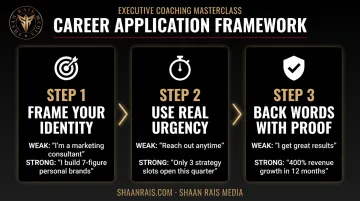
- Frame your identity, not just your effort. Instead of "I'm hoping to land this account," try "I'm the person who solves this exact problem." Coaches redefine identity before kickoff — do the same before your pitch.
- Use real urgency, not vague encouragement. "Let's try to hit our numbers" motivates no one. "This is the specific opportunity in front of us right now" does. Clear stakes beat generic cheerleading every time.
- Back your words with proof. Lombardi's pregame talk worked because his team had drilled the power sweep hundreds of times before he ever opened his mouth. A speech only carries weight if the credibility was built beforehand.
Building that credibility before you speak is where most professionals stall out. Talent alone doesn't guarantee the right perception — the market often overlooks skilled operators simply because their positioning hasn't caught up with their capability.
Shaan Rais, an industrial-organizational psychologist who has coached 400+ operators across 50+ industries, built his entire practice around closing that gap. He calls it "Perception Engineering": systematically shaping how the market perceives, categorizes, and prices you before you ever open your mouth in a pitch meeting.
Coaches call it a pep talk. In business, it's the groundwork that makes the pep talk believable. Professionals serious about building that kind of authority use structured positioning systems instead of leaning on hype alone.
Frequently Asked Questions
What is a speech coach?
A speech coach helps individuals improve public speaking, delivery, tone, and confidence, covering everything from organization to rehearsal. It's distinct from a sports coach's motivational talk, though both rely on similar communication psychology.
How do you express gratitude to a coach?
Keep it simple and specific: a handwritten note, a public acknowledgment, or naming exactly how their words or guidance changed a moment or your mindset. Specificity matters more than length.
What is considered the greatest motivational speech in sports history?
Herb Brooks' 1980 "Miracle on Ice" speech is most frequently ranked as the greatest, based on its cultural and historical impact, even though the most famous version of the wording comes from the 2004 film.
Are movie coach speeches based on real events?
Many are inspired by true stories, including Rudy, Miracle, and Remember the Titans, though the actual dialogue is typically dramatized for cinematic effect rather than transcribed from real events.
Why do motivational speeches work even outside of sports?
The same triggers, such as identity, urgency, and shared purpose, apply to any high-stakes moment, whether that's a business pitch, a career pivot, or a personal challenge.
Can these speech techniques help in professional or business settings?
Yes. Framing, timing, and consistency of message matter just as much in leadership and branding contexts as they do in locker rooms. Executives who master this often see it reflected directly in how the market prices and perceives them.