Marketers who treat awareness as one metric usually waste budget chasing the wrong goal at the wrong stage. A startup obsessing over "top-of-mind status" before anyone recognizes their logo is solving the wrong problem entirely.
Understanding these different types matters because each one requires a different strategy, budget, and timeline. This article breaks down the four core types of brand awareness, how they're measured, and how to figure out which one actually deserves your attention right now.
Key Takeaways
- Brand awareness splits into four types: recall, recognition, top-of-mind, and dominance
- Recall (unaided) and recognition (aided) are the two foundational measurement categories
- Top-of-mind and dominance sit at higher intensity levels, harder to reach and more competitive
- Your priority type depends on business stage and how buyers shop your category
- Each type requires its own survey method, since no single metric captures all forms of awareness
What Is Brand Awareness?
Brand awareness is the degree to which consumers can identify, recall, or associate a brand with a specific product category. The American Marketing Association defines it as the extent to which customers can recognize and remember a brand and connect it to its products or services.
It's the entry point to the entire purchase funnel. No one considers or buys from a brand they don't know exists — awareness has to come first, before consideration, before purchase, before loyalty.
This isn't some abstract branding concept, either. It's measurable:
- Surveys (aided and unaided recall tests)
- Search volume data (share of search within your category)
- Social mentions (volume and sentiment of online conversation)
Treat it as a tracked asset, not an afterthought.
Why Is Brand Awareness Important?
Nielsen's research across its client base found that a 1-point gain in awareness and consideration corresponds, on average, to a 1% increase in sales (Nielsen, 2021). That's a benchmark worth noting, not proof that awareness alone causes sales. Awareness and consideration still work together, not independently.
Here's what happens without it. A genuinely superior product gets passed over, simply because the buyer never thought to consider it. This shows up in a few common places:
- At the shelf: a competitor's product gets grabbed first, purely out of familiarity
- In search results: buyers click the name they recognize, not the best-reviewed option
- In the sales call: prospects "already know" a competitor before you get a chance to pitch
When you're invisible in a category, you're forced to compete on price instead of value. Price becomes the only lever a low-awareness brand has left to get noticed.
The same problem plays out at the individual level. A highly capable executive, consultant, or founder can be excellent at what they do and still get passed over — not because a competitor is more skilled, but because that competitor is simply easier to find, recognize, or recall when the opportunity comes up.
Addressing that gap is the core focus of Shaan Rais's Perception Engineering approach. Rais, an Industrial-Organizational Psychologist known as "The King of Branding and Positioning," calls this gap the Talent Tax: the space between someone's actual capability and how the market currently perceives and prices them. His view is blunt: most professionals don't have a marketing problem. They have a positioning problem. Posting more content or spending more on ads treats a symptom; it doesn't close the gap between capability and visibility.
Types of Brand Awareness
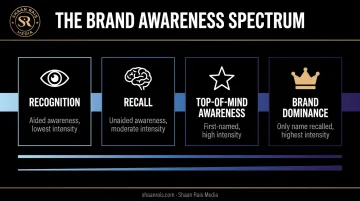
Brand awareness isn't one-size-fits-all. It exists on a spectrum, from faint recognition all the way to total category ownership. Different marketing goals call for different types — and in practice, brands measure several of these together to get a full picture of brand health, rather than picking just one.
Brand Recall (Unaided Awareness)
Brand recall is a consumer's ability to name your brand from memory when given only a product category, with no logo, name prompt, or cue involved.
It's tested through unaided (spontaneous) recall surveys. Researchers ask something like: "What brands come to mind when you think of running shoes?" Whatever gets named without any prompt counts as recall (Ipsos Encyclopedia).
How it's different: Recall demands active memory retrieval, not just recognition. That makes it a much stronger signal of brand strength than simply being recognizable.
Best suited for:
- High-involvement purchase categories (cars, financial services, B2B software)
- Frequently purchased goods where habitual brand association builds over time
- Brands trying to break into a consumer's consideration set
Strengths: Recall strongly predicts whether you'll be included when someone is actually shopping. It signals a deep, established brand-category link.
Limitations: It's slow and expensive to build. You'll often see the claim that consumers only recall "3 to 7 brands" per category — treat that as a repeated industry heuristic, not a verified fact. Research on consideration sets varies significantly by category, with some studies showing consumers naming 8-9 brands in certain product types (Columbia Business School research). Either way, competition for a recall slot is fierce.
Brand Recognition (Aided Awareness)
Brand recognition is a consumer's ability to confirm they've seen or heard of your brand once they're given a cue, such as a name, logo, or package design.
It's tested with aided surveys: show a list of brand names or logos and ask, "Which of these have you heard of?" Because the prompt supplies the memory cue, this measures recognition, not spontaneous retrieval (Ipsos Encyclopedia).
How it's different: Recognition leans on visual or verbal cues instead of unprompted memory. That structural difference makes it easier to achieve than recall.
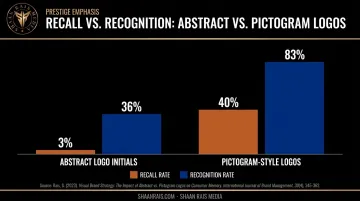
A 2023 study in the Journal of Business Research tested this directly. Across 841 respondents, abstract logo initials produced just 3% recall but 36% recognition. Pictogram-style logos performed even better, at 40% recall versus 83% recognition (Journal of Business Research, 2023). The gap between "remembering unprompted" and "recognizing when shown" is significant.
Best suited for:
- Newer or smaller brands still building basic familiarity
- Low-involvement or infrequently purchased categories (household goods, snacks)
Strengths: Visual branding elements, including logos, color palettes, packaging, and jingles, build recognition faster than they build recall. It's a realistic early-stage goal.
Limitations: Being recognized doesn't mean being chosen. A shopper can nod at your logo and still buy the competitor they actually recalled unprompted.
Top-of-Mind Awareness
Top-of-mind awareness (TOMA) is the single brand a consumer names first, unprompted, when asked about a category. It's not a separate survey question; it's simply the first-mentioned response within an unaided recall test (Ipsos Encyclopedia).
How it's different: TOMA is the leading result within brand recall. You're not just remembered; you're remembered first, ahead of every competitor in that consumer's head.
Best suited for: Low-involvement or impulse-purchase categories, where shoppers default to whatever brand pops into their head first rather than comparing options.
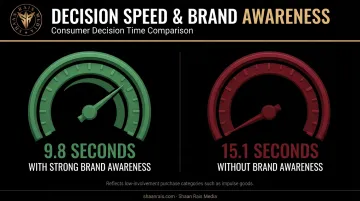
Strengths: Being first-to-mind correlates with real purchase behavior, especially when paired with positive brand associations. A related study using orange cordial as a test category found that consumers with strong brand awareness made purchase decisions in 9.8 seconds versus 15.1 seconds for consumers without that awareness (Macdonald and Sharp study). Awareness clearly speeds up low-involvement decisions.
Limitations: Only one brand can occupy this position per person, per category, at any given time. That makes it brutally competitive and expensive to maintain, since a competitor's campaign can knock you out of that slot.
Brand Dominance
Brand dominance is the point where a consumer can name only one brand in a category. Your brand has become a household name with essentially no unaided competition in that person's mind.
The most extreme version of this is the "going generic" phenomenon, where a brand name effectively replaces the category name in everyday language. People say "Google it" instead of "search the internet." That said, colloquial generic use isn't the same as legal genericide.
A necessary correction here: Google was actually ruled not generic by the Ninth Circuit in 2017. The court found that verb usage alone ("to google something") didn't prove the public saw GOOGLE as a generic term for search engines rather than the brand itself (Elliott v. Google, Inc., 2017). Xerox is another commonly cited example, but INTA presents it as a brand that successfully defended itself against genericide through active trademark enforcement and public education, not one that lost its mark (INTA Best Practices).
True legal genericide is rarer than the popular examples suggest. Historical cases include marks like Aspirin, Cellophane, and Thermos.
How it's different: This is the most saturated form of awareness, moving beyond being first-to-mind into being the only name that comes up at all.
Best suited for: Established market leaders with long histories of heavy advertising or first-mover advantage in their category.
Strengths: Near-automatic inclusion in every purchase decision within the category, with minimal ongoing effort required to stay top-of-mind.
Limitations: The genericide risk is real, even if it rarely results in losing legal trademark protection. When a name gets used generically, competitors can get substituted in. A shopper asking for "a Kleenex" might grab whatever tissue brand is actually on the shelf.
How to Choose the Right Type of Brand Awareness to Prioritize
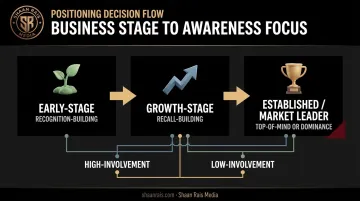
The right type to focus on depends on your business stage, your category's dynamics, and how people actually shop for what you sell. It's not about chasing whichever metric sounds most impressive in a board meeting.
Consider these factors:
- Business maturity: Early-stage brands should build recognition before chasing recall or top-of-mind status.
- Category purchase behavior: High-involvement categories, like enterprise software or luxury goods, reward recall-building, while low-involvement, impulse categories reward visual recognition and top-of-mind tactics.
- Budget reality: Recognition can be built affordably through consistent visual identity, while recall and top-of-mind status demand sustained, higher-frequency campaigns over a longer runway.
Kantar's research draws a useful related distinction here: awareness measures which brands come to mind generally, while salience measures which brand comes to mind quickly, in an actual buying situation. Salient brands get chosen now; brands with strong "meaningful difference" tend to grow more over time (Kantar). Both matter, but they answer different questions.
Two mistakes to avoid:
- Chasing dominance too early. Trying to become a household name before you've built basic recognition wastes time and money. It also ignores the going-generic risk once you do get there.
- Measuring only one type and calling it "brand health." If you only track recognition, you're blind to whether people actually recall you unprompted or default to a competitor first.
The same principle applies whether you're building a company's brand or your own. Shaan Rais's Perception Engineering approach treats visibility as a set of distinct stages, not a single finish line, and starts by diagnosing exactly where an operator's current reputation falls short of their actual capability. From there, the work focuses on closing that specific gap rather than adding more content for its own sake.
Conclusion
Brand awareness isn't a single score to chase. It breaks down into distinct types, recall, recognition, top-of-mind, and dominance, each reflecting a different depth of consumer familiarity and each requiring its own strategy to build.
Knowing which type actually matters for your business right now (or, for individual professionals, for your own personal brand) leads to sharper decisions and better-spent budget than chasing the most impressive-sounding metric.
Diagnosing that gap is exactly what Shaan Rais's Perception Engineering methodology is built for. It gives operators and experts a way to see, and close, the distance between how capable they are and how visible they currently are in the market's mind.
Frequently Asked Questions
What are the 5 levels of awareness in marketing?
This usually refers to Eugene Schwartz's customer awareness levels from Breakthrough Advertising (1966): unaware, problem-aware, solution-aware, product-aware, and most aware. It's a copywriting framework about buyer psychology, distinct from brand awareness types, though the two are often confused.
What are the 4 types of branding?
Common informal categories include product branding, personal branding, corporate branding, and service branding. No single authoritative source treats these four as an official canon, but each does apply brand awareness principles differently depending on what's being branded.
What are the 5 C's of branding?
No single canonical version exists; marketing sources list competing sets. Common versions include Clarity, Consistency, Constancy, Character, and Community. The American Marketing Association's personal-branding framework, however, uses just three: Communication, Competencies, and Character.
What is the difference between brand awareness and brand recognition?
Brand recognition is one specific type of brand awareness, the aided, cue-based version. Brand awareness is the umbrella term covering recall, recognition, top-of-mind status, and dominance together.
How do you measure brand awareness?
Three main approaches: surveys (aided and unaided recall tests), search volume data (share of search within your category), and social listening (mention volume and sentiment). Most brands combine at least two of these for an accurate picture.
Which type of brand awareness is most important?
It depends on your business goals and stage. That said, recall and top-of-mind awareness generally show the strongest link to actual purchase decisions, since both reflect whether you're actually considered at the moment someone's ready to buy.