
Many people confuse "professional development" with "continuing professional development," treating them as interchangeable. They're not. This post breaks down what CPD actually means, why it matters, what it looks like in practice, and how to build a plan without overcomplicating it.
For licensed professionals — doctors, lawyers, accountants, teachers — CPD isn't a nice-to-have. It's the price of keeping your license active.
Key Takeaways
- CPD is an ongoing, structured process — usually documented — not a single course or workshop
- Organizations with strong development programs report meaningfully higher confidence in attracting and retaining talent, according to workplace learning research
- Requirements vary wildly by profession, state, and licensing body — there's no universal hour count
- Skill-building matters, but market positioning determines whether that skill actually gets noticed
What Is Continuing Professional Development (CPD)?
CPD is the ongoing, structured process of maintaining and documenting the skills, knowledge, and competencies you need to stay effective — and compliant — in your profession.
The Chartered Institute of Personnel and Development (CIPD) defines it as learning experiences that help you develop and improve your professional practice, including both strengthening existing abilities and closing capability gaps. Professional bodies across industries draw a sharper boundary: CPD sits outside undergraduate education and postgraduate training. It's what happens after you're already qualified and licensed to practice.
That distinction matters. General "professional development" can mean any learning experience, formal or informal, at any career stage. CPD specifically refers to the continuous, career-long process — often cyclical, often tracked through points or hours, and frequently tied to maintaining a credential.
Licensing boards and regulators — from state bar associations to the UK's Health and Care Professions Council — reinforce this: CPD requires a continuous, up-to-date record and evidence that the learning actually improves practice. It's not passive; you're expected to show your work.
Many professional bodies formalize this through CPD cycles — recurring periods (annual, biennial, or longer) during which you accumulate a set number of hours or points. Miss the cycle, and depending on your profession, you could lose your ability to practice.
Formal vs. Informal CPD
CPD splits into two broad categories:
- Formal CPD: Accredited courses, certification exams, licensing renewals, structured employer training
- Informal CPD: Self-directed reading, mentoring conversations, shadowing a colleague, industry podcasts
Most professional bodies accept a blend of both. The catch? Formal hours almost always require documented proof — certificates, attendance records, or completion confirmations. Informal learning is valuable, but it's harder to verify, so many regulators cap how much of it counts toward your total.
Why Is Continuing Professional Development Important?
Industries shift fast. Tools, regulations, and client expectations don't stay static for long, and skills that felt current five years ago can become outdated without much warning. CPD is the mechanism that prevents that stagnation.
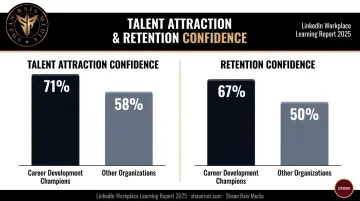
The data backs this up at the organizational level. LinkedIn's 2025 Workplace Learning Report found that companies with strong career-development programs — what it calls "career development champions" — reported 71% confidence in attracting qualified talent, versus just 58% among other organizations. Retention confidence showed a similar gap: 67% versus 50%.
Employees notice, too. A joint SHRM and TalentLMS survey of 1,001 U.S. workers found that 76% were more likely to stay with an employer that offered continuous training. That's a stated intention, not a guarantee, but it's a strong signal that development investment shapes loyalty.
At the organizational level, CPD helps companies:
- Maintain competitive skill levels across their workforce
- Meet client and regulatory expectations without scrambling
- Stay ahead of industry shifts instead of reacting to them
The benefits run just as deep for individuals, who gain their own set of advantages from consistent development.
At the individual level, it delivers:
- Increased confidence in day-to-day practice
- Real career advancement potential
- An expanded professional network through courses, conferences, and mentorship
- Eligibility for promotions or new roles that require documented expertise
For regulated professions, there's a harder edge to this. Failing to complete required CPD carries real consequences, not just a bad look. The State Bar of California, for example, notes that attorneys who miss their Minimum Continuing Legal Education requirements can be placed on administrative inactive status, making them ineligible to practice until they catch up.
Examples of Continuing Professional Development Activities
CPD looks different depending on the profession, but the activities generally fall into the same two buckets.
Common formal CPD activities:
- Accredited continuing education courses
- Certification or license renewal exams
- Degree or diploma programs
- Employer-sponsored training programs
Common informal CPD activities:
- Attending conferences and industry seminars
- One-on-one coaching or mentoring relationships
- Peer shadowing
- Industry reading, newsletters, and podcasts
These formal and informal buckets look different in practice depending on the field. A CPA completes continuing education credits through group study or self-paced online modules. A nurse attends clinical skills workshops tied to a specific certification category. A teacher might spend an entire school year focused on refining a single instructional practice, rather than jumping between disconnected trainings.
What a Real CPD Plan Looks Like
Take a marketing manager working toward a professional certification. Their CPD might include:
- Attending one structured workshop per quarter on a specific skill gap (say, data-driven campaign attribution)
- Reading two industry books per quarter and taking notes on how the concepts apply to current projects
- Logging hours and outcomes in a simple tracker for renewal purposes
This is the difference between "one-and-done" training and genuine CPD. A single workshop might spark ideas, but sustained focus over months (revisiting a skill, applying it, adjusting) produces deeper retention. The research supports this pattern broadly: isolated learning events fade quickly, while cyclical, applied learning sticks.
Who Needs CPD? Professions With Mandatory Requirements
CPD is legally required to maintain licensure in several major professions:
- Lawyers — Minimum Continuing Legal Education (MCLE) hours per compliance period
- CPAs — Continuing Professional Education (CPE) hours per rolling multi-year cycle
- Physicians and nurses — Continuing Medical Education (CME) hours per renewal period
- Teachers — Professional Development Points (PDPs) or CPE hours per certification cycle
- Financial advisors (CFP professionals) need CE hours, including required ethics training
- Engineers — Annual CE hours, often including ethics or jurisdiction-specific content
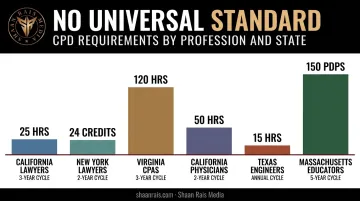
Here's where it gets messy: the numbers are nowhere near standardized.
| Profession | Requirement | Cycle |
|---|---|---|
| California lawyers | 25 hours | 3 years |
| New York lawyers (experienced) | 24 credits | 2 years |
| Virginia CPAs | 120 hours (20/year minimum) | 3 years |
| California physicians | 50 hours | 2 years |
| Texas engineers | 15 hours | Annual |
| Massachusetts educators | 150 PDPs | 5 years |
Even within the same profession, states diverge significantly. California lawyers work off a 3-year, 25-hour cycle, while their experienced New York counterparts answer to a tighter 2-year, 24-credit requirement. There is no universal CPD hour count — check your specific licensing board or membership organization directly.
That variability applies only to regulated professions with legal mandates. Outside those fields, plenty of employers still expect ongoing development informally — it's not law, but it's often the difference between staying relevant and getting passed over.
How to Build a Simple CPD Plan
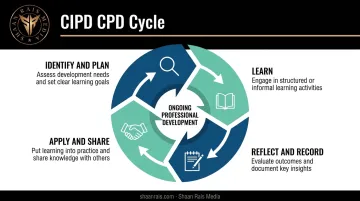
You don't need a complicated system to stay on top of CPD. CIPD's own framework breaks it into four repeatable stages:
- Identify and plan: Assess your current skills against where your role or industry is heading. Look for gaps, then map what's coming next.
- Learn: pursue the planned activities, whether that's a course, a mentorship relationship, or targeted reading.
- Reflect and record. Note what changed as a result, and log the activity, hours, and outcome for future reference.
- Apply and share: put the learning into practice and, where it makes sense, share it with colleagues or your team.
For professionals building a visible track record — not just a private one — a few practical starting points make the habit stick:
- Set time-bound goals: a certification by Q3, 20 hours logged by year-end, or one new skill mastered per quarter.
- Track everything. Most licensing bodies require proof, not just a promise you completed the work.
- Revisit your progress quarterly rather than waiting until renewal deadlines to find out you've fallen behind.
Beyond CPD: Why Skill-Building Alone Isn't Enough
CPD builds real competence. It's the foundation, and no one disputes that. But plenty of highly skilled, well-credentialed professionals stay stuck at the same income level for years, not because they lack ability, but because the market simply doesn't know what they can do.
This is the gap between capability and visibility:
- You complete every CPD hour your board requires
- You still get passed over for the promotion, the client, or the speaking slot
- Someone less qualified gets chosen instead, simply because they positioned themselves more clearly
That positioning gap is exactly what Shaan Rais has spent his career closing. Having worked with 400+ operators across 50-plus industries, he frames it directly: "you are more valuable than you are visible." The work of shaping how the market perceives and prices your expertise doesn't happen automatically once you're skilled. It's a separate, deliberate process, one that determines whether your CPD investment ever translates into recognition, opportunity, or premium pricing.
CPD keeps you competent. Positioning is what makes the market notice.
Frequently Asked Questions
What does ongoing professional development mean?
It's the continuous, career-long process of updating your skills and knowledge rather than a single training event. Most frameworks track it through logged hours or points over a defined cycle.
What is an example of ongoing professional development?
A common example: a professional attends quarterly workshops, earns a relevant certification, and works with a mentor over an extended period. The key is sustained, repeated engagement, not a one-time session.
Is CPD the same as professional development?
Not exactly. CPD is a subset of professional development that emphasizes continuity, structure, and often formal tracking or documentation, especially for licensed professions.
How many CPD hours or points do I need?
It depends entirely on your profession, licensing body, and location. There's no universal number. Confirm requirements directly with your specific regulatory or membership organization.
Can CPD be informal, like reading or podcasts?
Yes, informal learning counts in many CPD frameworks. Most bodies still require some documented formal component alongside it, so check the specific ratio your regulator allows.
What happens if I don't complete my required CPD?
In regulated professions, missing CPD requirements can result in penalties, suspension, or loss of your license or certification. Some boards, like California's State Bar, place noncompliant members on inactive status until they catch up.