

Ask any leadership team if communication matters, and they'll say yes without hesitation. But the real test shows up in daily friction: missed deadlines, duplicated work, confused customers, or a crisis response that takes hours longer than it should.
This article breaks down why a communication strategy matters in practice — the concrete advantages, what happens without one, and how organizations get the most value from theirs.
TL;DR
- A communication strategy defines what an organization says, to whom, and through which channels
- Core advantages span internal efficiency and external brand perception
- Without one, organizations face inconsistent messaging, siloed departments, and rising hidden costs
- Value compounds only when the strategy is applied consistently and measured against real KPIs
What Is a Communication Strategy?
A communication strategy is a documented plan that outlines the purpose, audience, channels, content, and feedback loops guiding how information moves inside and outside an organization.
It covers two directions:
- Internal communication — employees, leadership updates, cross-department coordination
- External communication — customers, investors, media, and partners
The strategy isn't a document you write once and file away. It's a working framework built to produce outcomes: alignment, trust, and speed. Think of it less like a policy binder and more like an operating system for how your organization talks, both to itself and to the market. That framing matters more now than ever.
According to Grammarly and The Harris Poll's 2024 State of Business Communication report, 73% of professionals reported more communication channels in the past year, and 78% reported more communication frequency. More channels without a strategy just means more noise.
Key Advantages of a Communication Strategy
The advantages below aren't abstract "soft skill" benefits. They tie to measurable business outcomes: productivity, retention, brand equity, and risk exposure. And each one compounds when applied consistently across departments rather than treated as a one-off initiative during major announcements.
Advantage 1: Stronger Alignment and Operational Productivity
A defined strategy makes sure the right information reaches the right people at the right time. That single principle eliminates a huge amount of clarification back-and-forth and duplicated effort.
In practice, this looks like:
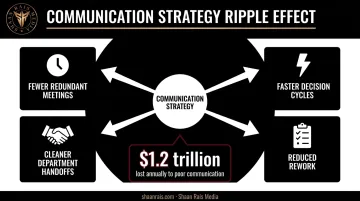
- Fewer redundant meetings called just to "get everyone on the same page"
- Faster decision cycles because roles and information flow are pre-defined
- Cleaner handoffs between departments, with less rework from misunderstood requirements
The cost of skipping this is real. Grammarly and The Harris Poll's 2022 report modeled that ineffective communication costs U.S. businesses $1.2 trillion annually, based on managers estimating roughly 7.47 hours lost per employee, per week. That figure comes from a self-reported model, not audited financials — but even directionally, it's a warning sign worth taking seriously.
KPIs impacted:
- Time-to-decision
- Project delivery timelines
- Employee engagement scores
- Internal error and rework rates
This advantage matters most for remote and hybrid teams, fast-scaling companies, and organizations mid-restructuring — situations where alignment gaps are the most expensive to leave unaddressed. Gallup's most recent workforce data shows 52% of U.S. remote-capable employees are hybrid and 26% are fully remote, meaning most organizations are now managing communication across physical distance by default, not by exception.
Advantage 2: Stronger Brand Reputation and Market Perception
Internal communication clarity shapes external brand consistency more directly than most leaders assume. Employees who understand company values and messaging become unofficial brand ambassadors — whether that's intentional or not.
Here's the mechanism: when internal messaging is fragmented, customer-facing teams send mixed signals. Sales says one thing, support says another, marketing promises a third. The market picks up on that inconsistency fast, and it weakens how the organization is perceived and, ultimately, priced.
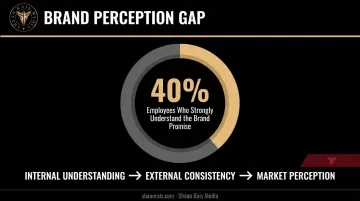
Gallup found that only 40% of employees strongly felt they understood their company's brand promise. That's a striking gap — most of the workforce delivering the brand experience doesn't actually know what that brand is supposed to stand for.
The gap matters because brand promise and lived employee experience are supposed to be the same thing. A brand isn't just what an organization says externally — it's whether its own people can say it consistently first. When internal understanding lags, external positioning becomes guesswork no matter how polished the marketing looks.
KPIs impacted:
- Brand consistency scores
- Customer satisfaction and NPS
- Employee advocacy rates
- External reputation metrics
This advantage hits hardest during rebrands, market repositioning, product launches, or periods of rapid growth — moments when perception can shift quickly, for better or worse.
Advantage 3: Improved Trust, Retention, and Crisis Resilience
Transparent, consistent communication reduces uncertainty. Uncertainty is one of the biggest drivers of disengagement, and disengagement drives turnover.
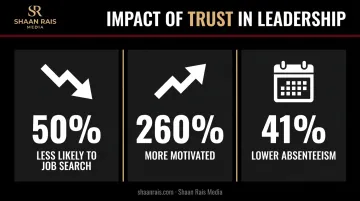
MIT Sloan Management Review's research found that employees who trusted their leaders were 50% less likely to look for another job, 260% more motivated, and had 41% lower absenteeism compared to employees in low-trust environments — a finding from MIT Sloan's research on building high-trust workplaces. That's not a soft outcome. That's retention, and retention is expensive to lose.
A pre-built communication strategy also does something less obvious: it removes the need to improvise during a crisis. Organizations with an existing crisis communication plan respond faster and more coherently because roles, escalation paths, and pre-approved messaging already exist.
Nearly two in three executives said their companies were unprepared for social-equity and geopolitical conversations, according to Edelman's 2024 Connected Crisis Study.
That's a preparedness gap most organizations don't discover until it's too late.
KPIs impacted:
- Employee turnover and retention rate
- Engagement survey scores
- Time-to-response during a crisis
- Stakeholder trust indicators
This matters most during layoffs, leadership transitions, PR incidents, or economic downturns — high-stakes moments where a lack of prepared communication does the most visible damage.
What Happens When a Communication Strategy Is Missing or Ignored
Skip the strategy, and the consequences show up gradually, then all at once. The common pattern:
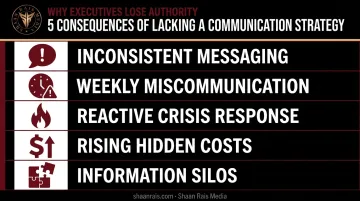
- Inconsistent or contradictory messaging across departments and channels, confusing employees and customers alike
- Higher rates of misunderstanding and rework: Grammarly's research found 100% of surveyed knowledge workers experienced miscommunication at least weekly
- Reactive firefighting during crises instead of a coordinated, pre-planned response
- Rising hidden costs over time from disengagement, turnover, and duplicated effort that rarely show up on a single line item
- Difficulty scaling communication as teams grow, leading to information silos — McKinsey found roughly one-third of organizational initiatives launch in silos
None of these show up on a P&L labeled "communication failure." They show up as slower growth, higher attrition, and a brand that feels inconsistent no matter how good the underlying work actually is.
How to Get the Most Value from a Communication Strategy
A strategy only compounds in value when it's applied consistently across every department, not rolled out once for a big announcement and then forgotten.
Three practices separate organizations that get real value from those that don't:
- Review on a set cadence. Use real KPIs — engagement scores, response times, feedback survey results — rather than assuming the strategy is working because nothing has visibly broken.
- Act on feedback, don't just collect it. Employee and stakeholder input needs to feed back into the strategy itself, turning it into a living framework rather than a static document.
- Treat it as infrastructure, not a project. The organizations that benefit most build communication into how decisions get made, not as an afterthought once decisions are final.
The same principle holds whether you're managing internal communication or refining how a leader speaks to the market: strategies that stay static lose value fast. Organizations that revisit and adjust their communication approach, based on what the data and feedback actually show, keep it working for them instead of against them.
Conclusion
The importance of a communication strategy comes down to three things that don't happen by accident as organizations grow: control, clarity, and consistency.
Alignment, reputation, and trust compound over time, but only when the strategy stays an evolving practice rather than a one-off project shelved after launch. Organizations that review, adjust, and act on feedback build communication into their operating rhythm instead of bolting it on during a crisis.
That operating rhythm shows up externally too: how an organization communicates internally is often the first signal of how clearly it's positioned in the market. Capability rarely gets recognized on its own. It needs a deliberate strategy behind it, and often a clear read on how the organization is perceived, to actually reach the people who need to see it.
Frequently Asked Questions
How do you communicate a strategic plan to employees effectively?
Break the plan into clear, actionable goals and repeat them across multiple formats — meetings, newsletters, visuals. Create space for two-way feedback and follow-up rather than a one-time announcement.
Who should be involved in building a communication strategy?
It typically requires a cross-functional team spanning leadership, HR, internal communications, and department heads. This ensures the plan reflects the needs of every stakeholder group it affects.
What are the key elements of an effective communication strategy?
Five core components: a clear purpose, a defined audience, appropriate channels, consistent content and tone, and structured feedback mechanisms to close the loop.
How can organizations measure the success of their communication strategy?
Track engagement survey scores, message open and read rates, reduced errors linked to miscommunication, and improved alignment on organizational goals. Focus on behavior change, not just delivery metrics.
What are the most common barriers to effective workplace communication?
Information overload, unclear messaging, cultural or language differences, and siloed communication between departments. Gartner found over 25% of employees and 38% of managers feel overwhelmed by excessive communication.
How often should a communication strategy be reviewed or updated?
Review quarterly, or immediately after major organizational changes like restructuring or leadership shifts. Tie reviews to KPI checkpoints rather than treating the strategy as a fixed, one-time setup.