That's what happens without a business-level strategy: the playbook a company uses to compete and win within a specific market or product line.
Many companies confuse having a strategy with having a plan or a mission statement. They're not the same thing. A business-level strategy makes concrete choices about positioning, pricing, and target customers, then sticks with those choices long enough to build a real advantage.
This article breaks down what business-level strategy actually means, walks through the five core types with real-world examples, and gives you a framework for choosing the right one for your organization.
TL;DR: Key Takeaways
- Business-level strategy sits between corporate-level strategy (organization-wide direction) and functional-level strategy (department execution)
- Five core types exist: Cost Leadership, Differentiation, Focused Cost Leadership, Focused Differentiation, and Integrated Strategy
- Each type trades scope (broad vs. niche) against approach (low cost vs. unique value)
- Choosing the right type depends on your resources and market position, not industry fads
What Is Business-Level Strategy?
Business-level strategy is the set of deliberate choices a company makes to gain a competitive edge within one specific market or business unit. It covers three things: who you're targeting, how you're positioned against rivals, and how you create value for customers.
This isn't a slide deck you build once a year and forget. It's a practical, ongoing operating framework — every pricing decision, product update, and marketing message should trace back to it.
According to OpenStax's Principles of Management, business-level strategy defines the general way a business organizes its activities to compete against industry rivals. That's the working definition worth remembering: organization of activities, not just a slogan or a positioning statement.
Business-Level Strategy vs. Corporate and Functional Strategy
Strategy operates on three levels, and mixing them up causes real confusion inside organizations.
Corporate-level strategy sets direction for the entire company:
- Which industries or markets should we compete in?
- Should we grow, diversify, or divest?
- How do we allocate resources across business units?
Functional-level strategy translates business-level choices into department-specific tactics — what marketing does, how operations runs, where R&D focuses.
Here's how it cascades in practice. Say corporate leadership sets a goal to "grow market share in the mid-market segment." At the business level, that might translate into a focused cost leadership strategy targeting small business customers ignored by larger competitors.
That single goal plays out differently at each level:
- Corporate: Grow share in the mid-market segment
- Business: Win price-sensitive customers larger rivals ignore
- Functional: Marketing messages affordability, operations trims onboarding costs, sales trains to close smaller deals faster
Same objective, three levels, three distinct execution paths.
Why Is Business-Level Strategy Important?
A clear strategy creates competitive advantage by defining exactly how you win: on price, uniqueness, or niche focus. Without that clarity, resources get spread across too many initiatives, and none of them get funded well enough to succeed.
What happens without a defined strategy:
- Inconsistent messaging that confuses customers about what you actually stand for
- Price wars with no clear differentiator to fall back on
- Difficulty building a durable market position that survives competitive pressure
Companies that never commit to a lane end up competing on price by default, because price is the only variable left when nothing else distinguishes you.
The same dynamic plays out at the individual level. Capable professionals without a defined market position often get undervalued, not because their skills are lacking, but because the market doesn't know how to categorize or price them. Talent alone rarely sets the price; positioning does.
Types of Business-Level Strategy
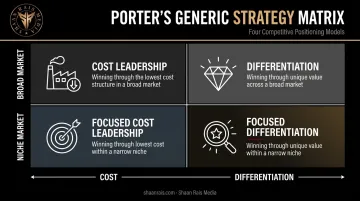
Business-level strategy isn't one-size-fits-all. Michael Porter's generic strategy framework splits the choices along two dimensions: cost vs. differentiation, and broad market vs. niche market (Cambridge's Institute for Manufacturing).
Most companies need to commit to one primary type. Porter's research warns against trying to straddle multiple approaches at once — you risk getting "stuck in the middle" with no clear competitive edge over anyone.
Cost Leadership Strategy
This means competing by becoming the lowest-cost producer in your industry through high-volume production, streamlined operations, and economies of scale.
McDonald's illustrates this well. With 43,477 restaurants worldwide as of year-end 2024, roughly 95% franchised, the company relies on standardized processes and supply-chain coordination to sustain affordability at massive scale.
- Key differentiator: Success depends on operational efficiency and scale, not product uniqueness
- Best suited for: Large-scale companies serving broad, price-sensitive markets
- Strength: Market share growth and resilience during price wars
- Limitation: Vulnerable to being undercut further, or getting perceived as "cheap"
Differentiation Strategy
Differentiation means competing by offering unique features, superior quality, or a strong brand identity that customers will pay a premium for.
Apple is the textbook example. Its most recent 10-K filing lists design innovation, product quality, reputation, and a strong ecosystem of third-party software and accessories as its principal competitive advantages. Customers pay more not because Apple is cheaper, but because the ecosystem experience is harder to replicate.
- Key differentiator: Success depends on innovation and perceived value, not price competitiveness
- Best suited for: Companies with strong R&D and brand-building capacity, targeting customers willing to pay for quality
- Strength: Customer loyalty and pricing power
- Limitation: Risk of imitation and a higher cost structure to maintain
Focused Cost Leadership Strategy
This targets a specific market niche with a low-cost offering built for that segment's particular needs.
Southwest Airlines built its early model this way. Starting in 1971 with just three Boeing 737s serving Dallas, Houston, and San Antonio, Harvard Business School case studies describe how its short-haul, point-to-point system produced the lowest operating-cost structure in the domestic airline industry at the time.

This approach narrows the scope of broad cost leadership, optimizing for one underserved segment rather than the entire market. It works best for businesses that can serve a niche more efficiently than larger competitors chasing scale.
The payoff is cost efficiency specifically within that niche. The catch: limited overall market size caps how big the business can eventually grow.
Focused Differentiation Strategy
This means delivering specialized, premium products tailored to a specific market segment's unique preferences.
Tesla's original 2006 master plan makes this explicit: enter at the high end, where customers were prepared to pay a premium, with a high-performance electric sports car — then use the proceeds to move down-market over time.
- Key differentiator: Combines the uniqueness of differentiation with the narrow scope of a focus strategy
- Best suited for: Niche markets willing to pay premium prices for tailored offerings
- Strength: Strong customer loyalty and premium pricing power
- Limitation: Small addressable market, exposed to shifting niche preferences
Integrated Strategy
This blends cost efficiency with differentiated features to deliver balanced value across a broader customer base.
Toyota built its entire production system around this idea. The Toyota Production System eliminates waste and shortens lead times, delivering vehicles quickly, at low cost, and with high quality — all from one operating system rather than two competing initiatives.
- Key differentiator: Requires managing two competing priorities simultaneously, rather than committing to one
- Best suited for: Organizations with mature operations and strong process discipline
- Strength: Flexibility and broader market appeal
- Limitation: Complexity, and real risk of "stuck in the middle" execution if neither side gets done well

Research on this is mixed. A study of 124 UK manufacturers found pure cost leaders and differentiators outperformed hybrid, stuck-middle firms (Nandakumar et al., via Emerald). But a study of 164 Spanish firms found coherent hybrid strategies were common and often associated with stronger performance. The takeaway: integrated strategy works only when the activities genuinely reinforce each other, not when they're just compromises.
How to Choose the Right Type of Business-Level Strategy
The right choice depends on market analysis, internal capabilities, and customer needs, not on which strategy sounds most impressive in a boardroom presentation.
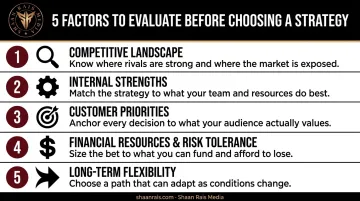
Work through these five factors before committing:
- Competitive landscape — Identify underserved needs or gaps competitors aren't addressing well
- Internal strengths — Honestly evaluate your operational efficiency, brand equity, and R&D capacity against what each strategy demands
- Customer priorities — Determine whether your target customers are price-driven, quality-driven, or seeking a tailored niche solution
- Financial resources and risk tolerance — Differentiation and integrated strategies typically require more sustained investment than cost leadership
- Long-term flexibility — Focus strategies carry more exposure to shifts within a narrow customer segment
Once you've scored each factor, the harder question is how much to commit before the picture is fully clear. Harvard Business Review frames strategic choices under uncertainty as a mix of big bets, safer options, and no-regrets moves (HBR, "Strategy Under Uncertainty"). If your market data is thin, don't make a big, irreversible bet on differentiation — start with moves you'd make regardless of how the future unfolds.
| Signal | What It Suggests |
|---|---|
| Thin or inconclusive market data | Favor no-regrets moves over big bets |
| Clear cost advantage, commoditized market | Cost leadership fits |
| Strong R&D, willing customers to pay more | Differentiation fits |
| Deep expertise in one underserved segment | Focus strategy fits |
| Resources to execute on multiple fronts | Integrated strategy may fit |
A consultant serving enterprise clients, for instance, might use a focus strategy for a niche (executive coaching) while layering differentiation through proprietary frameworks — an integrated approach that balances risk with distinct market positioning.
What to Check Before Finalizing Your Strategy
Before locking in your choice, run through these checks:
- Avoid complexity for its own sake. Integrated strategy sounds comprehensive, but it demands mature operations and disciplined execution — a simpler, focused approach often fits current resources better.
- Weigh the trade-offs honestly. Every strategy type carries limitations, particularly around long-term cost structure or execution demands. Know what you're signing up for before committing.
- Resist copying the competitor. Picking a strategy because an industry leader uses it, instead of because it fits your actual strengths and target market, is a common and costly mistake.
These checks exist because the goal isn't finding the most popular strategy — it's finding the one that matches your resources, market position, and execution capacity. Get that match right, and the strategy becomes a durable source of profitability rather than a constant drain on effort.
Frequently Asked Questions
What are the four business-level strategies?
Most frameworks reference four core types: Cost Leadership, Differentiation, Focused Cost Leadership, and Focused Differentiation. Some models add Integrated Strategy as a fifth, hybrid option.
What are the 4 levels of strategy?
Most organizations operate strategy across three levels: corporate, business, and functional. Some models add a fourth "operational level" covering day-to-day execution details.
What is the difference between business-level and corporate-level strategy?
Corporate strategy sets direction for the whole organization, including which industries to compete in. Business-level strategy defines how a single unit competes within its specific market.
What is an example of a business-level strategy?
A company adopting cost leadership by streamlining its production process to consistently underprice competitors while maintaining acceptable margins is a straightforward example.
Can a company use more than one business-level strategy at once?
A company can run different strategies across separate business units. Porter's research warns against blending strategies within a single unit, since doing so risks getting "stuck in the middle" with no clear competitive edge.
Which business-level strategy carries the most risk?
Differentiation and focused differentiation carry higher risk due to imitation and shifting customer preferences. Cost leadership carries the risk of being undercut by an even lower-cost competitor.