Introduction
Picture two professionals on the same commercial job site. The first gives crystal-clear safety briefings — every instruction precise, every expectation documented. But his crew quietly resents him, and turnover is high. The second knows everyone by name, reads the room perfectly, and has a team that would follow him anywhere — but after every meeting, nobody's sure what they're actually supposed to do next.
Neither is fully effective. One transfers information. The other builds the trust that makes people act on it. Most professionals default to developing one and neglecting the other.
In team-based, high-stakes environments (personal branding launches, client engagements, coaching programs), this confusion shows up as delayed projects and missed positioning opportunities. According to PMI's research, highly effective communicators report 80% of projects meeting original goals, compared to just 52% for minimally effective communicators.
Understanding where these two skill sets diverge — and where they depend on each other — is what separates professionals who merely inform from those who actually lead.
Key Takeaways
- Communication skills govern how accurately information travels from sender to receiver — through speaking, writing, listening, and nonverbal cues
- Interpersonal skills shape the quality of the relationship itself — the trust and empathy that determine whether communication lands or falls flat
- Having one without the other creates measurable gaps in team performance, leadership effectiveness, and client retention
- Developing both leads to fewer misunderstandings, stronger teams, and a professional reputation that builds over time
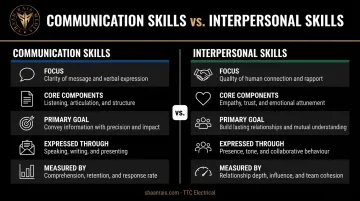
Communication Skills vs. Interpersonal Skills: At a Glance
| Dimension | Communication Skills | Interpersonal Skills |
|---|---|---|
| Focus | Message clarity and delivery | Relationship quality and emotional dynamics |
| Core Components | Verbal, written, nonverbal, active listening | Empathy, conflict resolution, trust-building, collaboration |
| Primary Goal | Ensure information is accurately transmitted | Build productive and respectful relationships |
| Expressed Through | Presentations, emails, instructions, feedback | Tone, attitude, behavior in group settings |
| Measured By | Comprehension, feedback accuracy | Team morale, trust levels, conflict outcomes |
Communication skills are often considered a component within the broader umbrella of interpersonal skills, but they can exist as a standalone technical ability, independent of emotional or relational intelligence. Both require deliberate development.
What Are Communication Skills?
Communication skills are a person's ability to convey, receive, and process information effectively. They span four core channels:
- Verbal — spoken words, tone, pacing, and clarity
- Nonverbal — body language, facial expressions, eye contact
- Written — emails, reports, work orders, documentation
- Listening — active engagement with what others are saying, not just waiting for your turn to speak
The fifth element is feedback delivery — the ability to communicate your response to information in a way that's clear and constructive.
Put simply, communication is about the message — what you send, how you send it, and whether the other person actually receives it correctly.
Why It Matters in Industrial and Commercial Settings
In a client engagement, ambiguous instructions aren't just inefficient — they're costly. A vague brief on positioning or a missed strategy briefing can lead to messaging drift, missed deadlines, or a diluted brand. In high-stakes environments, clear communication is part of the job — not a soft skill sitting alongside it.
A 2018 survey of 599 construction leaders by FMI and PlanGrid found that 26% of US construction rework was attributed to poor stakeholder communication, costing an estimated $17 billion annually. The cost is measurable, direct, and entirely preventable with better communication practices.
Where Communication Skills Drive Results
Communication skills are the primary success factor in:
- Written project briefs and work orders
- Pre-job safety briefings and site orientations
- Client update calls and progress reports
- Cross-department coordination and vendor communication
- Performance feedback sessions
If your team consistently misses instructions, misreads priorities, or asks the same clarifying questions repeatedly, the root problem is usually a communication skills gap — not a knowledge one.
What Are Interpersonal Skills?
Interpersonal skills are the behaviors and qualities that shape how you interact with others — going well beyond what you say to encompass how people feel during and after that interaction.
The five core areas:
- Empathy and emotional intelligence — reading and responding to others' emotional states
- Conflict resolution — navigating disagreements without damaging relationships
- Team collaboration — working effectively within group dynamics
- Trust-building and relationship management — creating the consistency others rely on
- Adaptability — shifting your approach based on who you're talking to and what the situation demands
The Critical Distinction
A person can deliver a technically flawless message and still damage a relationship through indifference, condescension, or tone. Interpersonal skills govern the relational environment in which communication happens — and that environment determines whether people engage, stay invested, or pull back entirely.
Gallup research estimates that managers account for at least 70% of the variance in employee engagement across business units. Much of that variance comes down to interpersonal quality — not just whether instructions were clear.
Where Interpersonal Skills Drive Results
That gap between technically correct communication and genuinely effective leadership is where interpersonal skills do their real work. They're the primary driver of outcomes in:
- Managing team morale during high-pressure or high-stakes projects
- Navigating disagreements between crew members, subcontractors, or clients
- Retaining client relationships over the long term
- Leading teams through change, adversity, or organizational tension
If the message was clear but the relationship still took damage, the problem wasn't communication — it was the interpersonal layer beneath it.
Key Differences Between Communication Skills and Interpersonal Skills
Communication skills address the how of sharing information. Interpersonal skills address the quality of relationship in which that sharing occurs. Both matter — but they fail in completely different ways when they're missing.
The "One Without the Other" Problem
Two contrasting scenarios make this concrete:
Scenario 1 — High communication, low interpersonal: A technically skilled project manager sends detailed work orders, runs tight meetings, and documents everything. But she dismisses concerns with impatience, reads facial expressions poorly, and leaves her crew feeling undervalued. Turnover climbs despite operational clarity.
Scenario 2 — High interpersonal, low communication: A crew lead is universally liked — people trust him, morale is high, and he handles conflict gracefully. But his verbal instructions are vague, his written updates are incomplete, and his team frequently misses deadlines because expectations weren't set clearly. Relationships are warm; results are inconsistent.
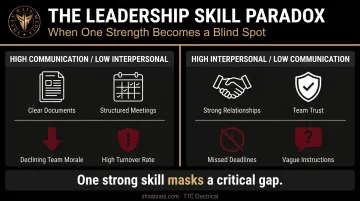
In each case, one strong skill set masks a critical gap — and the gap is what shows up in results.
Where Both Must Work Together
Some situations demand both skill sets simultaneously:
- Conflict resolution — clear articulation of the issue matters, but so does the emotional regulation to hear the other side without escalating
- Performance feedback — precision in what needs to change, delivered with enough relational sensitivity that the person can actually receive it
- Client relationship management runs on both accurate information and the interpersonal trust that makes clients feel like more than a contract
When to Prioritize Which
| The Core Issue | Prioritize |
|---|---|
| Instructions unclear, deadlines missed, information lost | Communication skills |
| Low team morale, eroding trust, recurring conflict | Interpersonal skills |
| Leadership role — ongoing | Both, equally |
How to Strengthen Both Skills in a Professional Setting
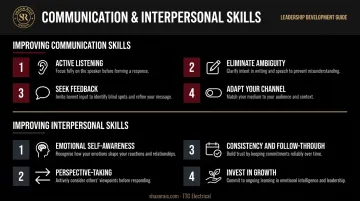
Improving Communication Skills
Four practices that move the needle:
- Practice structured active listening — After someone speaks, summarize what you heard before responding. This closes the loop and surfaces misunderstandings early
- Eliminate ambiguity in written messages — Every written instruction should include a clear action item, owner, and deadline. If it doesn't, revise before sending
- Seek feedback on how your messages land — Not just "did you get my email?" but "was that clear enough to act on?" The difference matters
- Adapt your communication channel to your audience — A veteran crew member and a new subcontractor need different levels of context
Improving Interpersonal Skills
Four practices grounded in research and real leadership:
- Develop emotional self-awareness before high-stakes conversations — Know what you're bringing into the room before the conversation starts
- Practice perspective-taking in conflict situations — Before responding, articulate the other person's position back to them accurately. This shifts the dynamic
- Build rapport through consistency and follow-through — Trust is built by doing what you said you'd do, repeatedly. Not by big gestures
- Invest in people's growth, not just their output — Acknowledging a team member's potential and backing it with development signals genuine care
The Real-World Application
In trades, contracting, and industrial environments, these aren't "soft" skills — they're operational requirements. Clear safety communication and relational trust aren't separate priorities; they're mutually reinforcing.
Shaan Rais, founder of Shaan Rais Media, built his personal-branding and positioning practice around this principle directly. His Perception Engineering philosophy, shaped by his background as an Industrial-Organizational Psychologist and years of work with 400+ operators across 50+ industries, treats clear communication as an act of respect and relational trust as a positioning standard.
In his approach, if a crew member leaves a conversation confused, the leader has failed regardless of how clearly the words were delivered. When communication and interpersonal skill develop together, that's the result: fewer gaps, fewer hazards, and a team that actually functions as one.
Conclusion
Communication skills and interpersonal skills are not the same thing — and treating them as interchangeable is where most professionals hit a ceiling.
Communication gets your message across. Interpersonal skills determine whether people trust you enough to act on it. Neither works without the other — and the gap between them shows up in team performance, client relationships, and the kind of reputation that either compounds or steadily erodes.
The professionals who build teams that perform, relationships that last, and careers that grow are the ones who invest in both — and they do it with intention. Start by identifying which of the two is currently limiting you, then build from there.
Frequently Asked Questions
What is the difference between communication skills and interpersonal skills?
Communication skills focus on how information is sent and received — covering clarity, listening, writing, and nonverbal delivery. Interpersonal skills focus on the quality of the interaction itself — empathy, trust, collaboration, and emotional attunement. Both are distinct, but both are required for effective professional relationships.
What are examples of communication and interpersonal skills?
Communication skill examples include active listening, clear verbal instructions, professional writing, and nonverbal awareness. Interpersonal skill examples include empathy, conflict resolution, team collaboration, and trust-building — skills that govern how interactions feel, not just what they convey.
Can you have strong communication skills but weak interpersonal skills?
Yes, absolutely. Someone can be articulate, precise, and well-organized in their messaging while still struggling to build trust, read emotional dynamics, or make others feel heard. Technically clear communication can come across as cold or alienating without the relational layer.
Are interpersonal skills a subset of communication skills, or vice versa?
Communication skills — speaking, writing, listening — are often considered components within the broader umbrella of interpersonal skills. But communication can also function as a standalone technical ability, independent of emotional or relational intelligence. The two overlap without being identical.
Which is more important for leadership: communication skills or interpersonal skills?
Effective leadership requires both. Communication skills are essential for giving clear direction and feedback. Interpersonal skills determine whether people trust and follow the leader. One without the other creates significant leadership gaps — directive without warmth, or warmth without direction.
How can I improve both communication and interpersonal skills at the same time?
Seek honest feedback after important conversations, practice active listening in every interaction, and put yourself in collaborative settings where both clear messaging and relational trust are tested. Both skill sets develop through consistent, reflective practice rather than passive exposure.