Most advice on this topic stays abstract: "be a better communicator." But the real value shows up in specific moments. The promotion that went to someone else. The deal that closed because one person explained the value clearly. The conflict that never escalated because someone paused before reacting.
This article breaks down why communication skills matter in practice, what happens when they're missing, and how to actually strengthen them.
TL;DR
- Communication is the delivery mechanism for every other soft skill: leadership, negotiation, and teamwork all run through it
- As AI handles technical tasks, human-centered skills become what employers pay for
- Poor communication creates rework, disengagement, and missed opportunities
- Strong communicators earn more visibility and responsibility than quieter experts
- Consistent practice builds communication skill over time
What Is Communication as a Soft Skill
Communication skill is the ability to convey and interpret information clearly, read emotional and contextual cues, and adjust your delivery so the message lands the way you intended.
It shows up everywhere:
- Team meetings and status updates
- Feedback conversations with direct reports
- Client pitches and proposals
- Written reports and emails
- Cross-team collaboration
- Negotiations and high-stakes conversations
Think of communication as a means to an outcome, not a personality trait. The goal isn't "talking well" — it's building trust, clarity, alignment, and influence.
The Listening Half of the Equation
Most people equate communication with talking or writing well, but listening carries equal weight. A sales executive who reads a client's hesitation in a pause, then adjusts the pitch on the spot, is practicing communication just as much as the person delivering a polished presentation. Miss that cue, and even the clearest message falls flat.
Key Advantages of Strong Communication Skills
These aren't abstract "soft" benefits. Each one ties to something organizations already track — decision speed, error rates, retention, career progression. That's what makes communication worth investing in deliberately, not just something to improve "when you get around to it."
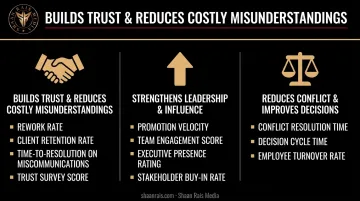
Advantage 1: Builds Trust and Reduces Costly Misunderstandings
Clear, consistent communication removes ambiguity about expectations, deadlines, and priorities. In practice, that means fewer clarifying emails, less rework, and smoother handoffs between teams.
Most workplace friction doesn't come from lack of effort. It comes from misread tone or unclear intent. And the cost adds up fast.
Grammarly and The Harris Poll estimate that poor communication could cost U.S. businesses as much as $1.2 trillion annually, or roughly $12,506 per employee, based on lost time and salary data. Separately, Grammarly's 2024 research found knowledge workers spend 88% of their workweek communicating, and a quarter experience miscommunication multiple times a day.
KPIs impacted:
- Rework rate
- Project turnaround time
- Employee engagement scores
- Client retention
This advantage matters most during cross-functional projects, remote or hybrid collaboration, and client-facing work — anywhere context gets lost easily between people who aren't in the same room.
Advantage 2: Strengthens Leadership and Influence
A leader's vision only matters if it's communicated clearly enough for people to act on it. Leaders who communicate well are more likely to be trusted, followed, and handed stretch opportunities. It's not raw intelligence that earns those chances; it's clarity people can act on.
Promotions rarely go to the person with the best technical output alone. They go to the person who can align others around a goal. The Center for Creative Leadership lists communication as one of its "Fundamental 4" leadership skills, essential to how leaders inform and inspire through verbal, nonverbal, and written messages.
Feedback frequency backs this up too. Gallup found that employees who received meaningful feedback in the prior week were significantly more likely to be fully engaged, and those getting daily feedback were 3.6 times more likely to be motivated to do outstanding work.
Shaan Rais sees this pattern constantly in his coaching work: capability without visibility rarely converts into opportunity. You can be the most technically skilled person in the room, but if you can't communicate that clearly to decision-makers, you get overlooked. His coaching practice centers on closing that specific gap, helping high performers get seen and understood, not just get better at the work itself.
KPIs impacted:
- Promotion velocity
- Team engagement
- Retention of direct reports
- Stakeholder buy-in rates
This matters most during organizational change, team scaling, or when you're competing for visibility in a crowded talent pool.
Advantage 3: Reduces Conflict and Improves Decision Quality
Active listening and emotional regulation determine whether disagreements stay productive or spiral. Teams that separate behavior from personality in feedback conversations resolve issues faster, with less lingering resentment.
Reacting emotionally in the moment, instead of pausing and responding intentionally, is a primary driver of workplace conflict. A 2022 Myers-Briggs study found respondents spent 4.34 hours per week dealing with workplace conflict, according to Myers-Briggs Company research, with 47% citing poor communication as the cause.
There's a decision-quality angle too: research on boardroom decision-making suggests emotional regulation helps mitigate bias and supports better conflict resolution during high-stakes strategic choices. Teams that disagree productively surface more options before committing to a direction. They use tension instead of avoiding it.
KPIs impacted:
- Conflict resolution time
- Turnover linked to interpersonal issues
- Decision-making cycle time
Stakes run highest during performance conversations, negotiations, restructuring, and any high-pressure interaction where emotions run hot.
What Happens When Communication Skills Are Missing or Ignored
The absence of strong communication doesn't announce itself. It shows up as friction that gets blamed on other things — "we're just busy" or "priorities keep shifting." Common consequences include:
- Inconsistent understanding of goals and priorities across teams
- Higher rework rates and endless clarifying back-and-forth
- Reactive conflict management instead of proactive alignment
- Talented people overlooked for promotions their capability alone should have earned
- Difficulty scaling leadership or delegating effectively as teams grow
The point about overlooked talent deserves a closer look. Being good at your job isn't the same as being known for being good at your job — plenty of capable operators get passed over not because they lack skill, but because nobody upstream ever clearly saw it.
Take a mid-level manager who consistently solves problems quietly, without ever presenting results in a leadership meeting. Their director sees the deliverables but never connects them to a name, and when a leadership slot opens, someone louder gets the nod. The skill was there; the visibility wasn't.

How to Get the Most Value from Communication Skills
Communication improves fastest through deliberate practice, not passive exposure. That means active listening drills, structured feedback sessions, and consciously adjusting your tone and delivery depending on who's in the room.
Start with self-awareness. Before any technique sticks, you need to recognize your own emotional triggers and default habits. Do you go quiet under pressure? Over-explain when nervous? Interrupt when excited? None of these are fixable until you notice them.
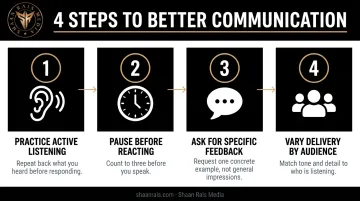
A few practical starting points:
- Practice active listening deliberately — summarize what someone said before responding, rather than jumping straight to your reply
- Pause before reacting in tense conversations, even if it's just three seconds
- Ask for specific feedback on tone and clarity from a colleague you trust
- Vary your delivery based on audience — the way you explain something to your manager should differ from how you explain it to a peer
But here's the part that gets skipped: skill alone doesn't create career value. You can be an excellent communicator internally and still get overlooked if the right audiences — your manager, your clients, the broader market — never actually perceive that capability.
Being good and being known as good are not the same thing. Communication skill-building only translates into career value when it's paired with deliberate positioning — making sure the people who decide your next raise, promotion, or client contract actually see the capability you've built.
Conclusion
Communication's real value lies in trust, clarity, and consistency across every professional interaction you have. Far from a soft extra layered on top of "real" skills, it's the mechanism through which every other skill gets recognized.
These advantages compound. Better communicators accumulate trust, opportunities, and influence faster than equally capable but quieter peers. Over a career, that gap widens significantly.
Being skilled is only half the equation. Being recognized for that skill is what actually converts into promotions, client trust, and business outcomes. Communication is an ongoing practice, but visibility is what turns that practice into results. The professionals who master both won't just do great work; they'll be known for it.
Frequently Asked Questions
What are soft skills in communication?
They're the interpersonal abilities behind how a message is delivered and received — active listening, emotional intelligence, tone, and body language. This is distinct from the technical content of what's actually being said.
What are the 5 C's of soft skills?
Common adaptations include clarity, conciseness, coherence, confidence, and courtesy. Some institutional frameworks define seven Cs instead, so treat the five-C version as a simplified variant rather than a universal standard.
Can communication skills really be learned, or are some people just naturally better at it?
Some people start with a head start, sure. But communication is trainable through deliberate practice: active listening exercises, feedback loops, and honest self-reflection move the needle regardless of where you start.
Why do soft skills like communication matter more now than in the past?
AI is automating technical and repetitive tasks fast. The World Economic Forum found 86% of employers expect AI to transform their business by 2030, yet human-centered skills like communication and empathy remain among the ten most important core skills employers want.
What's the difference between hard skills and soft skills?
Hard skills are teachable, measurable technical abilities : coding, accounting, data analysis. Soft skills like communication are interpersonal and behavioral; they shape how those hard skills actually get applied and perceived by others.
How can I quickly improve my communication skills at work?
Start small: practice active listening in your next meeting, pause for a beat before responding in tense moments, and ask one trusted colleague for specific feedback on your tone and clarity. Small, consistent reps beat occasional big efforts.