Workplace conflict isn't the issue here. It never is. What determines whether that exchange damages a working relationship or strengthens it is entirely about how the two people communicate through the tension.
This guide breaks down the communication strategies that actually resolve workplace conflict, a step-by-step framework for having the conversation itself, and the habits that quietly sabotage even well-intentioned attempts to fix things.
Key Takeaways
- Most workplace conflict traces back to communication breakdowns and unclear expectations, not incompatible personalities
- Active listening, empathy, assertive "I" statements, and reading non-verbal cues form the core skill set for de-escalation
- A structured six-step process turns heated arguments into lasting resolutions
- How you handle conflict shapes your professional reputation as much as your technical output
Why Communication Breaks Down During Workplace Conflict
Conflict itself is neutral. Two people disagreeing about priorities or approach is normal, even useful — it surfaces problems that silence would hide. What turns that disagreement into dysfunction is poor communication layered on top of it.
A 2022 survey by The Myers-Briggs Company found that among respondents who had recently completed a conflict-styles assessment, 47% cited poor communication as a cause of workplace conflict, more than any other factor listed. Nearly as common was a lack of role clarity, cited by 42% — a reminder that plenty of "personality conflicts" are actually expectation conflicts wearing a disguise (Myers-Briggs, 2022).
Common triggers show up in almost every workplace:
- Clashing work styles — one person wants detailed plans upfront, another prefers to adjust as they go
- Unclear expectations — nobody defined who owns a decision or what "done" actually means
- Workload perception issues — one side feels overloaded while the other assumes things are fine
- Misread tone in written communication — a short Slack reply reads as cold when it was just rushed
That last point matters more than people assume. In an experiment described by the American Psychological Association, senders expected recipients to correctly read their intended tone in email 78% of the time. Recipients actually got it right only 56% of the time, compared to 75% accuracy over the phone (APA, 2006).
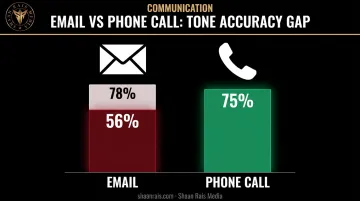
Text strips out the cues that usually keep tone honest. When a conversation is tense or ambiguous, moving it off Slack and into a call or face-to-face chat isn't overreacting — it's just accounting for a well-documented gap.
Core Communication Strategies to Resolve Workplace Conflict
These five strategies aren't independent tricks. Each one closes a different gap in how people talk and listen when tension is already running high.
Active Listening
Hearing is passive. Active listening is a deliberate act: giving full attention, asking clarifying questions, and reflecting back what you heard so the other person can confirm or correct it (HBR, 2024).
In practice, that looks like:
- Making eye contact instead of glancing at your inbox
- Paraphrasing before responding: "What I'm hearing is the handoff timing left you without enough review time — is that right?"
- Letting the other person finish instead of jumping in with a rebuttal
Active listening de-escalates tension for a simple reason: it signals the other person's perspective is being taken seriously before anyone tries to fix anything. Most people aren't looking for an instant solution. They're checking whether they've been heard at all.
Empathy and Perspective-Taking
Listening confirms you've registered the words. Empathy goes a step further and asks why the other person sees it this way — that single question shifts a conversation from defense to understanding.
Compare two responses to the same complaint — a colleague saying they felt blindsided by a decision made without them:
- Dismissive: "It wasn't a big deal, we had to move fast."
- Empathetic: "I can see why that felt frustrating, especially if you'd been working on that piece already. Let's talk about how we loop you in earlier next time."
Same situation. Completely different outcome for the relationship.
Assertive "I" Statements
Assertive communication sits between passive avoidance (saying nothing and stewing) and aggressive confrontation (blaming outright). "I" statements are the tool most people reach for here, but they're often misused. Starting a sentence with "I" doesn't automatically make it non-accusatory. "I feel frustrated that you missed the deadline" still centers on the other person's fault — it's just wearing a nicer outfit (HBR, 2018).
| Blame-based ("you") statement | Responsibility-based ("I") statement |
|---|---|
| "You never send the report on time." | "The report arrived after the review window closed, so I couldn't complete the check. Can we agree on a cutoff that leaves a day for review?" |
The second version states the observable fact, the concrete impact, and a specific request — without labeling anyone careless.
Reading and Managing Non-Verbal Communication
Tone, facial expression, and posture often carry more weight than the words themselves, especially once a conversation gets tense. Albert Mehrabian's well-known 7%-38%-55% breakdown of verbal, vocal, and facial communication is frequently misquoted as applying to all communication. It doesn't. Mehrabian's own research limited that formula specifically to situations where someone is judging feelings or attitudes, and only when the words and the tone contradict each other (Mehrabian).
That said, the underlying point holds up in any tense exchange: if your words say "let's work through this" but your arms are crossed and your voice is flat, the other person will believe the arms and the voice. Watch for:
- Crossed arms or turned-away posture (defensiveness, disengagement)
- Flat or sharp vocal tone that contradicts calm wording
- Avoided eye contact (can signal discomfort or dishonesty, depending on context)
Collaborative Problem-Solving
These verbal and non-verbal signals tell you when both sides actually feel heard — and that's the moment to move into solutions, not before. Jumping to a fix too early skips the step that makes people actually commit to it.
- Use collaboration when the issue is important, complex, or recurring, and both people's needs matter to the outcome
- Use compromise when the issue is moderate, time is short, or a "good enough" answer beats a perfect one delayed by a week
Treating every disagreement as worthy of a two-hour collaborative session burns goodwill fast. Save the deep dive for problems that will keep resurfacing if they're not properly solved.
A Step-by-Step Framework for Resolving Conflict Through Conversation
- Pause and name the conflict. Letting it simmer unaddressed rarely makes it smaller. Say plainly: "I think we see this differently, and I'd like to talk it through."
- Set a private, neutral time and place. Frame the conversation as solution-focused, not blame-focused, before it even starts: "I want to figure out a process that works for both of us."
- Let each party speak fully. Use active listening and clarifying questions before responding. Resist the urge to interrupt with your own version of events.
- Brainstorm options together and agree on one specific next step. Assign clear ownership. Vague agreements ("we'll communicate better") don't survive the next busy week.
- Follow up after a set period. Confirm the resolution held, and address any lingering friction before it turns into a second conflict.
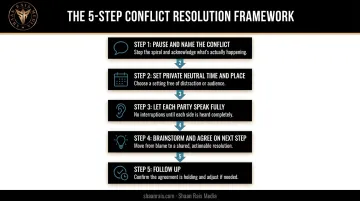
Notice what these five steps have in common: each one keeps listening and solving separate. That separation matters more than it sounds.
Most failed conflict conversations collapse because both people try to solve the problem while still defending their position.
Once each party feels heard, the brainstorming step in #4 becomes far easier, since neither side is still fighting to be understood.
Communication Habits That Escalate Conflict
Some habits feel protective in the moment but make the original issue harder to resolve:
- Assuming intent — deciding someone missed a deadline because they don't respect your time, rather than checking what actually happened
- Venting to uninvolved coworkers — it might feel like relief, but it spreads the conflict without resolving it
- Stonewalling — shutting down and refusing to engage, which research on relationship conflict shows tends to escalate rather than cool a dispute (Gottman Institute)
- Reacting emotionally — firing back a sharp reply before thinking it through
These habits damage trust because they replace direct problem-solving with guesswork, gossip, or silence. The other person usually notices, and trust erodes faster than either side realizes.
A quick self-check before responding in a heated exchange: "Am I responding to what actually happened, or to what I've assumed about why it happened?" That one question catches most defensive reactions before they leave your keyboard or your mouth.
How You Handle Conflict Shapes Your Professional Reputation
Leadership notices conflict-handling style just as closely as technical output — sometimes more closely, since it's harder to fake composure under pressure. Anyone can look competent when things are calm. How someone communicates when a project is behind schedule or a colleague is frustrated reveals far more about whether they're ready for bigger responsibility.
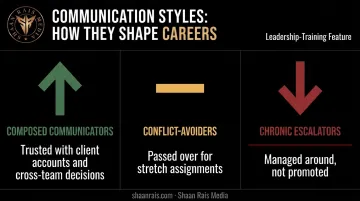
Composed, solution-oriented communicators tend to get positioned for higher-visibility roles. People who avoid conflict entirely, or escalate it every time, rarely get handed the accounts, teams, or decisions that come with more exposure. The difference shows up clearly:
- Composed communicators get trusted with client accounts and cross-team decisions
- Conflict-avoiders get quietly passed over for stretch assignments
- Chronic escalators get managed around, not promoted through
Personal-branding strategist Shaan Rais makes a related point about positioning: capability alone doesn't determine how a market, or a leadership team, perceives someone. The same logic applies inside a company.
A brilliant analyst who handles disagreement poorly gets remembered for the friction, not the results. Someone who navigates tension with composure builds a quiet reputation that opens doors talent alone doesn't.
Frequently Asked Questions
What are some communication strategies to resolve conflict?
The core strategies are active listening, empathy and perspective-taking, assertive "I" statements, reading non-verbal cues, and collaborative problem-solving. Each addresses a different point where communication typically breaks down during disagreement.
What are the four C's of conflict resolution?
There's no single universally accepted framework. One widely referenced version outlines Commitment, Communication, Culture, and Continuity — useful as a lens, not a rigid rulebook.
What is usually the first step in resolving a workplace conflict?
Acknowledging that the issue exists rather than letting it simmer. Choosing the right time and setting — private, neutral, and framed around solutions — comes immediately after.
Why is active listening considered the most important conflict resolution skill?
It builds the trust and mutual understanding that has to exist before any real solution works. Skipping straight to problem-solving without it usually produces a fix nobody actually commits to.
How do you communicate during a conflict without it escalating?
Stay calm, use "I" statements that focus on impact rather than blame, and avoid assuming the other person's intent. Moving tense exchanges from text to a real conversation also helps significantly.
What should you avoid saying or doing during a workplace disagreement?
Avoid assuming intent, venting to uninvolved coworkers, shutting down entirely, or reacting emotionally before thinking it through. Each of these habits makes the original issue harder to actually resolve.