: Complete Guide](https://file-host.link/website/shaanrais-jlmxib/assets/refined-images/1787320923460000_77f24aa14bcc4b3a80e90b7757dea3f1/360.webp)
Most speakers never actually choose a delivery method. They default to whatever feels safe, usually reading from notes or freezing up and winging it. That habit can undercut even the most well-researched, well-organized speech.
This guide breaks down the four methods of delivery in public speaking, how they differ, and how to pick the right one for whatever room you're walking into.
Key Takeaways
- Four core delivery methods exist: manuscript, memorized, impromptu, and extemporaneous
- Each method trades off preparation time, flexibility, and audience connection differently
- Extemporaneous delivery suits most professional settings by balancing preparation with natural delivery
- The right method depends on occasion, stakes, and available prep time — not personal preference
- Strong delivery can elevate a thin message; poor delivery can sink a brilliant one
What Is Delivery in Public Speaking and Why Does It Matter?
Delivery is the vocal and physical execution of a speech. It's separate from content or structure. Two people can deliver the exact same script and produce completely different results based on pacing, eye contact, and vocal variety.
Delivery method specifically refers to how much of a speech is scripted or prepared in advance. That's the core distinction this guide covers.
That distinction matters because delivery shapes how an audience perceives credibility, confidence, and authority. According to MTSU's public speaking text, delivery sits between casual conversation and reading aloud: more formal than chatting, but flexible enough to allow pauses, emphasis, and natural wording shifts.
Without a deliberate approach, three things tend to go wrong:
- Sounding robotic when a speech is over-scripted and under-rehearsed
- Losing composure when a speaker is underprepared and gets thrown off
- Failing to connect because the delivery method doesn't match the room
Why This Matters Beyond the Classroom
For founders, executives, and experts, delivery isn't an academic exercise. It's a business variable.
How someone delivers a pitch, a keynote, or a media interview shapes how the market perceives their expertise, which is central to how professionals get positioned (and priced) in their field. A shaky delivery on a high-stakes stage doesn't just feel bad in the moment. It directly limits how much authority, and how much revenue, that appearance generates.
The Four Methods of Delivery in Public Speaking
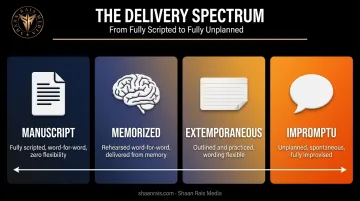
These four methods sit on a spectrum, from fully scripted to fully unplanned. Where you land on that spectrum changes how natural, flexible, or risky your delivery feels to the audience.
Manuscript Speaking
Manuscript speaking sits at the fully scripted end of that spectrum. Manuscript speaking means delivering a speech word-for-word from a fully written script, similar to a newscaster reading a teleprompter.
When it's used: Situations where exact wording carries real consequences — legal statements, official policy announcements, formal political addresses.
The trade-off: You get precision and consistency, but often at the cost of eye contact and natural warmth. Toastmasters points out that reading from a script affects rhythm, confidence, and audience connection — the speaker's attention goes to the page instead of the people.
Manuscript delivery is best suited for high-stakes moments where misquoting or improvising isn't an option. Think shareholder statements or crisis communications, not keynote stages.
Memorized Speaking
Memorized speaking means committing an entire speech to memory and delivering it without notes or a script.
The upside: Full eye contact and audience engagement, since there's nothing to glance down at.
The risk: Going blank mid-speech with nothing to fall back on. University of Arkansas's public speaking text also warns that exact-word recitation can sound mechanical rather than natural, since the speaker is focused on recall instead of connection.
This method fits short, high-polish occasions best:
- Wedding toasts or tributes
- Award acceptance speeches
- Timed speaking competitions
It's rarely the right call for a 45-minute keynote or a business presentation where flexibility matters more than perfect recitation.
Impromptu Speaking
Impromptu speaking is delivering a message with little to no advance preparation. It's the delivery method most people use daily without even labeling it — answering an unexpected question in a meeting, being called on to comment, offering a toast you didn't see coming.
What you sacrifice: You gain authenticity and spontaneity, but lose research, polish, and supporting evidence. Without time to organize a central point, impromptu remarks can easily ramble.
MTSU's research notes that impromptu speaking works best when kept brief and centered on one clear point. Trying to cover three ideas on the fly usually means covering none of them well.
This method suits spontaneous business moments — and it's a skill worth building deliberately. Executives who can think clearly and speak confidently on the spot, without a script, tend to read as more competent under pressure, not less.
Extemporaneous Speaking
Extemporaneous speaking is thoroughly researched and practiced, but delivered conversationally using brief notes or a keyword outline instead of a full script.
This is the method most public speaking educators point to as the general-purpose default. MTSU calls it the recommended style for the great majority of speaking situations. The University of Pittsburgh's Communication Department adds that it's adaptable and time-efficient — built around eye contact, audience feedback, and a keyword outline rather than a script.
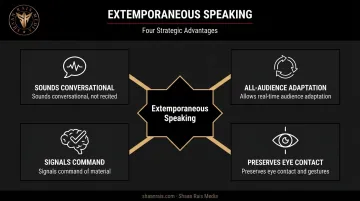
Why it works:
- Sounds conversational, not recited
- Allows real-time adaptation to audience reactions
- Signals command of the material without sounding rehearsed
- Preserves eye contact and natural gestures
The trade-off: It demands serious upfront preparation. You have to know your material well enough to speak from a skeleton outline rather than full sentences. Skip that prep and extemporaneous delivery collapses into disorganized rambling — the exact risk it's supposed to avoid.
This is the method suited for the vast majority of speeches, presentations, and professional talks where both credibility and audience connection are on the line.
How to Choose the Right Method of Delivery
The right method depends on occasion, stakes, and available prep time, not on which style feels most impressive from the outside.
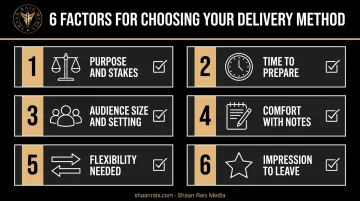
Run through these factors before your next talk:
- Purpose and stakes — Is this legal, ceremonial, informative, or persuasive? Higher legal or reputational risk pushes toward manuscript.
- Time available to prepare — A same-day request rules out memorization; a month of lead time opens up every option.
- Audience size and setting — A formal stage, a boardroom, a virtual call, and a casual team meeting all call for different approaches.
- Comfort with notes versus speaking freely — Some speakers genuinely perform better with a light outline; others freeze the moment they see bullet points.
- Flexibility needed in the moment — Will you need to adjust based on audience reactions, questions, or energy in the room?
- The impression you want to leave: extemporaneous delivery often works best for executives and founders building a public profile, since it signals command of the material without sounding scripted.
That last point matters more than most speakers realize. A founder pitching investors or an executive giving a keynote is being evaluated as a leader in real time, not just judged on the information delivered.
Delivery that sounds rehearsed-but-alive tends to land better than delivery that sounds stiff or unprepared. How you say something often shapes your authority as much as what you say.
Common Mistakes to Avoid When Choosing a Delivery Method
Most delivery mistakes come from choosing out of habit or nerves, not strategy. Watch for these:
- Nervous defaulting: Choosing manuscript or memorized delivery because it feels safer, not because the occasion calls for it
- Underestimating extemporaneous prep: "Conversational" doesn't mean "unrehearsed" — this method still demands real practice time
- Ignoring audience and setting: Memorizing a speech for a large formal event, where one memory lapse in front of hundreds could derail the entire speech
- Repeating past choices: Sticking with what worked before instead of matching the method to this speech's specific purpose and stakes
A method that worked brilliantly for a five-minute toast won't necessarily work for a 45-minute keynote to 500 people. Even in a 40-minute keynote setting, the stakes of a mismatched method compound fast — match the tool to the job at hand, not the one from last time.
Conclusion
Delivery isn't a single skill — it's a choice among four distinct methods, each built for different occasions and different levels of preparation.
Manuscript locks in precision. Memorization frees up eye contact for short, polished moments. Impromptu handles the unexpected. Extemporaneous balances preparation with natural, adaptable delivery for most professional situations.
Understanding these differences means you can prepare strategically instead of guessing and hoping it works out. The stakes go beyond a single speech, too. The delivery method someone chooses, whether on stage or in a boardroom, becomes part of how colleagues, clients, and audiences read their authority long after the talk ends.
Frequently Asked Questions
What is delivery in public speaking?
Delivery is the vocal and physical execution of a speech — pacing, eye contact, gestures, and vocal variety. It's distinct from the speech's content or organizational structure.
What are the main methods of delivery in public speaking?
The four methods are manuscript (word-for-word script), memorized (committed to memory), impromptu (little to no preparation), and extemporaneous (prepared but delivered from notes, conversationally).
Which delivery method is best for public speaking?
Extemporaneous delivery is generally recommended for most professional speaking situations because it balances preparation with natural connection. Still, the right choice depends on the occasion and what's at stake.
What are the key delivery skills in public speaking?
Core delivery skills include vocal variety, eye contact, body language, and pacing. Mastering these matters more than which method you choose, since they affect how any method comes across.
What is the difference between impromptu and extemporaneous speaking?
Impromptu means speaking with little to no advance preparation. Extemporaneous involves full research and rehearsal, delivered conversationally from a brief outline rather than a script.
Can you combine different methods of delivery in one speech?
Yes. Many speakers blend approaches, such as memorizing a strong opening line for impact, then shifting to extemporaneous delivery with notes for the rest of the talk.