Hybrid schedules, AI-generated dashboards, and four generations working side by side have rewritten the rules. Employees no longer want a boss who just directs traffic. A 2025 Deloitte survey of over 23,000 Gen Z and millennial workers found that 44% of Gen Z respondents had already left a job because it lacked purpose. Meanwhile, only 6% named "becoming a leader" as their top career goal.
That's the tension every leader now sits inside: deliver hard results while genuinely investing in people who may not even want your job. This article breaks down what leadership looks like today, the five C's separating strong leaders from struggling ones, and a skill almost nobody talks about, leading your own visibility in the market.
Key Takeaways
- Modern leadership requires measurable results and real investment in people's growth and autonomy
- Credibility, connection, and courage now matter as much as strategy when building a team that delivers results
- AI and remote work have turned emotional attunement into a core leadership skill, not an optional soft skill
- External perception now drives as many career opportunities as internal performance metrics do
What Does Leadership Look Like Today?
Leadership today gets measured on two tracks at once: Did you hit the target? And did the people on your team actually grow while helping you get there?
That second question used to be optional. Not anymore.
From Command-and-Control to Context-Sharing
The old model, give orders, expect compliance, is losing ground fast. A systematic review of 43 studies spanning 1966 through 2021 found that authoritarian leadership was consistently linked to worse performance, higher turnover intention, and weaker follower commitment. Compare that to empowering leadership styles, which a separate meta-analysis of 105 samples tied to stronger creativity, job satisfaction, and organizational commitment.
Today's leaders are expected to:
- Share context, not just instructions
- Admit uncertainty instead of projecting false confidence
- Treat mistakes as data, not liabilities
- Build psychological safety into daily interactions
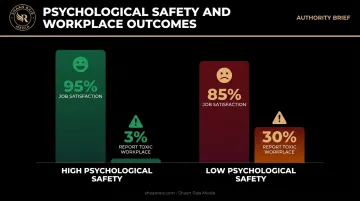
That last point matters more than it sounds. In an APA survey of over 2,000 U.S. workers, employees with high psychological safety reported 95% job satisfaction, compared to 85% for those without it. Only 3% called their workplace "toxic," versus 30% among low-safety teams.
Presence Isn't Physical Anymore
Psychological safety used to build itself through hallway conversations and shared physical space. Hybrid teams don't get that for free.
Leaders now have to create those moments deliberately. That means scheduling one-on-ones with no agenda beyond checking in, naming tension on video calls instead of letting it sit unspoken, and making remote wins as visible as in-office ones. Skip this, and trust doesn't fail loudly — it just quietly erodes.
The Real Marker of Good Leadership: What Happens After You Leave
Here's the uncomfortable truth: your leadership isn't judged by what happens while you're in the room. It's judged by whether your team can still perform, grow, and produce new leaders after you're gone. The Center for Creative Leadership frames succession planning as a regenerative strategy, not a backup plan; it's about building a talent pipeline strong enough to survive your exit.
The Key C's of Leadership Today
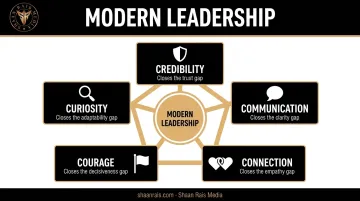
Five traits separate leaders who thrive from those who quietly lose their teams. Call them the five C's.
Credibility
Credibility today isn't inherited from a title. It's built through consistency and follow-through, showing up the same way under pressure as you do in calm moments. This matters more than ever: DDI's Global Leadership Forecast found that trust in immediate managers dropped from 46% in 2022 to just 29% in 2025, based on responses from nearly 11,000 leaders. That's a steep collapse in a short window, and it means credibility can no longer be assumed. It has to be earned repeatedly, the same way positioning has to be earned before a market extends trust or premium pricing to a professional.
Communication
Regular, two-way communication kills uncertainty before it spreads. Teams don't need constant good news. They need honest updates delivered consistently, even when the news is mixed. Leaders who skip this step leave employees guessing, and guessing breeds anxiety.
Connection
Empathy and genuine curiosity about people's different perspectives are no longer "soft skills" filed under nice-to-have. They're core competencies. DDI's 2025 forecast places authentic human connection alongside trust and employee growth as central capabilities leaders need amid AI disruption.
Courage
Courage means:
- Making a clear call when the data is incomplete
- Having the hard conversation instead of avoiding it
- Killing a strategy that isn't working, even if you championed it
Deloitte's research on inclusive leadership, drawn from over 1,000 global leaders, names courage as a signature trait, specifically the willingness to challenge the status quo while staying humble enough to admit you might be wrong.
Curiosity
Courage gets a leader to act. Curiosity determines what they do next. Leaders who treat disruption, whether it's AI, market shifts, or new competitors, as an opportunity tend to outperform those clinging to the original plan. Rigid leaders get blindsided; curious ones adapt and pull their teams along with them.
Essential Qualities of Effective Modern Leaders
Beyond the five C's, a handful of underlying qualities determine whether a leader actually executes on them.
Emotional Intelligence Isn't Optional Anymore
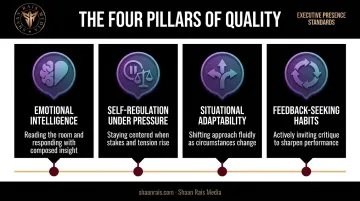
Daniel Goleman's landmark analysis of competency models across 188 large companies found that emotional intelligence mattered twice as much as technical skill and IQ combined when predicting performance. At senior levels, EI accounted for nearly 90% of the gap between star performers and average ones.
More recent research backs this up. A cross-cultural meta-analysis found that a leader's emotional intelligence predicts subordinate job satisfaction, task performance, and turnover intention, independent of cognitive ability or personality traits.
Self-Regulation Under Pressure
Leaders who pause before reacting build more trust than those who fire off decisions in the heat of the moment. It's a simple behavior with an outsized payoff: teams learn they can bring bad news without triggering chaos.
Consider a leader who receives news of a missed deadline. Reacting with composure instead of blame signals that mistakes get solved, not punished, so the next problem surfaces early rather than getting hidden.
Situational Adaptability
Not every team member needs the same leadership style. The Hersey-Blanchard model argues leaders should flex between directive and supportive approaches depending on a person's competence and confidence level. It's not perfectly validated across every setting, but the core idea holds up: one-size-fits-all leadership fails individuals.
Feedback-Seeking Habits
A meta-analysis of 24 longitudinal studies on 360-degree feedback found modest but real performance improvements, particularly when leaders accepted the need to change, set specific goals, and took action. Leaders who ask "what am I missing?" tend to keep improving. Those who don't, plateau.
How Technology, AI, and Remote Work Are Reshaping Leadership
AI isn't replacing leadership judgment, but it is changing what leaders spend their time doing. Deloitte's Global Human Capital Trends research found that 60% of executives now regularly use AI to support decisions. The catch: adoption is often outpacing governance, meaning leaders need to actively decide where AI informs a decision versus where human judgment should override it.
That same judgment call extends to distributed teams, where leaders face a different set of decisions entirely.
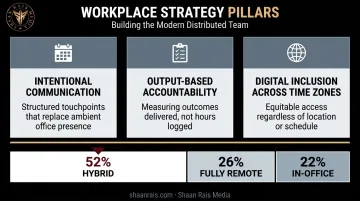
Three Pillars of Remote and Hybrid Leadership
- Intentional communication - nothing happens by accident on a distributed team, so check-ins and context-sharing need to be scheduled, not assumed
- Output-based accountability - measuring results instead of hours logged or webcam time
- Digital inclusion across time zones - making sure async workers get the same access to information and mentorship as in-office staff
These pillars matter because hybrid work isn't a fringe arrangement anymore. Gallup reports that among U.S. remote-capable employees, 52% work hybrid schedules and 26% work fully remote as of Q2 2025. And the effectiveness case is building: a randomized trial of over 1,600 employees at Trip.com found hybrid work reduced quit rates by roughly a third, with no drop in performance reviews or promotion rates.
Beyond the Team: Why Modern Leaders Must Also Lead Their Own Narrative
Internal leadership skills, trust-building, decisiveness, communication, are necessary. They're just not sufficient anymore.
How a leader is perceived outside their organization, by their industry, their market, their future employers or investors, increasingly shapes the opportunities that come their way. Edelman's global survey of over 32,000 respondents found that 62% expect CEOs to help manage changes happening in society, not just inside their own businesses.
Leadership has become a public act, whether leaders asked for that or not.
This is the core idea behind what Shaan Rais calls Perception Engineering: the market usually isn't missing capable leaders. It's missing leaders whose positioning hasn't caught up with their capability. Rais, an Industrial-Organizational Psychologist who has worked with 400+ operators across 50+ industries, built his entire practice around a simple observation: the most positioned professionals command more trust and pricing than the most talented ones who stay invisible.
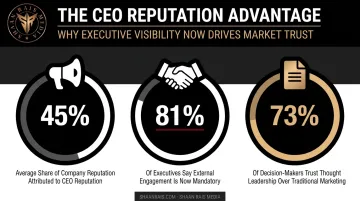
There's data behind the instinct, too. Edelman and LinkedIn surveyed nearly 3,500 management-level professionals and found that 73% of decision-makers trust an organization's thought leadership more than traditional marketing materials when assessing capability.
Separately, Weber Shandwick's global survey of over 1,700 executives found that CEO reputation accounts for an average of 45% of total company reputation. Notably, 81% said external engagement has become mandatory for building that reputation.
The pattern is consistent:
- Founders who build visibility alongside their skills earn trust faster
- Executives who share their thinking publicly get considered for opportunities they'd otherwise miss
- Consultants who position themselves clearly command premium pricing instead of competing on price
This pattern is exactly what Rais's programs, including Branded Like a Leader, are built to produce: positioning leaders for their ideal audience rather than teaching them to "sell themselves." One client, Thomas Taylor, generated $20,000 in a single month after enrolling, more than his entire previous year's revenue, in under 90 days. Correct positioning, not extra hours, drove that result.
Internal trust gets you promoted. External authority gets you recognized, referred, and paid what you're actually worth. Leaders who build both turn two separate advantages into one compounding career asset.
Frequently Asked Questions
What does leadership look like today?
Today's leadership blends measurable results with genuine investment in people's growth, transparency, and adaptability. It requires leading dispersed, multi-generational teams without relying on old command-and-control habits.
What are the key C's of leadership today?
Credibility, communication, connection, courage, and curiosity form the core traits distinguishing effective modern leaders. Each one maps to a specific gap: trust, clarity, empathy, decisiveness, or adaptability.
What is the difference between leadership and management today?
The distinction has less to do with title and more to do with outcomes. Leadership means consistently delivering results while actively developing the people around you, not just directing their tasks.
How has remote work changed leadership expectations?
Remote work shifted the emphasis toward intentional communication, output-based accountability, and digital inclusion. Physical presence no longer signals commitment or performance the way it once did.
Can leadership skills be learned, or are leaders born?
Skills like communication, empathy, and decisiveness can be developed through practice, coaching, and consistent feedback. Research on 360-degree feedback shows measurable improvement when leaders actively act on what they learn.
Why does personal branding matter for leaders today?
Visibility and positioning increasingly determine how a leader's expertise gets recognized and rewarded. Capability alone doesn't guarantee trust or premium opportunities; positioning closes that gap.