Here's the uncomfortable truth: talking at people isn't the same as moving them. Talented professionals broadcast their expertise constantly, credentials, updates, announcements, and still fail to build the two-way trust required to get people to act. This confusion between communication and engagement quietly kills change initiatives, stalls careers, and flattens personal brands that should be taking off.
This article breaks down what these two terms actually mean, the four components that separate real engagement from noise, and how positioning determines whether your message lands at all.
Key Takeaways
- Communication informs; engagement builds trust and drives action — you need both
- Only 20% of employees globally are engaged, according to Gallup's State of the Global Workplace report, meaning most communication efforts fail to create real buy-in
- Four components : clarity, trust, purpose, and participation decide whether your message sticks or gets ignored
- Strong positioning makes your message land faster before you even speak
What Does Engagement Mean in Communication?
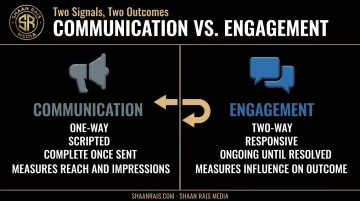
Communication is the transmission of a message. It's one-way by design: an announcement, an email, a press release. You send it. The receiver gets it. That's the whole transaction.
Engagement works the opposite way. It's an active, two-way process where your audience responds, pushes back, asks questions, and helps shape what happens next. Public participation frameworks call this the "inform vs. influence" distinction — informing tells people what's happening; influencing lets them affect the outcome.
The difference shows up fast when you compare the two side by side:
- Communication: One-way, scripted, complete once sent
- Engagement: Two-way, responsive, ongoing until resolved
- Communication: Measures reach and impressions
- Engagement: Measures influence on the actual outcome
Put simply: communication answers "what is happening." Engagement answers "how do you feel about it, and what do you want to do about it."
The Loudspeaker vs. the Conversation
Think of a loudspeaker at a rally. It's loud, clear, and reaches everyone in range. But nobody can talk back. Now think of a conversation across a table. It's slower, messier, and far more powerful, because both people are shaping where it goes.
Most corporate messaging is a loudspeaker dressed up as a conversation — and that disguise has a name.
The Communication Theater Trap
"Communication theater" describes leaders who talk at people while mistaking activity for actual buy-in. They hold the town hall. They send the newsletter. They check the box.
But if nobody's opinion changes the outcome, it's theater, not engagement. And over time, employees and audiences notice. Trust erodes every time the "feedback" loop turns out to be one-directional.
Why Communication and Engagement Are the Backbone of Success
The gap between the two isn't theoretical. It shows up directly in performance numbers.
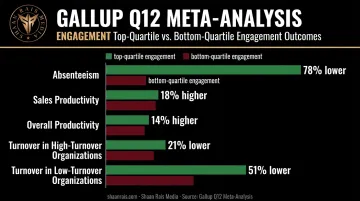
Gallup's 11th-edition Q12 Meta-Analysis, covering 183,806 business units and over 3.3 million employees across 53 industries, found stark differences between top-quartile and bottom-quartile engagement teams:
| Outcome | Top vs. bottom-quartile difference |
|---|---|
| Absenteeism | 78% lower |
| Sales productivity | 18% higher |
| Overall productivity | 14% higher |
| Turnover (high-turnover orgs) | 21% lower |
| Turnover (low-turnover orgs) | 51% lower |
Globally, only 20% of employees are engaged, while 64% are not engaged and 16% are actively disengaged, according to Gallup's State of the Global Workplace data. Gallup estimates this disengagement costs the world economy roughly $10 trillion, about 9% of global GDP.
Change Fails Where Communication Fails
Change initiatives collapse for the same reason. McKinsey's transformation research found transformation success was 5.8 times more likely when CEOs told a compelling change story, and 6.3 times more likely when senior leaders communicated aligned messages. When frontline employees felt no ownership at all, success rates dropped to just 3%.
A common failure pattern: a leader rolls out a bold new vision in a single all-hands meeting, assumes alignment because nobody objected in the room, then watches key people quietly disengage and leave within months. The strategy wasn't wrong. The team was never actually brought into it.
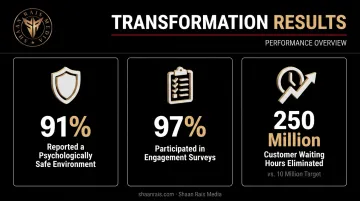
A contrasting example: DBS Bank's transformation into a technology-led institution embedded engagement directly into the rollout. Process Improvement Events let employees redesign their own workflows, while "Meeting MOJO" practices gave everyone equal voice in discussions.
The results were measurable:
- 91% of employees reported a psychologically safe environment
- 97% participated in engagement surveys
- The bank eliminated 250 million customer waiting hours against an initial target of just 10 million
The same principle scales down to individuals. Visibility and trust aren't the same thing: visibility gets you attention, while trust converts that attention into opportunity.
Shaan Rais has seen this play out directly in his own keynote work. One presentation generated $250,000 in new business closed within 72 hours, with 60 strategy calls booked in a single day — a result that only happens when an audience feels personally seen and engages enough to act immediately.
The 4 Core Components of Engagement
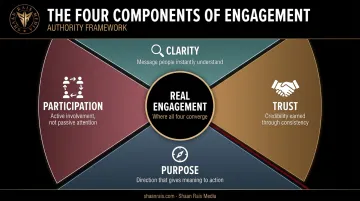
Real engagement isn't a vibe. It's built from four specific ingredients, each grounded in established research on workplace and public engagement.
1. Clarity
People need a message they can actually repeat back. Gallup's Q12 survey opens with exactly this: "I know what is expected of me at work." Confusing messaging kills engagement before it starts.
2. Trust
Openness and authenticity remove the fear of hidden agendas. Organizational psychologist William Kahn's foundational research identifies psychological safety as a core condition for engagement, meaning people can show up without fear of career consequences.
3. Purpose
People need a "why" that connects their role to something bigger. Gallup's data backs this directly, with items like "the mission of my company makes me feel my job is important."
4. Participation
This is where passive reception becomes co-ownership. It maps to the "Involve," "Collaborate," and "Empower" tiers of the IAP2 Spectrum of Public Participation, where the audience actually shapes the decision instead of just hearing about it.
Put all four together and the effect compounds. A leader who holds an open Q&A forum demonstrates clarity (answering directly), trust (no scripted deflection), purpose (tying answers back to the mission), and participation (letting the questions actually steer the conversation). Remove any one component, and the forum turns into theater fast.
Practical Strategies to Build Real Engagement
Strategies for Leaders and Teams
Building engagement inside an organization takes structure, not good intentions. Try these:
- Build two-way channels, not one-off announcements — town halls, structured team check-ins, and pulse surveys create ongoing dialogue instead of a single broadcast moment
- Involve people before plans are finished — the "co-create vs. inform-only" distinction matters; people who help shape a decision defend it later
- Celebrate milestones publicly — recognition signals that participation is noticed and valued, not just tolerated
Gartner's 2025 research backs the involvement point directly: organizations that regularly adapt change plans based on employee feedback are four times more likely to achieve change success, according to a Gartner survey of 313 senior-level respondents.
Gartner also warns against over-involving employees in every decision — that habit can slow progress and create its own burnout.
Strategies for Personal and Market-Facing Communication
The same feedback loop matters outside the org chart too. For founders, consultants, and experts, engagement follows the same logic but looks different in practice: consistent, authentic content and direct interaction with your audience, not just broadcasting credentials and hoping people notice.
Here's the part most people skip: positioning has to happen before tactics. Audiences engage faster with people whose identity and expertise are already clearly defined. If your market position is fuzzy, no amount of posting frequency fixes that.
Shaan Rais's Perception Engineering methodology tackles this exact positioning-before-tactics problem through his 120-Day Personal Brand Legacy Protocol. The approach moves through distinct phases:
- Perception Diagnosis — identifying the specific gap between your actual capability and current market recognition
- Core Positioning Refinement — defining what makes you the only logical answer to a specific problem, not one option among many
- Brand Messaging Creation — translating that positioning into consistent voice, narrative, and copy across every channel
- Conversion System Development — building the pipeline that turns market perception into actual booked business
- Premium Brand Identity — locking in a visual and verbal presence that supports premium pricing
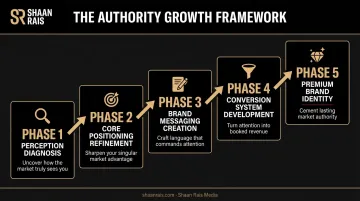
Running through all five phases is the CSA Method: Clarify your message, Simplify it until it's unmistakable, then Amplify it to your audience. Skipping straight to amplification before the message is clarified is the single most common way experts waste their marketing budget and confuse the exact audience they're trying to engage.
Frequently Asked Questions
What does engagement mean in communication?
Engagement means moving past one-way messaging into a two-way exchange, where your audience responds, asks questions, and helps shape the outcome. It's the difference between talking at people and talking with them.
What are the 4 components of engagement?
The four components are clarity, trust, purpose, and participation. Together they determine whether a message actually lands or gets tuned out entirely.
What is an example of engagement?
A leader hosting an open Q&A forum, where questions genuinely steer the discussion, is a solid example. So is a brand that responds to audience feedback and visibly acts on it.
What is the difference between communication and engagement?
Communication shares information in one direction. Engagement builds a relationship where the audience actively participates in shaping decisions and outcomes, not just receiving updates.
How can leaders improve employee or audience engagement?
Build consistent two-way channels like pulse surveys and open forums, stay transparent about decisions, and give people real input, not just a chance to comment after the fact.
Why does positioning matter for effective communication?
Clear positioning builds trust before you ever speak. When your expertise is already well-defined, your audience is primed to listen, so your message lands faster and carries more weight.