
Many capable experts still under-deliver on stage. They obsess over content instead of command, then wonder why the room forgets them by lunch. Meanwhile, the speaker before them said less but was remembered more.
This post breaks down five specific, practical ways to own the stage. We'll cover what happens before you speak, how you open, your body language, your vocal control, and how you close. Master these, and audiences remember you, not just your slides.
Key Takeaways
- Positioning yourself as the authority before you speak changes how the room listens
- Your first and final 60 seconds shape most of what the audience remembers
- Physical presence and vocal control are trainable skills anyone can build
- Stage command builds your personal brand well beyond the applause
5 Ways to Own the Stage With Your Presentation
Each of these builds on the last. We'll move chronologically: from the moment you're visible to the room, through your opening, your physical presence, your voice, and finally your close.
Way 1: Own the Room Before You Say a Word
Stage command starts the second you're visible, not when you start talking. Posture, stillness, and a confident walk to your spot all set the tone before your first word lands.
Researchers Ambady and Rosenthal found that observers rated silent video clips of teachers, some as short as two seconds, and those ratings predicted end-of-term evaluations months later. It's classroom research, not a keynote study, but the mechanism translates directly to stages: people form snap judgments from nonverbal behavior before a single sentence is spoken.
Here's the move:
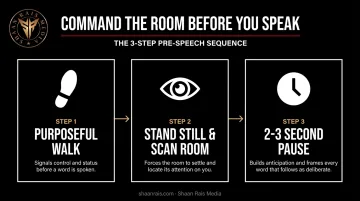
- Walk to your spot with purpose. No shuffling, no fumbling with notes.
- Stop. Stand still. Look at the room.
- Pause for 2-3 seconds before you speak.
That pause feels uncomfortable the first few times you try it. Do it anyway — the discomfort is doing its job. Speech coach Nick Morgan recommends finishing housekeeping, going still, and holding a 3-second pause before beginning your substantive opening. It forces the room to settle and gives the audience a reason to focus on you rather than their phones.
This is pre-framing. How you occupy the room before speaking sets the audience's expectations before they've read your bio, seen your title slide, or heard your credentials. You're teaching them how to categorize you in real time.
Way 2: Open With a Hook That Establishes Authority, Not Just Curiosity
Most speakers reach for a curiosity hook: an interesting fact, a surprising statistic, a "did you know" moment. That's fine, but it's not enough. An authority hook does something different: it signals you've earned the right to be believed, not just to be heard.
The difference matters more than people think:
- Curiosity hook: "Did you know 90% of startups fail?"
- Authority hook: "I've sat across the table from 400 operators who thought they had a marketing problem. Almost none of them did."
An authority hook works because it's specific, personal, and tied to lived experience. Try one of these formats:
- A bold, specific claim rooted in something you've actually done or seen
- A contrarian statement that challenges the room's assumption about the topic
- A rapid credibility marker woven into a story, not read off a title slide
Avoid the generic "Thanks for having me, I'm so excited to be here." It burns your first 15 seconds on nothing. Open on the insight the audience is about to get instead.
Chris Anderson, who runs TED, has described how speaker Richard Turere's original explanation of his lion-deterring invention was reshaped into a personal narrative and rehearsed extensively before it earned a standing ovation on the TED stage. The content barely changed. The framing did — and that's what earned the ovation. It's the same principle behind Perception Engineering: your capability doesn't shift, but how the room receives it can transform completely.
Way 3: Command the Room With Physical Presence
Your body talks before your mouth does. Researchers coding 22 nonverbal behaviors across 60 videotaped speakers found that persuasiveness correlated with vocal pleasantness, fluency, and kinesic immediacy. How you move and hold yourself is a credibility signal, not decoration.
Eye contact, done right:
- Hold your gaze on one section of the room for a few seconds at a time
- Avoid rapid scanning, which reads as nervous energy
- Don't force a rigid stare either. Research on persuasion shows that overly intense, sustained eye contact can actually backfire with audiences who already disagree with you. Natural, distributed contact beats a fixed formula.
Movement with purpose:
- Walk to punctuate a transition between ideas, not to burn nervous energy
- Use stillness deliberately during your most important point. Standing still while the room is quiet draws focus like nothing else.
- Step out from behind the podium or laptop when you can. Closing that physical gap closes psychological distance too.
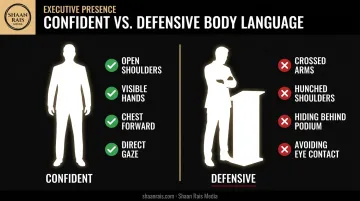
Open, expansive posture (shoulders back, hands visible, chest open) reads as confident. Crossed arms, hunched shoulders, or hiding behind a laptop reads as defensive, whether or not that's your intent.
Way 4: Control the Room's Energy With Your Voice and Pauses
Monotone delivery is one of the fastest ways to lose a room. Doesn't matter how good your content is. If your voice doesn't move, the room's attention won't either.
Vocal variety is your primary tool:
- Vary your pace — speed up for energy, slow down for weight
- Vary your volume — a quieter moment can land harder than a loud one
- Vary your tone — flat delivery signals disinterest even when you're not disinterested
This directly affects how the room rates you. The same 60-speaker study cited above found pitch variety and vocal fluency tied directly to perceived persuasiveness.
Next, there's the pause — probably the most underused tool in the room. Morgan's coaching guidance recommends pausing before a key statement and again after it, letting the point land instead of rushing past it to fill silence. Silence feels awkward to the speaker. It rarely feels awkward to the audience.
On filler words:
- Record yourself rehearsing. You will hear things you don't notice live.
- Research comparing "um" against silent pauses found that speakers who used "um" didn't score better on any measured trait compared to those who simply paused.
- A silent pause reads as confidence. A filler word reads as searching for the next thought.
Way 5: Close Like You Mean It
A weak ending erases the authority you built for the previous 45 minutes. "So, uh, I guess that's it" undoes real work in five seconds.
Closing options that hold the room:
- A clear call to action — something the audience can actually execute, not a vague inspirational note
- A callback to your opening hook — bookend the talk so it feels complete
- A memorable, quotable line — something the room can repeat to someone else afterward
- A direct statement of what changes now — tell the room plainly what's different because they listened
TEDx's own speaker guidance is blunt about this: a call to action has to be something attendees can actually act on, and it should never turn into a pitch for funding or a product plug. Save the ask for a follow-up conversation, not the final slide.
Then stop. Pause. Hold eye contact. Walk off with the same purpose you walked on with. No trailing off, no apologetic shrug — the last thing the room sees should match the authority you opened with.
Common Mistakes That Undermine Stage Presence
Even strong content gets buried by these habits:
- Opening with an apology. "Sorry, I'm a little nervous" or "sorry for the tech issues" signals low status before you've said anything substantive. Presentation coach Deborah Grayson Riegel advises cutting the apology entirely unless something genuinely requires acknowledgment.
- Reading directly off slides or notes. This breaks eye contact and instantly signals under-preparation. TEDx's speaker guidance is explicit that slides shouldn't double as your script.
- Overloading the talk without pauses. Data dumps without breathing room lose the room fast — the fix is more space between ideas, not fewer of them.
Turning Stage Presence Into Lasting Personal Brand Equity
A commanding presentation is a moment. The real opportunity is compounding that moment into how the market remembers, categorizes, and prices you afterward.
Here's the catch most speakers miss: the way you're perceived on stage has to match how you're positioned everywhere else. Your bio, your LinkedIn, your website. If the confident, authoritative version of you only exists for 45 minutes under stage lights, the impression fades within days.
Shaan Rais, an Industrial-Organizational Psychologist known for his work in personal branding, calls this Perception Engineering : the deliberate architecture of how you're seen, categorized, and remembered, on stage and everywhere else. His view is direct: the market isn't missing capable operators because they lack talent. It's missing them because their positioning hasn't caught up with their capability.
He's applied this idea in his own keynote work. During a talk called "Positioning Creates Opportunity," delivered to a room of business operators, he used a simple comparison to make the point land: a Lamborghini and an Audi can share nearly identical specs, yet the Lamborghini commands double the price. That gap is pure perception, not performance.
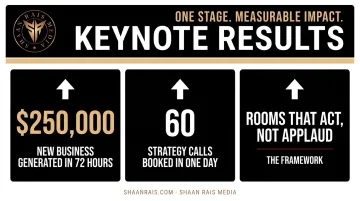
The results from that single keynote:
- $250,000 in new business generated within 72 hours
- 60 booked strategy calls in one day
- A framework Shaan calls "Rooms That Act, Not Applaud" — talks engineered as conversion moments, not performances
The takeaway for your next presentation: your positioning shouldn't rely on chance. Make sure the room's memory of you matches exactly what they find the moment they look you up afterward.
Frequently Asked Questions
What is the 5-5-5 rule for presentations?
It's a slide design heuristic: no more than five words per line, five lines per slide, and no more than five text-heavy slides in a row. It's a popular guideline for keeping slides digestible, though it's not a formally validated law.
What are the 5 C's of a presentation?
One commonly cited version defines strong communication as clear, concise, confident, credible, and compelling. Treat it as a useful evaluation framework, not a universal standard, since different coaches define it differently.
What's a better way to say "presented a presentation"?
Try "delivered a presentation," "gave a talk," "led a session," or "presented findings." Any of these avoid the redundant repetition while sounding more natural.
How do I stop feeling nervous when I'm on stage?
Prepare and rehearse out loud until the material feels automatic, use slow breathing before you walk on, and reframe the adrenaline as enthusiasm rather than fear. The physical sensation is nearly identical either way.
How long should I practice before a big presentation?
A widely cited Harvard Business Review benchmark is roughly 10 times the length of your talk, rehearsed out loud and ideally in front of a real listener. Mental run-throughs alone aren't enough.
What makes a presenter look confident on stage?
Steady (not rigid) eye contact, open posture, controlled pacing, and purposeful pauses. These are the visible markers audiences consistently associate with confidence, and all of them are learnable.