Their team hits a great quarter, then stumbles for two. A star performer carries the group, then burns out. Everyone celebrates a big win, then struggles to repeat it. This is the gap between having leadership skills and actually building a team that performs on command.
Gallup's research puts a number on how much this matters: managers account for at least 70% of the variance in employee engagement across business units. That's not a minor factor. That's the whole ballgame.
This article breaks down what high-performance leadership actually means, the traits that separate leaders who build lasting teams from those who don't, and a factor most leadership content skips entirely: how a leader is perceived by their own team.
Key Takeaways
- High-performance leadership means sustainable results over time, not sporadic wins followed by slumps
- Vision, resilience, emotional intelligence, accountability, and a growth mindset consistently define effective leaders
- Clarity, psychological safety, and hard conversations build high-performing teams; talent alone falls short
- How a leader is perceived directly shapes their trust, buy-in, and loyalty
What Is High-Performance Leadership?
High-performance leadership is the ability to create conditions where a team consistently delivers strong results — and keeps adapting as circumstances change. It's not about how hard the leader works. It's about what the team produces when the leader isn't in the room.
The core distinction is intensity versus consistency. Some leaders and teams run hot, then cold. They pull off an impressive sprint, then coast for weeks. Others build systems and habits that produce steady output regardless of mood, energy, or crisis. The second group is what we mean by "high performance."
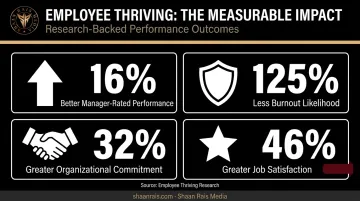
Harvard Business Review frames this slightly differently through the lens of employee "thriving" — combining vitality with continuous learning. Employees who experience both show:
- 16% better manager-rated performance
- 125% less likelihood of reporting burnout
- 32% greater organizational commitment
- 46% greater job satisfaction
Those numbers point to the same conclusion: systems that sustain people outperform systems that just push them harder.
Why This Matters More Right Now
Hybrid work has changed the equation. McKinsey's 2021 survey of 100 executives found 90% expected to run a hybrid model going forward — yet most hadn't settled the operational details of how it should actually work.
Leaders can no longer rely on physical presence, daily check-ins, or informal hallway conversations to keep a team aligned. High-performance leadership scales through other people, not through the leader's personal output. Without deliberate systems for clarity and trust, hybrid teams drift apart fast.
Key Qualities of High-Performance Leaders
Certain traits show up consistently in leaders who build teams that deliver, quarter after quarter.
Visionary
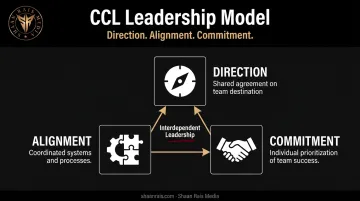
High-performance leaders set a direction the whole team can see and rally around. That direction has to be concrete and repeatedly communicated, not a slogan on a wall — it needs to connect daily tasks to a bigger outcome. CCL's Direction-Alignment-Commitment model captures this well:
- Direction: Shared agreement on where the team is headed and why
- Alignment: Coordinated systems and processes that support that direction
- Commitment: Individual willingness to prioritize the team's success over personal agendas
Resilient
Setbacks happen. What separates resilient leaders is how they respond. HBR's interviews with 150 successful leaders across 15 organizations found that resilience depends heavily on relationships — leaders who lean on others to shift workloads, process adversity, and reconnect with purpose recover faster than those who go it alone.
Emotionally Intelligent
Self-regulation and social awareness keep a team stable when pressure spikes. Meta-analysis research shows corrected correlations between emotional intelligence and job performance in the r = 0.24 to 0.30 range — meaningful, even after accounting for cognitive ability and personality traits. A leader who stays composed during a crisis sets the emotional tone for everyone underneath them.
Accountable
Owning both wins and losses builds credibility fast. Gallup describes effective accountability as clear expectations paired with consistent follow-through — not just admitting fault after a mistake, but setting a visible standard the team can actually model.
Growth-Oriented
Setbacks become data, not verdicts. Carol Dweck's research on growth mindset warns against oversimplifying this into "just praise effort" — real growth-oriented leadership means building systems that reward learning, risk-taking, and improved process, not just outcomes.
Empathetic and People-Focused
Understanding what actually motivates each team member, beyond a paycheck, builds the kind of loyalty that survives hard seasons. This trait gets skipped first when leaders get busy — and it's usually the first thing employees notice is missing.
How to Build a High-Performing Team: Core Leadership Practices
Traits matter, but practices are what actually build the team. Here's what separates leaders who build lasting performance from those who don't.
Create Clarity
Every team member needs to know:
- What the goal is
- Why it matters
- How their specific work connects to it
Vague direction produces vague effort. Locke and Latham's decades-long research on goal setting found specific, difficult goals consistently outperformed vague "do your best" targets, with effect sizes between d = 0.52 and 0.82 — though results depend on feedback, commitment, and task complexity.
Build Trust and Psychological Safety
Google's Project Aristotle studied 180 internal teams and found psychological safety was the single most important factor separating high-performing teams from average ones — ahead of skill, resources, or even clarity of role.
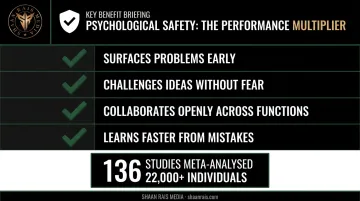
Teams with psychological safety:
- Surface problems early instead of hiding them
- Challenge ideas without fear of retaliation
- Collaborate more openly across functions
- Learn faster from mistakes
A separate meta-analysis spanning 136 samples and more than 22,000 individuals confirmed psychological safety adds predictive value for team performance even after accounting for engagement and work design.
Hold Consistent High Standards
Standards that shift depending on mood or convenience erode trust fast. High-performance leaders:
- Set the bar once and hold it steady, regardless of workload or mood
- Model the same standard they expect from the team
- Apply the standard consistently across every project, not just high-visibility ones
This is where accountability and consistency intersect.
Have Courageous Conversations
Avoiding a hard conversation doesn't make the problem disappear — it lets it compound. A SHRM-reported poll of 540 people found roughly half avoided addressing a difficult workplace issue directly, sometimes for years. Separately, a Crucial Learning survey of 1,100 employees found 43% spent at least two weeks ruminating over an unresolved issue at work.
Addressing performance gaps or team tension directly — even when it's uncomfortable — keeps small issues from becoming culture-wide problems.
Invest in People Development, Not Just Output
Teams built purely around short-term output plateau. Leaders who invest in development instead:
- Coach individuals on skill gaps, not just performance metrics
- Mentor emerging talent to build future bench strength
- Build capacity that outlasts any single leader's day-to-day involvement
The payoff shows up as teams that keep improving long after the leader stops micromanaging results — a pattern reflected in coaching engagements where positioning and capability-building precede any tactical push.

Stay Adaptable
High-performing teams treat mistakes as feedback, not failure. They adjust the plan quickly instead of repeating the same error while hoping for a different outcome.
The Overlooked Lever: How Leadership Positioning Impacts Team Performance
Here's what most leadership advice misses: how a leader is perceived — by their team, their peers, and the broader market — directly shapes how much trust and buy-in they actually receive.
Two leaders can have identical strategies and skill levels. But if one is seen as credible, decisive, and visible in their field, their team follows with more conviction. The other leader might have the same capability but struggle to get the same commitment, simply because perception hasn't caught up.
This is the gap Shaan Rais, an Industrial-Organizational Psychologist and founder of his eponymous branding and positioning practice, calls Perception Engineering — the systematic work of closing the distance between what an operator can actually do and how the market, and their own organization, sees them.
Leaders with strong external credibility — media recognition, published thought leadership, a clear professional identity — tend to find it easier to:
- Attract top talent who want to work under a recognized name
- Retain employees who take pride in being associated with a credible leader
- Get faster buy-in on new initiatives, because the team already trusts their judgment
Positioning functions as an internal leadership asset, not a vanity project. A team follows a vision more confidently when the person delivering it has already demonstrated, visibly, that they know what they're doing.
As Rais puts it, "you are more valuable than you are visible." That gap between value and visibility shows up inside the org chart, not just in the marketplace.
Common Mistakes That Undermine Team Performance
Even skilled leaders fall into these traps.
Confusing bursts of intensity with real performance. A great month doesn't prove the system works. It might mean the team got lucky, or burned through reserves it can't replace. Trust erodes quietly when the next slump hits.
Avoiding difficult conversations. Letting misalignment or underperformance slide feels kind in the moment. It's actually the opposite: small friction compounds into resentment and disengagement over time.
Ignoring well-being while chasing output. Research across 15 countries has identified toxic workplace behavior, not workload, as the strongest predictor of burnout and intent to leave. Separate workplace studies point to similar drivers:
- 76% of employees report experiencing burnout at least sometimes
- Unfair treatment and unclear communication rank among the top causes
Frequently Asked Questions
What is high-performance leadership?
It's the ability to consistently create the conditions for a team to deliver strong results over time, not just occasional peak performance. The focus is on team-wide output, not individual heroics from the leader.
What are the key qualities of high-performance leaders?
Vision, resilience, emotional intelligence, accountability, and a growth mindset are the traits that show up most consistently. Empathy and people-focus round out the list, since teams follow leaders who understand what motivates them.
What are the 5 C's of high-performance leadership?
One widely used version includes Character, Competence, Communication, Commitment, and Courage. These traits reinforce the kind of trust and consistency that high-performing teams rely on.
What is the 70-20-10 rule for high-performance leaders?
It's a leadership development guideline suggesting roughly 70% of growth comes from on-the-job experience, 20% from mentoring and relationships, and 10% from formal training. The Center for Creative Leadership treats this as a reference point, not a rigid formula.
How do you build a high-performing team from scratch?
Start with clarity: define goals and success metrics everyone understands. Layer in trust-building and psychological safety, then hold consistent standards from day one. Talent matters less than the system you build around it.
What's the difference between a high-achieving team and a high-performing team?
High achievers produce strong results occasionally, often through individual effort or short bursts of intensity. High performers sustain results consistently, as a collective unit, over time.