That gap is where the modern people development professional lives. Not a traditional HR generalist. Not a corporate trainer running the same slide deck for the fifth year running. Someone who treats human potential as a strategic asset worth architecting, not just managing.
Here's the harder truth: many genuinely talented people go unnoticed inside their own organizations. They do great work and nobody sees it. Shaan Rais, founder of a personal branding and positioning practice, built his entire philosophy around this exact gap: "You are more valuable than you are visible." A skilled people development professional exists to close that gap — for individuals and for the organizations that employ them.
This article breaks down the seven skills that separate elite people developers from everyone else still running generic training programs.
Key Takeaways
- Effective people development rests on strategic coaching paired with I-O psychology principles
- Personal branding and perception management are now core, not optional, skills
- Development decisions should be driven by data, not gut feeling or the latest trend
- Growth only sticks when psychological safety is present and plans account for what's next
1. Strategic Coaching & Mentorship
Strategic coaching isn't telling people what to do. It's asking the right question at the right moment and letting them arrive at their own answer.
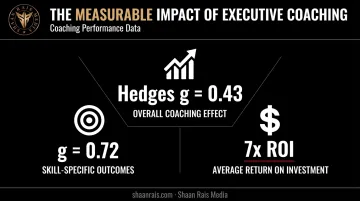
Workplace coaching produces a moderate but meaningful overall effect (Hedges g = 0.43), with skill-specific outcomes nearly double that (g = 0.72), according to a 2023 meta-analysis on workplace coaching effectiveness. The financial case is even stronger: a global survey by PwC and the International Coaching Federation found an average ROI of seven times the initial investment.
Spotting What Someone Could Become
The best people developers don't just evaluate current performance. They look past the job title to what an employee is actually capable of, given the right support.
That means:
- Asking open-ended questions instead of leading ones
- Noticing patterns in how someone solves problems, not just whether they solve them
- Treating career conversations as legacy conversations, not promotion checklists
Spotting potential is only half the work. Turning that observation into a repeatable skill takes deliberate practice.
How to Build This Skill
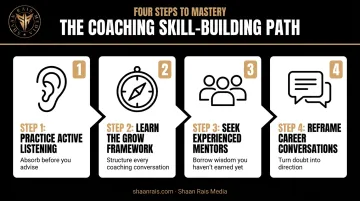
- Practice active listening: resist the urge to jump in with advice before someone finishes their thought
- Learn a formal framework, like GROW (Goal, Reality, Options, Will), a widely used model for structuring coaching conversations around performance and development
- Seek out mentors — experienced coaches who will critique your technique, not just your intentions
- Reframe career talks around long-term impact instead of the next title bump
The goal isn't task completion. It's developing people who eventually don't need you — future leaders and subject-matter experts who can operate independently at a higher level.
2. Applied Industrial-Organizational Psychology
Here's where most people developers fall short: they treat every performance problem as a training problem. Someone's underperforming, so the answer must be more training. That assumption is often wrong.
Industrial-Organizational (I-O) psychology gives you the tools to diagnose why someone or some team is struggling before you prescribe a fix. Sometimes it's a skill gap. Just as often, it's a broken system, poor job design, or a manager creating friction without realizing it. Shaan Rais, an I-O psychologist who now applies the discipline to branding and positioning work, built his entire "Perception Engineering" framework on this same premise: the problem is rarely capability — it's usually structure, incentives, or visibility.
Applying this lens means asking:
- Is this a motivation problem or a structural one?
- Does the org chart actually match how work gets done?
- Are incentives aligned with the behavior we want?
Once you've diagnosed the root cause, the fix usually looks less like a workshop and more like a system adjustment.
Practical Applications
- Running short pulse surveys to gauge team morale before launching a new initiative
- Analyzing performance data to find systemic bottlenecks rather than blaming individuals
- Applying Self-Determination Theory to program design — research shows identified regulation (understanding why a task matters) is the strongest predictor of workplace performance among motivation types
An I-O lens turns you from someone who runs programs into someone who diagnoses root causes. That's the difference between a program that gets attended and one that actually changes behavior.
3. Perception Engineering & Personal Branding
Developing someone's skills is only half the job. If nobody in the organization or the market knows those skills exist, the development was wasted.
This is the skill that separates good people developers from elite ones. Shaan Rais calls it Perception Engineering — systematically architecting how the market perceives, categorizes, and prices a professional. It functions as deliberate market positioning, not self-promotion for its own sake.
"The market isn't missing you because you're not good enough — it's missing you because your positioning hasn't caught up with your capability." — Shaan Rais
Personal branding isn't just an add-on to career growth, either. Research confirms it's positively related to career satisfaction, an effect fully mediated by how employable someone perceives themselves to be. Skill builds capability. Branding builds opportunity.
Helping Others Build Authentic Authority
A people developer who understands perception engineering helps others:
- Define a unique value proposition that reflects actual capability, not a generic title
- Craft a narrative that connects rather than just informs
- Align online presence, in-room presence, and reputation so they all say the same thing
Shaan Rais's 120-Day Personal Brand Legacy Protocol illustrates what this looks like in practice: a structured system built on three pillars — breakthrough clarity, relationship compounding, and authority positioning — designed to turn talent into a market-recognized, premium-priced brand. Rais has applied this framework across 400+ client engagements spanning 50+ industries, reinforcing that positioning skill is teachable, not innate.
4. Data-Driven Development Strategy
Generic training is losing ground, and for good reason. "Everyone gets sales training" is a lazy default when the actual data might point somewhere completely different.
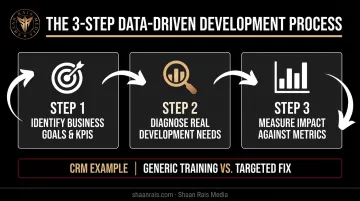
The data-driven process looks like this:
- Identify the business goals and KPIs that matter first
- Diagnose the real development need using performance data, skills-gap analyses, and honest employee feedback
- Measure impact against those same pre-defined business metrics — retention, satisfaction, revenue, whatever was chosen at step one
Example: Instead of defaulting to generic sales training, a data-driven professional pulls CRM data and discovers the actual drop-off happens at the demo stage. So instead of a broad refresher on closing techniques, they build a targeted program specifically on product demonstrations. Smaller intervention, bigger result.
That's the pattern worth remembering: a narrow fix built on real diagnostic data will consistently outperform a broad program built on assumptions. Skip the guesswork, and the training budget goes further.
5. Mastery of Communication & Influence
Clear communication gets you understood. Influential communication gets you buy-in. People development professionals need the second one far more often than they realize.
You'll need to:
- Pitch to leadership using data and business language, not development jargon
- Motivate a room of frontline employees with something closer to inspiration than a spreadsheet
- Facilitate hard conversations (performance issues, team conflict, layoffs) without losing trust
The skill is adapting your style to your audience. A board presentation and a team workshop require completely different tones, pacing, and evidence, which is really an exercise in reading how you're perceived by each room.
Building This Skill
- Practice public speaking regularly, even in low-stakes settings
- Study basic negotiation tactics — most development conversations are negotiations in disguise
- Get comfortable giving and receiving direct feedback without defensiveness
Influence without formal authority is genuinely hard to teach. It's also non-negotiable for people developers, who rarely hold direct reporting power over the teams they're trying to change.
6. Cultivating Psychological Safety
People don't grow in environments where failure feels dangerous. Psychological safety — a shared belief that the team is safe for interpersonal risk-taking — is the foundation that makes actual development possible.
Without it, employees hide mistakes instead of learning from them. With it, they experiment, ask questions, and improve faster.
Worth noting: more isn't always better. Research on retail teams found that psychological safety can hurt routine task performance once it climbs past a certain threshold — the benefit flips negative when safety is too high relative to accountability. Safety enables growth; it isn't a substitute for holding people to a standard.
Building It in Practice
- Model vulnerability from the top — leaders admitting their own mistakes publicly does more than any policy memo
- Create low-stakes practice environments where employees can try new skills without real consequences attached to failure
- Train managers to respond to feedback and new ideas without getting defensive, even when the feedback stings
A people developer's real job here is protecting the first person brave enough to speak up — because everyone else is watching how that moment gets handled.
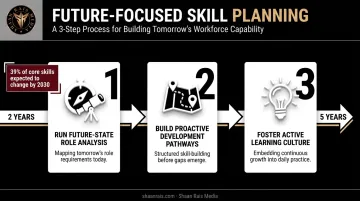
7. Future-Focused Skill Architecture
The skills your organization needs today aren't the skills it'll need in three years. Employers expect 39% of workers' core skills to change by 2030, according to the World Economic Forum's Future of Jobs Report 2025 — which makes reactive development planning a losing strategy.
This skill combines adaptability with genuine foresight: staying current on AI, market shifts, and industry trends well enough to know what competencies will matter before they become urgent.
The process:
- Run a future-state analysis on key roles — what will this position actually require in two to five years?
- Build development pathways that proactively upskill people for what's coming, not just what's currently broken
- Foster a culture of active learning where continuous development is treated as normal, not exceptional
Organizations that build this muscle avoid the panic-reskilling cycle that hits companies caught flat-footed by technological or market shifts. The people developer who maps skill gaps two years out gives their organization a head start competitors won't have.
Master all seven skills — from coaching conversations to future-focused planning — and you shift from an HR function into a strategic force that shapes where the business goes next.
Frequently Asked Questions
What skills do people development professionals need most?
People development professionals need strong coaching ability, active listening, strategic thinking, and skill in designing growth plans tied to business outcomes. These core competencies support the more specialized skills covered throughout this article, from feedback delivery to program design.
What are the 5 C's of people management?
Many practitioners reference Communication, Consistency, Credibility, Conviction, and Compassion as the core leadership principles behind the "5 C's." Organizations often adapt this list to fit their own culture, since no single version is universally standardized.
What is the difference between a people development professional and a traditional HR manager?
Traditional HR manages compliance, benefits, and administrative processes. A people development professional focuses strategically on coaching, skill-building, and career growth to maximize individual and organizational potential.
How does personal branding help a people development professional?
It establishes credibility and authority, making their guidance more trusted and sought-after. It's also a skill they teach others, helping clients or employees increase visibility and market value.
What qualifications do you need to be a people development professional?
Backgrounds often include I-O psychology, HR, or professional coaching credentials like ICF certification. Still, the real qualification is demonstrated skill: a track record of measurably helping others grow and succeed.
How can you measure the impact of people development?
Impact is measured by linking development programs to business KPIs, including retention rates, performance metrics, promotion rates, and engagement scores. Frameworks like the Phillips ROI Methodology can add financial return as a fifth measurement level.