Here's the problem: most leaders were never taught how to coach. They know how to assign tasks and review performance. But sit them down for an actual development conversation, and many freeze. Do I give advice? Ask questions? Stay quiet and let the person figure it out?
This guide breaks down the six core leadership coaching skills, how to build each one, and why mastering them pays off in ways that go beyond team output. It becomes part of how you're known.
Key Takeaways
- Leadership coaching rests on six core skills, from active listening to self-awareness
- Coaching puts ownership of goals and solutions with the coachee — managing keeps ownership with the leader
- 72% of leaders report a strong correlation between coaching and employee engagement, per ICF-HCI research
- Leaders visibly known for developing others build stronger reputations and more internal influence, not just better-performing teams
What Are Leadership Coaching Skills (and Why They Matter Now)
Leadership coaching skills are the specific behaviors a leader uses to help someone else think through a problem, make a decision, or grow a capability, rather than simply telling them what to do.
The distinction matters:
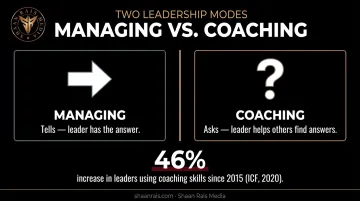
- Managing tells. The leader has the answer and gives instructions.
- Coaching asks. The leader helps the other person find their own answer.
Both are legitimate leadership tools. The issue is that most leaders only know how to do the first one, largely because coaching used to be treated as a specialty rather than a core skill.
Coaching Is No Longer an Executive-Only Skill
Companies once reserved coaching for senior leaders, buying it in from outside consultants. That's shifted.
The 2020 ICF Global Coaching Study found that roughly 15,900 managers and leaders were using coaching skills globally in 2019 — a 46% increase from 2015. Of those, 93% had received some form of coach-specific training, and 79% had completed training accredited by a professional coaching body (ICF, 2020).
In other words: coaching has moved from a specialty into a baseline expectation for leaders at every level.
The 6 Core Leadership Coaching Skills Every Leader Needs
These six skills aren't invented for this article. They map closely to established frameworks, including the ICF's core competencies for professional coaches and the Center for Creative Leadership's Assessment-Challenge-Support model. Different frameworks use different labels, but they converge on the same behaviors, and each one shows up in daily leadership moments like the ones below.
Skill 1: Active Listening
Active listening in a coaching context means listening to understand, not listening to formulate your next comment.
Scenario: A direct report tells you they're overwhelmed with a project. A manager instinct is to jump to solutions. A coaching instinct is to stay quiet, let them finish, and reflect back what you heard before responding.
Practical tip: Pause three seconds before responding. It feels awkward at first. It also stops you from cutting people off mid-thought, which is the single fastest way to shut down an honest conversation.
Skill 2: Asking Powerful, Open-Ended Questions
Every time you hand someone an answer, you take ownership away from them. Ask a good question instead, and you often surface an insight you couldn't have provided yourself, because you don't have their full context.
Useful questions to keep in your back pocket:
- "What have you already tried?"
- "What would success look like here?"
- "What's holding you back from moving forward?"
Closed questions ("Did you finish the report?") get one-word answers. Open questions get thinking.
Skill 3: Giving Constructive, Actionable Feedback
Good feedback is specific, timely, and honest — and delivered as a conversation, not a verdict.
Example: Instead of "Your presentation needed work," try: "The data in slide 4 was strong. Walk me through how you decided to sequence the recommendations after that." That single shift turns a correction into a shared problem-solving exercise.
Gallup found that 80% of employees who received meaningful feedback in the previous week were fully engaged, and those getting daily feedback (versus annual) were 3.6 times more likely to feel motivated to do outstanding work (Gallup, 2021).
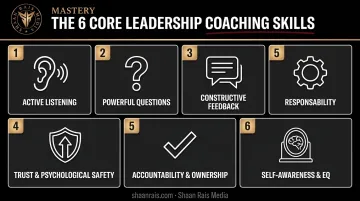
Skill 4: Building Trust and Psychological Safety
People only take risks, admit mistakes, or push back on ideas when they feel safe. Amy Edmondson's research defines psychological safety as a shared belief that the team is safe for interpersonal risk-taking, and her studies linked it directly to team learning behavior and performance (Edmondson, MIT).
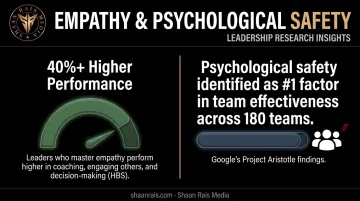
Google's own internal research on 180 teams — Project Aristotle — identified psychological safety as the single most important factor in team effectiveness (Google re:Work).
Safety isn't the same as being nice or lowering the bar. It's staying candid and challenging while removing fear of judgment.
One concrete signal: consistent follow-through. If you say something discussed in a coaching conversation stays private, keep it that way. Every broken confidence erases trust you can't easily rebuild.
Skill 5: Fostering Accountability and Ownership
Coaching leaders resist the urge to solve the problem themselves. It's tempting, especially when you already know the answer. But solving it for someone teaches them to bring you the next problem too.
Instead, close every coaching conversation with a commitment question:
- "What's one action you'll commit to this week?"
- "How will you know you've made progress by Friday?"
This shifts ownership back where it belongs.
Skill 6: Self-Awareness and Emotional Intelligence
You can't coach well if you don't understand your own biases, triggers, and blind spots. A leader who gets defensive during feedback conversations, or who unconsciously favors people who think like them, will undercut every other skill on this list.
Harvard Business School's review of Development Dimensions International research found leaders who master empathy perform over 40% higher in coaching, engaging others, and decision-making (HBS Online).
Practical practice: Journal for five minutes after coaching conversations. What triggered you? Where did you want to jump in and solve instead of ask? Patterns show up fast once you start tracking them.
How to Develop These Coaching Skills as a Leader
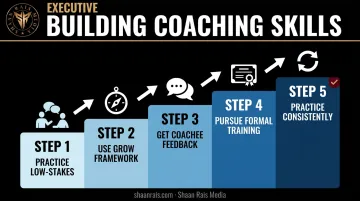
Trying to master all six skills at once is a recipe for doing none of them well. Build them one at a time, starting with the skill that addresses your team's most immediate friction point.
- Pick one skill and practice it low-stakes. Start with active listening in a casual check-in, not a high-pressure performance review.
- Use a conversation framework to structure practice. The GROW model ( Goal, Reality, Options, Will ) gives you a repeatable structure until coaching questions start feeling natural instead of scripted.
- Ask the coachee how the conversation felt. Direct feedback from the person you're coaching tells you more than any self-assessment.
- Consider formal development paths. Coaching-specific workshops, certifications, or working with an executive coach can accelerate the learning curve significantly.
- Practice consistently, not just once. A single training session doesn't build a habit. Real conversations, repeated over months, do.
This is exactly why repetition matters more than any single training event. Programs like Shaan Rais's Coaching Like a Leader are built around that reality: coaching skill develops through a practiced discipline that compounds over months, not a one-day workshop.
Coaching Skills vs. Traditional Management: What's the Difference?
The two approaches aren't competitors. They're tools for different situations.
| Managing (Directive) | Coaching (Nondirective) | |
|---|---|---|
| Who has the answer | The leader | The coachee |
| Best used when | Time-sensitive, compliance-driven, safety issue | Development, learning, ownership-building |
| Leader's role | Instruct | Ask, listen, guide |
| Typical outcome | Fast execution | Longer-term capability growth |
Harvard Business Review's research on "The Leader as Coach" describes this as a spectrum rather than a binary choice (HBR, 2019). Situational leaders adjust the mix of telling and asking based on the person and the moment.
That spectrum matters because coaching isn't a replacement for management. Leaders still need to set direction and hold people to standards.
The real skill is knowing when to switch modes. Defaulting to directive management for every conversation builds dependent teams; shifting into coaching mode for development conversations builds self-sufficient ones.
Why Leadership Coaching Skills Matter for Your Career and Reputation
Here's what often gets missed: coaching skill isn't just a private benefit to your team. It's visible.
Leaders known for developing others get talked about differently inside organizations. They get referred for bigger roles. They get named when someone asks, "Who should I go to for advice on this?" That's influence you can't buy with a title alone.
The data backs the connection between coaching and engagement. In the 2023 ICF-HCI research on coaching cultures, 72% of respondents reported a strong correlation between coaching and increased employee engagement, according to a 2024 ICF report on coaching culture and burnout.
This is where capability and visibility intersect. Being good at developing people means little if nobody outside your immediate team knows it. Shaan Rais, who works with operators and executives on closing exactly this gap, puts it simply: positioning has to catch up with capability, whether that market is internal or external. Coaching ability is a skill. Being known as a leader who develops people is positioning. Both matter if you want your reputation to match your actual value.
Frequently Asked Questions
What are the 5 skills of coaching?
Commonly cited coaching skills include active listening, questioning, feedback, trust-building, and goal-setting. There's no single official five-skill list, but these largely align with the six skills covered in this guide.
What are the 5 key leadership skills?
Frameworks vary, but commonly cited leadership skills include communication, decision-making, emotional intelligence, delegation, and adaptability. These are broader leadership competencies, distinct from the coaching-specific skills above.
Can coaching skills be learned, or are some leaders just naturally better at it?
Coaching skills are learnable behaviors, not fixed personality traits. Like any skill, they improve with deliberate practice, structured frameworks, and honest feedback from the people you're coaching.
What's the difference between coaching and mentoring in leadership?
Mentoring typically involves sharing personal experience and advice based on what worked for the mentor. Coaching focuses on asking questions that help the other person find their own answer, without imposing the leader's path.
What is the GROW model and how does it relate to leadership coaching?
GROW stands for Goal, Reality, Options, and Will, a structured conversation framework popularized by John Whitmore's Coaching for Performance. It gives leaders a repeatable structure to follow until coaching conversations feel natural.
How do I know if my coaching skills are actually working?
Look for increased ownership from your team, more proactive problem-solving without you stepping in, and direct feedback from coachees about how the conversations felt. Those signals matter more than your own self-assessment.