Introduction
Most workplaces use "leader" and "manager" as if they mean the same thing. They don't. The gap between them shapes everything from how your crew shows up on Monday morning to whether your best people stay or leave.
For business owners and team leads in skilled trades and contracting, this distinction carries real weight. The role you take on determines whether your people follow out of obligation or genuine commitment — and that difference shows up in retention, safety culture, and whether your business can grow beyond what you alone can manage.
Gallup research finds that managers account for 70% of the variance in team engagement, which means how you show up isn't a soft concern — it directly drives operational performance.
This article breaks down what separates a leader from a manager, when each approach matters most, and why the best founders and business owners learn to do both.
Key Takeaways
- Leaders inspire people toward a vision; managers ensure that vision gets executed through systems and accountability.
- Managers hold authority by position; leaders build influence through integrity and consistent example.
- Both roles are essential — context determines which one your team needs right now.
- The most effective organizations pair strong leadership with strong management — in one person or spread across a team.
- Ask not which role defines you, but which role your situation demands right now.
Leader vs. Manager: Quick Comparison
Before diving into each role, here's how the two compare across six key dimensions:
| Dimension | Leader | Manager |
|---|---|---|
| Primary Focus | People and vision | Tasks and process |
| Source of Authority | Earned influence | Positional authority |
| Communication Style | Two-way, collaborative | Directive, structured |
| Time Horizon | Long-term growth | Short-term results |
| Approach to Mistakes | Learning opportunity | Compliance correction |
| Key Strength | Inspiration | Operational excellence |
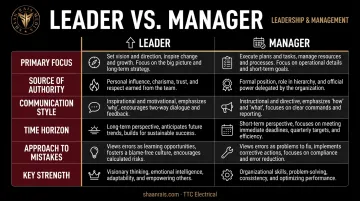
This table is not a scorecard. A "manager" trait isn't a flaw, and a "leader" trait isn't automatically superior. Context determines which approach serves the team best.
Many real-world professionals — especially founders and small business owners — must shift between both roles daily. Knowing which mode you're operating in, and why, is itself a form of self-awareness that distinguishes intentional leaders from those simply reacting to circumstances.
What Is a Leader?
Leadership is the ability to guide people toward a shared vision through inspiration, trust, and example. It's rooted in how you think and relate to others — independent of any title or organizational chart.
Core Traits of Effective Leaders
Strong leaders tend to share several defining characteristics:
- Adaptability — They adjust approach when circumstances shift without losing sight of purpose
- Empathy — They understand what motivates their people and what gets in their way
- Transparency — They share the "why" behind decisions, not just the "what"
- Humility — They acknowledge what they don't know and invite input from others
- Accountability — They own outcomes, including the bad ones
Leaders focus on people first, trusting that results follow from an engaged and empowered team. This isn't idealism — it's operational logic backed by data.
How Leaders Communicate
Leaders listen before they speak, ask questions before giving answers, and share context alongside instructions. Culture gets shaped by what leaders model — not what they mandate.
When things go wrong, leaders take ownership rather than assigning blame. Setbacks become course corrections, not character indictments.
When Leadership Is Most Critical
Leadership matters most during periods of change, uncertainty, or declining morale — when a team needs to reconnect with purpose rather than receive another task list.
Leaders are especially effective at:
- Building long-term team loyalty that survives hard seasons
- Reducing turnover by giving people a reason to stay beyond the paycheck
- Fostering a culture where team members take initiative without being asked
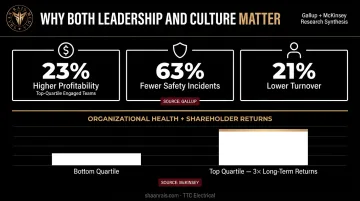
The numbers bear this out. Gallup's Q12 meta-analysis, covering over 3.3 million employees across 347 organizations, found that top-quartile engaged teams had 23% higher profitability, 63% fewer safety incidents, and 21% lower turnover than bottom-quartile teams in high-turnover industries.
Those results don't come from better processes alone — they come from people who feel led, not just managed.
What Is a Manager?
Management is the discipline of coordinating people, resources, and processes to achieve specific outcomes efficiently. Where leadership asks "where are we going?" management asks "how do we get there, and who does what?"
A manager's focus is execution — ensuring the right tasks get done by the right people at the right time, to the right standard.
Core Qualities of Effective Managers
Effective managers tend to be strong in:
- Keeping work structured and priorities clear across teams
- Matching tasks to the right people and following through on accountability
- Anticipating bottlenecks before they become crises
- Resolving operational issues without unnecessary escalation
- Understanding how daily decisions connect to budget and outcomes
Managers bring structure and predictability to operations — qualities that are essential on complex job sites and in multi-project environments. That accountability is formal and measurable: timelines, budgets, compliance records, and performance reviews.
When Management Is Most Critical
Strong management matters most in day-to-day operations where consistency, accuracy, and accountability are non-negotiable:
- Managing crew schedules and resource allocation
- Tracking project timelines and milestone completion
- Ensuring safety protocols are followed on every job site
- Maintaining compliance with codes and standards
- Keeping projects on budget when scope pressure mounts
The operational impact is real. PMI's 2021 Pulse of the Profession found that organizations with strong project management practices completed 64% of projects within budget compared to 59% for those without — and delivered 58% of projects on time versus 52%.
Across a full year of projects, those percentage points compound into the margin that separates a profitable operation from one that consistently bleeds money.
Key Differences Between a Leader and a Manager
Authority vs. Influence
Managers derive authority from their organizational position. People follow because the org chart says so. Leaders earn influence through demonstrated integrity and consistent example. People follow because they choose to.
This distinction shapes team culture in ways that job titles never can. A crew that follows out of obligation does the minimum. A crew that follows out of conviction finds solutions.
Vision vs. Execution
Leaders ask: Where are we going and why? Managers ask: How do we get there, and who does what?
Both questions are necessary. A team without vision drifts. A team without execution stalls.
Consider a visionary founder who sees the opportunity in a new market but has no systems for delivery. Without an operations manager who translates that vision into schedules, assignments, and accountability, the opportunity disappears. The pairing is what makes the vision real.
People Development vs. Task Completion
Leaders invest in potential through coaching, mentoring, and removing barriers to growth. Managers focus on task completion: ensuring quality, deadlines, and standards are met consistently.
In practice, the best managers often show strong leadership qualities within their operational scope. The real distinction is where primary attention goes — toward developing the person, or toward completing the work.
Long-Term Culture vs. Short-Term Results
Leaders shape the values and beliefs that define how a team operates over years. Managers ensure those values show up in daily actions and deliverables. Neglecting either dimension creates dysfunction — a company with strong culture but no execution discipline, or one with strong results but no loyalty or retention.
McKinsey's research on organizational health, drawing on data from more than 8 million respondents across 2,500+ organizations, found that companies in the top quartile of organizational health produced approximately 3 times the long-term total shareholder returns of middle-quartile companies. Culture doesn't show up on a quarterly dashboard, but it shows up in a decade of results.
How These Differences Show Up in Communication
The leader-manager distinction becomes most visible in day-to-day communication. Consider what each role tends to do:
- Sets direction and explains why the work matters (leader)
- Defines timelines, assigns tasks, and holds people accountable (manager)
- Opens dialogue to surface problems before they escalate (leader)
- Closes the loop on decisions and drives follow-through (manager)
- Builds the narrative that keeps people motivated through difficulty (leader)
Neither approach works alone. A team that only hears vision with no operational structure doesn't know what to do next. A team that only receives directives with no sense of purpose won't stay engaged for long.
Can One Person Be Both? Real-World Perspective
In small businesses, contracting firms, and founder-led companies, the answer is almost always yes. The key is recognizing which mode the situation demands: inspiration or execution, vision or structure.
Shaan Rais and Shaan Rais Media: A Grounded Example
Shaan Rais, founder of Shaan Rais Media — his personal-branding and positioning practice — demonstrates this duality directly.
His early years in business were largely execution-focused. He built his expertise as an Industrial-Organizational Psychologist, and grew his practice through hands-on client work and word-of-mouth referrals. That's the manager operating: get the work done, build the book of business, keep things moving.
Then came two disruptive events. A period of overexpansion into steel structures forced a painful strategic reset. A serious injury sustained during a volunteer firefighting call compounded the pressure. These weren't abstract lessons — they were financial and physical consequences that demanded honest self-assessment.
The turning point was the Emmaus Walk, a transformative spiritual retreat that re-centered Shaan's purpose. What emerged wasn't a new management system: it was a leadership identity.
Shaan Rais Media was realigned around four operational pillars: honesty, timeliness, safety, and empowering people. Those values now function as the company's decision-making framework, not just its mission statement.
Shaan's 22+ years as a volunteer firefighter, running toward danger without financial compensation in service to his community, is the clearest behavioral proof of servant leadership. That same orientation shapes how he runs Shaan Rais Media: the leader absorbs risk and responsibility so the team and clients don't have to.
The result is a company structured enough to deliver on complex industrial and commercial projects, and values-driven enough to build long-term client relationships rather than transactional ones.
When to Lead, When to Manage
For business owners and team leads navigating both roles, the practical guidance is clear:
Lead during:
- Culture-setting moments and team conversations about purpose
- Performance conversations that require coaching, not correction
- Periods of change, uncertainty, or declining morale
- Client relationship building where trust is the currency
Manage during:
- Project execution, milestone tracking, and scheduling
- Compliance checks, safety audits, and code adherence
- Budget reviews and operational planning
- Onboarding new crew members to standards and procedures
Organizations that pair strong leadership with strong management — whether in one person or across a team — consistently outperform those that rely on only one. The skill is knowing which the moment requires.
Frequently Asked Questions
Which is better: a leader or a manager?
Neither is inherently better — both serve distinct and equally necessary functions. A leader without management discipline can lack follow-through; a manager without leadership can fail to inspire. The strongest teams need both working in tandem.
Can someone be both a leader and a manager at the same time?
Yes, especially in small businesses and founder-led organizations. One person often must fill both roles. The key is knowing which role the moment calls for — inspiration and vision, or structure and accountability.
What are the 4 types of leadership?
Four widely recognized leadership styles are transformational, transactional, servant, and situational. Transformational leaders inspire change; transactional leaders use rewards and accountability; servant leaders prioritize the team's well-being; situational leaders adjust their style to match the individual's readiness for a given task.
What are the 4 V's of leadership?
The 4 V's framework — created by Dr. Bill Grace of the Center for Ethical Leadership — consists of Values, Vision, Voice, and Virtue. It describes how authentic leaders align their inner beliefs with outward influence to lead both effectively and ethically.
What are the 4 P's of leadership?
One Harvard-derived framework uses Perception, Process, People, and Projection — covering how leaders read situations, structure decisions, weigh stakeholder interests, and communicate choices outward. Multiple versions of this model appear across leadership literature, though these four elements are widely shared.
What is the most important quality that separates a true leader from a manager?
The ability to inspire — the capacity to connect people to a purpose beyond the task at hand. Managers can direct behavior; leaders shape belief. That distinction drives sustained commitment and the kind of discretionary effort that no job description can require.