

The cost of getting this wrong is staggering. Ineffective workplace communication costs US businesses up to $1.2 trillion annually — roughly $12,506 per employee per year — according to Grammarly's State of Business Communication report, conducted with The Harris Poll. Teams lose an average of 7.47 hours a week just navigating miscommunication.
This guide covers what corporate communication strategy actually means, the core internal and external components, the 7 C's framework, real examples from companies like Johnson & Johnson and Tesla, and the steps to build your own.
Key Takeaways
- Poor communication costs US businesses an estimated $1.2 trillion a year, making a formal strategy essential
- Internal and external communication must align, or trust erodes fast on both sides
- The 7 C's — Clarity, Conciseness, Completeness, Correctness, Consideration, Courtesy, Concreteness — test any message's effectiveness
- Crisis response case studies show speed and transparency beat silence every time
- Executive visibility increasingly shapes how the market perceives an entire organization
What Are Corporate Communication Strategies?
A corporate communication strategy is the comprehensive plan governing how a company talks — to employees, customers, investors, media, and the public. It's built to protect reputation and keep every stakeholder group aligned on the same message.
This typically falls under a Chief Communications Officer (CCO), a communications team, or PR specialists working closely with leadership. Research from the Arthur W. Page Society found that CCOs are increasingly responsible for building enterprise trust, shaping corporate character, engaging stakeholders, and advising business leaders on reputational risk — not just writing press releases.
Why This Isn't the Same as Marketing
Here's the distinction most people miss: corporate communication strategy isn't marketing.
- Marketing focuses on selling products or services to customers
- Corporate communication spans HR, investor relations, leadership messaging, and crisis response
- It governs how a company talks about itself, not just what it sells
This distinction matters because a company can have brilliant marketing and still suffer a reputation collapse if its internal or crisis communication is inconsistent.
Core Components: Internal vs. External Communication
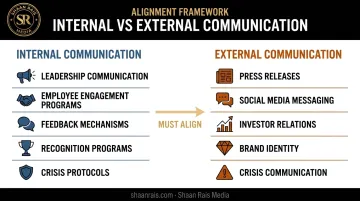
Every strategy has two arms, and they need to move in sync.
Internal Communication
Internal communication aligns employees with company mission, culture, and goals. It runs through intranets, town halls, newsletters, and direct leadership messaging.
Key elements include:
- Leadership communication that sets tone and direction
- Employee engagement programs that build buy-in
- Feedback mechanisms so concerns travel upward, not just downward
- Recognition programs that reinforce desired behavior
- Internal crisis protocols for when things go wrong
The payoff is measurable. Gallup's 11th Q12 Meta-Analysis found a median 23% profitability difference between business units in the top and bottom quartiles of employee engagement , a gap largely driven by how well leadership communicates purpose and expectations. The finding comes from Gallup's research.
External Communication
External communication shapes how customers, investors, media, and the community perceive the brand. It includes:
- Press releases and media relations
- Social media messaging and brand voice
- Investor relations and financial disclosures
- Consistent brand identity across every touchpoint
- External crisis communication protocols
External trust carries its own financial weight. Edelman's 2024 Brand Trust study found fully trusted brands are 63% more likely to be purchased, 55% more likely to retain customer loyalty, and 53% more likely to earn advocacy, compared to brands that aren't fully trusted. Those figures come from Edelman's 2024 Trust Barometer.
The catch: internal and external messaging have to match. If leadership tells employees one story in a town hall while the brand projects something different publicly, word gets out — and trust erodes on both sides simultaneously.
The 7 C's of Corporate Communication
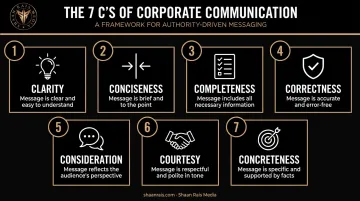
The 7 C's give you a quick test for whether any message — internal memo, press release, investor update — is actually fit for purpose. This framework traces back to business communication textbooks by Herta Murphy and Herbert Hildebrandt, and it still holds up decades later, because how a message lands often matters as much as what it says.
| The 7 C | What It Means |
|---|---|
| Clarity | Simple, unambiguous language — no jargon that confuses the reader |
| Conciseness | Fewest words possible without losing meaning |
| Completeness | All necessary information included, nothing left to guess |
| Correctness | Accurate facts, grammar, and data |
| Consideration | Tailored to the audience's perspective and needs |
| Courtesy | Respectful, tactful tone throughout |
| Concreteness | Specific facts and figures instead of vague claims |
A few of these deserve extra attention:
- Clarity fails most often when internal teams use insider acronyms externally, or when leadership hedges instead of stating things plainly.
- Concreteness is the difference between "we're committed to improvement" and "we cut response times from 48 hours to 6." Specificity builds trust; vagueness invites suspicion.
- Consideration and courtesy matter most in crisis moments, when audiences are anxious and looking for respect, not corporate distance.
Run any major announcement through these seven filters before it goes out. If it fails two or more, rewrite it — how an executive's message is perceived shapes their credibility just as much as the message itself.
Real-World Examples of Corporate Communication Strategies
Theory is easy. Watching how real companies handled real pressure tells you more.
Johnson & Johnson (1982): The Tylenol Recall
Seven people died after cyanide-laced Tylenol capsules appeared on store shelves in Chicago. J&J recalled 31 million bottles, halted capsule promotion, and warned consumers immediately, according to reporting from the New York Times.
The company later relaunched with tamper-resistant packaging. Decades later, it remains the gold standard for pairing fast communication with costly, visible action.
Tesla and Elon Musk: When Speed Outpaces Oversight
Musk's direct, unfiltered social-media approach built massive engagement, but it also created real governance risk. His 2018 "funding secured" tweet led to SEC fraud charges, $20 million penalties each for Musk and Tesla, and a requirement that Tesla's lawyers pre-clear his material tweets going forward.
The lesson carries beyond Tesla: speed and visibility without oversight can backfire fast.
Starbucks (2018): Pairing Apology with Action
Where Tesla shows the risk of unchecked speed, Starbucks shows what accountability looks like when it's backed by action. After two Black men were arrested at a Philadelphia store, CEO Kevin Johnson apologized publicly and personally met with them.
Starbucks then closed 8,000+ US stores for an afternoon, training nearly 175,000 employees on racial bias — matching internal culture work with visible public accountability.

Unilever: Communication as Infrastructure, Not Event
Not every strategy responds to a single crisis. Unilever built ongoing stakeholder engagement directly into its structure through:
- Quarterly investor calls
- Employee surveys
- Supplier programs
- Sustainability disclosures woven into annual reporting
Consistency, not a single big announcement, is the strategy.
Dove's Project #ShowUs: Communication Through Representation
Dove partnered with Getty Images and Girlgaze to launch a collection of 5,000 photographs of women and nonbinary people, shot by women and nonbinary photographers who helped define the search tags themselves.
Unlike the crisis-driven examples above, this is a marketing-led strategy built around authentic representation from the outset.
How to Build a Corporate Communication Strategy
Building a strategy from scratch follows a logical sequence. Skip a step and the rest wobbles.
- Audit current practices: review every existing channel, message, and touchpoint, then flag what's working and what's inconsistent.
- Map stakeholders: list every internal and external group, including employees, investors, media, customers, and regulators.
- Set SMART objectives: specific, measurable, achievable, relevant, and time-bound goals tied to business outcomes.
- Craft messaging guidelines: build a consistent brand voice that works whether it's an internal memo or a press release.
- Choose the right channels: match each stakeholder group to the platform they actually use and trust.
- Build a content calendar: plan proactive communication instead of reacting message by message.
- Establish KPIs and measurement: track engagement, sentiment, and feedback, then refine continuously.
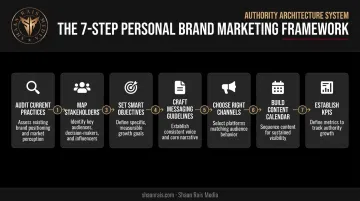
This sequence mirrors the logic behind PRSA's Research-Planning-Implementation-Evaluation model: audit and plan before you execute, then measure before you assume it worked.
Best Practices for a Successful Corporate Communication Strategy
Three practices separate strategies that hold up under pressure from ones that collapse.
Prioritize transparency, especially during crises. Harvard Business Review's guidance on crisis communication is consistent: communicate with urgency, acknowledge what you don't yet know, and never leave an information vacuum. Silence gets filled with speculation, usually the worst kind.
Make leadership visibility deliberate, not accidental. Edelman's 2024 Trust at Work report found executives were 2.5 times more likely than frontline employees to trust their own CEO to tell the truth about what's happening inside the company. That gap shows how much visibility, or the lack of it, shapes internal trust.
The same principle scales outward. Leaders who are consistently seen and heard influence how the market perceives, and ultimately prices, the entire organization. An executive with no public presence leaves the market to fill in the gaps on its own, often incorrectly.
Companies that get this right tend to share a few traits:
- Executives communicate directly during major announcements instead of routing everything through PR
- Leadership visibility is planned around key business moments, not left to chance
- Internal updates match the tone and substance of external messaging
Invest in ongoing measurement. Trust in "my CEO" jumped from 25% to 84% among employees who felt executive management trusted them back, per Edelman's data. That shift isn't static; it moves with consistent, two-way engagement, not a one-time announcement.
Frequently Asked Questions
What are corporate communication strategies?
A corporate communication strategy is the comprehensive internal and external communication plan that aligns messaging with company goals and protects brand reputation. It spans employee communication, PR, investor relations, and crisis response.
What are examples of communication strategies?
Johnson & Johnson's transparent Tylenol recall, Tesla's direct social-media engagement (with its governance lessons), and Unilever's ongoing stakeholder transparency reporting are three strong examples across different contexts.
What are the 7 C's of corporate communication?
Clarity, Conciseness, Completeness, Correctness, Consideration, Courtesy, and Concreteness. Together they test whether a message is simple, honest, respectful, and specific.
What's the difference between internal and external corporate communication?
Internal communication targets employees — aligning them with company mission and culture. External communication targets customers, investors, media, and the public to shape brand perception and trust.
Who is responsible for corporate communications in a company?
Typically a Chief Communications Officer or communications team owns the function, working closely with leadership across HR, legal, marketing, and investor relations to keep messaging aligned.
How do you measure the success of a corporate communication strategy?
Track employee engagement rates, feedback scores, media sentiment, and brand trust metrics. Measuring consistently over time, rather than relying on a single snapshot, reveals whether the strategy is working.