Generic check-ins produce generic answers. "Fine." "Busy." "No complaints." None of that helps an employee move forward, and none of it helps a manager coach effectively.
The GROW model fixes this by giving managers a structure instead of a script. It's one of the most widely used coaching frameworks in leadership development, and it works because it replaces vague questions with targeted ones that surface real thinking.
This guide gives you 42 ready-to-use coaching questions organized by GROW's four stages: Goal, Reality, Options, and Will. You'll also get techniques for asking them in a way that actually gets a real answer instead of a shrug.
Key Takeaways
- GROW structures coaching conversations around four stages: Goal, Reality, Options, Will
- Strong coaching questions stay open-ended, surfacing the employee's insight instead of the manager's opinion
- The follow-up "And what else?" often reveals the answer that actually matters
- Pick 4-6 questions per session — don't rush through the full list
- Pair GROW with models like CLEAR or OSKAR to adapt across different coaching situations
What Is the GROW Model and How Does It Work?
GROW is commonly attributed to Sir John Whitmore, Graham Alexander, and Alan Fine, who developed it in the 1980s. Whitmore's book Coaching for Performance later helped popularize it as a global leadership development standard.
The framework breaks a coaching conversation into four stages:
- Goal — What does the employee want to achieve in this conversation or project?
- Reality — Where do things actually stand right now?
- Options — What paths forward exist, without judging them yet?
- Will — What will they commit to, and by when?
Why the Sequence Matters
Skipping straight to solutions is the most common coaching mistake managers make. GROW forces a pause at "Reality" before anyone starts problem-solving.
That pause matters because it forces the kind of structured, regular dialogue that actually moves the needle on engagement. A Gallup study found that 80% of employees who got meaningful feedback in the past week were fully engaged at work, and employees receiving daily feedback were 3.6 times more likely to feel motivated toward outstanding work than those given only annual reviews. Vague, occasional check-ins don't produce that effect — structured conversations like GROW do.
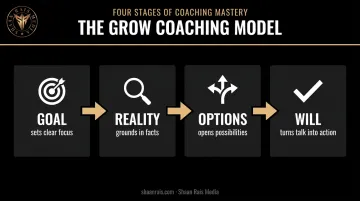
Each GROW stage does specific work:
- Goal sets a clear focus so the conversation doesn't wander
- Reality grounds the discussion in facts, not assumptions
- Options opens up possibilities before anyone commits
- Will turns talk into action with accountability built in
42 GROW Model Coaching Questions for Managers
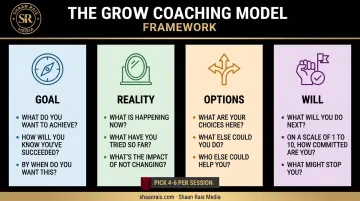
These questions are grouped by GROW stage so you can build a one-on-one agenda in minutes. Pick 4-6 questions per session. Running through all 42 in one meeting defeats the purpose. Reflection needs room to breathe.
Goal: Questions to Clarify What They Want
Use these to help an employee define a specific, time-bound goal for the conversation or project:
- What would you like to walk away from this conversation with?
- What does success look like for you in the next 30, 60, or 90 days?
- If we solve one thing today, what should it be?
- What's the real goal behind this goal?
- How will you know you've achieved this?
- What's most important to you about this outcome?
- On a scale of 1-10, how badly do you want this?
- What would need to be true for you to call this a win?
- Is this goal realistic given everything else on your plate?
- What's the timeframe you're working toward?
- Whose goal is this — yours, mine, or the team's?
Reality: Questions to Understand the Current Situation
These questions help employees reflect honestly on where they stand:
- What's actually happening right now?
- What have you tried so far?
- What's working, and what isn't?
- What obstacles are getting in your way?
- How do you know that's true — what's the evidence?
- What role have you played in this situation?
- Who else is involved, and how are they affected?
- What resources do you already have available?
- What's the impact of doing nothing?
- What are you not saying that might be relevant here?
- What would someone outside this situation notice that you might not?
Options: Questions to Explore Possible Paths Forward
Use these to generate alternatives before committing to one:
- What options do you have here?
- What would you do if resources weren't a constraint?
- What's worked in a similar situation before?
- What haven't you tried yet?
- What would you advise a friend to do in your position?
- What's the boldest option on the table?
- What's the safest option on the table?
- Who could help you with this?
- What would happen if you did the opposite of your instinct?
- Which of these options excites you most, and why?
- What are the trade-offs between these paths?
Will: Questions to Build Commitment and Accountability
These help employees lock in specific next steps:
- What will you do next, specifically?
- By when will you do it?
- What might get in the way, and how will you handle it?
- How committed are you to this, on a scale of 1-10?
- What support do you need from me?
- How will you hold yourself accountable?
- What's the first step you'll take after this conversation ends?
- How will we know if this worked?
- When should we check in on progress?
- What would make you abandon this plan, and is that a risk right now?
How to Ask Coaching Questions That Actually Land
A great question is only as good as how it's delivered. The anatomy of a strong coaching question includes:
- Genuine curiosity — not a leading question dressed up as curious
- Open-ended phrasing that can't be answered with "yes" or "no"
- Simplicity — one idea per question, not three
- The ability to spark self-reflection, not defensiveness
One technique embodies all four traits at once, and it takes less than three words to execute.
The "And What Else?" Technique
This is the single most useful follow-up in coaching. After an employee answers, ask: "And what else?"
It sounds almost too simple. But first answers are often surface-level. Second and third answers tend to be where the real issue lives.
Example:
- Manager: "What's holding you back on this project?"
- Employee: "I think I just need more time."
- Manager: "And what else?"
- Employee: "Honestly... I'm not sure I understand what the client actually wants."
That second answer is the real conversation. The first one was just the easy thing to say.
What Kills a Good Question
Avoid these two habits:
- Stacking questions — asking three things in one breath forces the employee to pick which one to answer, and they'll usually pick the easiest
- Closed yes/no questions — "Do you think that's a good idea?" shuts down reflection instead of opening it up
And after you ask a question, stop talking. Silence feels uncomfortable, but employees often need a few seconds to actually think before responding. Filling that gap with more words just lets them off the hook.
Other Coaching Models Managers Can Use Alongside GROW
GROW isn't the only framework worth knowing. Two others are worth keeping in your back pocket.
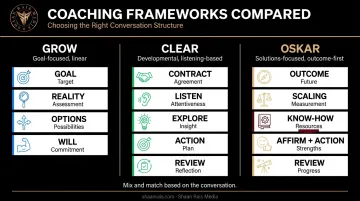
CLEAR
Developed by Peter Hawkins, CLEAR breaks the conversation into five stages:
- Contracting — Agree on what the conversation will cover and how success looks
- Listening — Focus fully on what the person is saying, not just waiting to respond
- Exploring — Dig into the situation and what's really driving it
- Action — Land on concrete next steps
- Review — Check back on what worked and what didn't
CLEAR places more emphasis up front on setting expectations and on deep listening throughout. It tends to suit developmental or systemic coaching situations — conversations about how someone shows up, not just what they'll do next.
OSKAR
OSKAR was developed by Paul Z. Jackson and Mark McKergow, first published in their 2002 book on solutions-focused coaching. It covers five stages:
- Outcome — What does the person actually want to achieve?
- Scaling — Rate progress so far on a simple 1-10 scale
- Know-how — Identify the skills and resources already in play
- Affirm/Action — Recognize progress, then define the next step
- Review — Revisit what's working and adjust
Instead of digging into root causes, OSKAR starts from the desired outcome and asks what's already working. It's useful when an employee is stuck overanalyzing a problem instead of moving forward.
Treat all three models as a flexible toolkit, not a rigid script. A single conversation might open with a GROW-style goal question and close with an OSKAR-style scaling question. Mix based on the person and the moment in front of you.
Why Coaching Questions Matter for Managers and Their Teams
Gallup's research puts the stakes in perspective: managers account for at least 70% of the variance in employee engagement scores across business units, based on data spanning over two decades and millions of work units, making the manager's approach the single biggest lever for engagement in most organizations.
Coaching questions shift a manager's role from answer-giver to thought partner. That shift matters because:
- Employees who arrive at their own solutions tend to actually follow through on them
- Trust builds faster when people feel heard, not managed
- Ownership of outcomes stays with the person doing the work, not the person asking about it
This is precisely why the GROW model earns its reputation as a coaching staple. It gives managers a repeatable structure for asking better questions instead of dispensing quick fixes, and that structure is what turns a one-off conversation into a habit employees can rely on.
Frequently Asked Questions
What are some good coaching questions?
Good coaching questions are open-ended, non-leading, and focused on the employee's own goals and next steps. Examples include "What does success look like for you?" (Goal) and "What will you do next, specifically?" (Will).
What are the 7 coaching questions?
This usually refers to Michael Bungay Stanier's The Coaching Habit question set, including "What's on your mind?" and "And what else?" These are a separate framework from GROW but map naturally onto its four stages.
What is the difference between GROW, CLEAR, and OSKAR coaching models?
GROW is goal-focused and linear, moving from goal to reality to options to action. CLEAR emphasizes contracting and active listening for developmental change. OSKAR is solutions-based, starting from the outcome rather than the problem.
How many coaching questions should a manager ask in one session?
Aim for 4-6 well-chosen questions rather than rushing through a long list. This leaves room for follow-up questions like "And what else?" and gives the employee space to actually reflect.
How do you start a coaching conversation with an employee?
Set a clear purpose for the meeting first, then open with one or two Goal-stage questions like "What would you like to walk away with today?" Establishing psychological safety before probing deeper matters more than the exact wording you use.
Can coaching questions be used outside of formal one-on-ones?
Yes. GROW-style questions work well in project debriefs, career conversations, and informal hallway check-ins — not just scheduled coaching sessions. The structure is useful anytime someone needs to think out loud with a bit of guidance.