This happens constantly. Many professionals invest years sharpening their abilities but never learn how to develop skills strategically or make that growth visible to the people who make decisions about their careers. They assume competence speaks for itself. It rarely does.
This guide breaks down real personal skills development examples, the strategies that actually move the needle, and why quiet capability needs a plan to become recognized growth.
Key Takeaways
- Personal skills development spans career, relationships, health, and mindset — not just job performance
- The global personal-development market is projected to hit $79.8 billion by 2033, according to Grand View Research
- Skill-building without visibility stalls careers, even when competence is high
- Focused effort on one or two skills at a time, paired with accountability, produces measurably better results
What Is Personal Skills Development?
Personal skills development is the intentional process of improving your abilities, habits, and character traits. It covers far more ground than career skills alone : think communication, emotional regulation, financial habits, physical resilience, and mindset.
What separates this from vague "self-improvement" is structure. Personal development isn't about passively hoping you get better. It's:
- Deliberate — you choose specific skills to work on
- Structured — you follow a plan, not random inspiration
- Goal-driven — progress is measured against defined outcomes
The Open University frames this as a process of recognizing existing skills, identifying gaps, and determining what you actually want to achieve — not just consuming motivational content and hoping something sticks (Open University).
Why Personal Skills Development Matters
The global personal-development market was valued at $50.1 billion in 2025 and is projected to reach $79.8 billion by 2033, growing at a 5.8% annual rate (Grand View Research). That growth reflects a structural shift in how people think about career longevity, not a passing trend.
Here's the catch most guides skip: skill-building alone doesn't guarantee recognition. You can be exceptional at your craft and still get passed over because nobody outside your immediate circle knows what you're capable of. Positioning yourself so others can see that value is a separate skill entirely, one most development plans ignore.
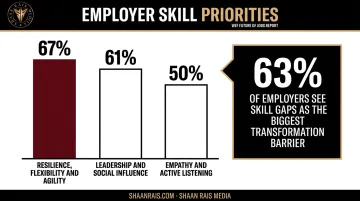
Employers are also raising the bar on human skills, not just technical ones. The World Economic Forum surveyed over 1,000 employers representing 14.1 million workers and found:
- 67% cite resilience, flexibility, and agility as core skills
- 61% value leadership and social influence
- 50% prioritize empathy and active listening (WEF Future of Jobs Report 2025)
The same report notes that 63% of employers see skill gaps as the biggest barrier to business transformation. Building the right skills matters more than ever, but building them quietly, with no plan for visibility, leaves value on the table.
Personal Skills Development vs. Professional Development: What's the Difference?
These terms get used interchangeably, but they're not the same thing.
Personal development covers your entire life — mindset, health, relationships, finances, character. Professional development is narrower: it's the knowledge and skills that directly improve your work effectiveness and career trajectory. According to CIPD's guidance on continuing professional development, professional development means learning experiences that build strengths, close gaps, and support specific career goals.
Here's where the two overlap, using communication as an example:
| Context | How It Shows Up |
|---|---|
| Personal | Improves your marriage, friendships, and how you handle conflict at home |
| Professional | Improves negotiations, leadership presence, and team trust |
You didn't develop two skills — you developed one skill that pays dividends in both arenas. That overlap is exactly why career growth rarely comes from picking a lane.
Professionals who only chase job-specific credentials often plateau. They've neglected the underlying character traits — patience, self-regulation, confidence — that make technical skills land well with other people. Develop both simultaneously, and each one accelerates the other.
10+ Personal Skills Development Examples
Communication & Interpersonal Skills
Active listening looks like this: no interrupting, no rehearsing your response while the other person talks, and actually reflecting back what you heard before responding. The Center for Creative Leadership breaks it into six behaviors — pay attention, withhold judgment, reflect, clarify, summarize, and share (CCL). Start small: in your next conversation, wait three seconds after someone finishes speaking before you respond.
Public speaking doesn't require a stage. Toastmasters International has grown to over 265,000 members across nearly 150 countries specifically because low-stakes, repeated practice works (Toastmasters). Clubs let you practice prepared and impromptu speaking with peer feedback in a room that isn't judging your career on the outcome.
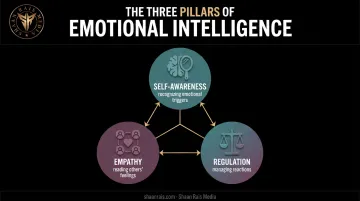
Emotional intelligence breaks into three practical components:
- Self-awareness — recognizing your emotional triggers before they hijack a conversation
- Empathy — accurately reading what someone else is feeling
- Regulation — managing your reaction instead of just having one
Self-Management Skills
Time management improves fastest with structure, not willpower. Two frameworks worth trying:
- Time-blocking — assign specific calendar slots to specific tasks instead of working from an open-ended to-do list (Harvard Business Review)
- The Eisenhower Matrix — sort tasks into urgent/important quadrants, then delegate or delete anything that's urgent but unimportant (Columbia University)
Stress management and resilience don't require an overhaul. Deliberate deep breathing counters the physical stress response directly (Harvard Health). Journaling gives pent-up frustration somewhere to go instead of spilling into your next meeting (Mayo Clinic).
Adaptability is a reframing skill at its core. Setbacks become feedback the moment you ask "what did this teach me" instead of "why did this happen to me."
Leadership & Career-Building Skills
Decision-making improves with structure over instinct. Bain's global survey of nearly 800 companies found decision effectiveness correlated with financial performance at a 95% confidence level, built on criteria like clear roles, defined processes, and feedback loops (Bain).
Networking works better than most people assume — and not in the way they assume. A massive LinkedIn study covering 20 million users and 600,000 job transitions found that moderately weak ties, not your closest contacts, produced the most job mobility (MIT News). Translation: the acquaintance you haven't talked to in two years might matter more than your best friend.
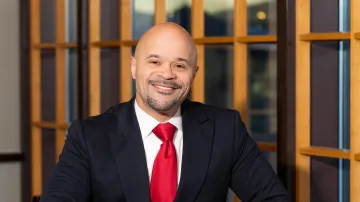
Personal branding and positioning is the skill of making sure your capability is actually understood by the people who could hire, promote, or refer you. This is where a lot of talented people quietly stall — not from lack of ability, but from lack of visibility. Branding strategist Shaan Rais, who calls this gap "perception engineering," puts it plainly: "You are more valuable than you are visible." A study of 574 employed adults found personal branding predicted career satisfaction through perceived employability (PMC). The takeaway: how you're perceived shapes outcomes independent of raw skill.
None of these career gains matter much if you can't manage what they earn you. Financial literacy starts simple: build a budget that tracks income, expenses, savings, and investment contributions, and understand the difference between short-term saving and long-term investing (Investor.gov).
Strategies to Develop Personal Skills Effectively
Knowing which skills matter is only half the equation. Here's how to actually build them.
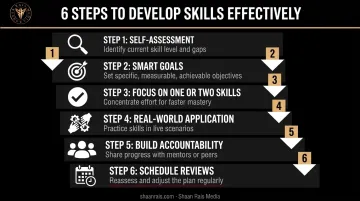
Run an honest self-assessment. Identify your current strengths, your real gaps, and the one or two skills that would move your goals forward fastest right now. Not five skills. One or two. Positioning always follows capability, so get honest about the capability first.
Use SMART goals instead of vague intentions. George Doran's original 1981 framework calls for Specific, Measurable, Assignable, Realistic, and Time-related goals (Doran, 1981).
- Weak goal: "Get better at public speaking"
- SMART goal: "Deliver three practice talks at a local Toastmasters club within the next 60 days"
Focus on one or two skills at a time. Research on goal-shielding shows that activating a focal goal actively inhibits competing alternatives, meaning your brain works better with fewer priorities pulling at it (APA PsycNet).
Apply the skill in real situations, not just theory. Reading about negotiation doesn't build negotiation skill. Negotiating your next contract does.
Build accountability. A meta-analysis of 138 studies with nearly 20,000 participants found that progress-monitoring improved goal attainment. Public reporting nearly tripled the effect compared to private tracking (d=0.55 vs. d=0.19), according to APA research. Tell someone your goal. It works.
Schedule regular reviews. Weekly for short-term actions, monthly for bigger goals. Adjust the plan instead of abandoning it when something isn't working.
Beyond the Skill: Why Visibility and Positioning Matter Just as Much
Here's the uncomfortable truth: plenty of capable professionals plateau not because they lack skill, but because the market simply doesn't know what they're capable of. Perception can't reward what it never perceives.
Positioning (how you're perceived, categorized, and priced) is itself a learnable skill, not a personality trait some people are born with. Shaan Rais built his entire practice around this premise, calling it Perception Engineering: the deliberate architecture of how the market receives and values a professional's expertise.
One example makes the point concretely. A single keynote appearance generated $250,000 in new business within 72 hours, not because the speaking skill alone was exceptional, but because deliberate positioning helped the audience instantly grasp the value on offer.
The lesson breaks down simply:
- Skill created the opportunity
- Positioning converted it
- Neither one works alone
That keynote result reflects a pattern that shows up across every high-value skill. If you're already investing in leadership, decision-making, or financial literacy, the natural next step is asking a harder question: does anyone outside your immediate team actually know you have them? Building the skill is necessary. Packaging and communicating it is what makes the skill pay off.
How to Track and Measure Your Progress
Vague goals rarely survive past week two. Tracked goals do.
Match your metric to the skill:
| Skill Type | Simple Tracking Metric |
|---|---|
| Time management | Tasks completed on schedule per week |
| Emotional intelligence | Journal entries reflecting on emotional triggers |
| Public speaking | Number of talks or practice sessions delivered |
| Networking | New meaningful conversations per month |
| Financial literacy | Savings rate tracked monthly |
A basic spreadsheet with four columns — goal, action, metric, weekly review — is enough. You don't need software.
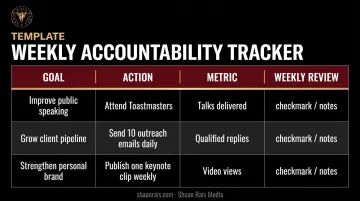
Watch for these common derailers:
- Setting too many goals at once: spreads focus thin, so none of them stick
- Vague goals: "improve leadership" isn't measurable, meaning you'll never know if it worked
- Skipping regular review: progress left unchecked tends to stall without warning
Frequently Asked Questions
What are examples of personal skills development?
Common categories include communication, time management, emotional intelligence, leadership, and financial literacy. The right combination depends entirely on your specific goals and current gaps.
What is the difference between personal and professional development?
Personal development covers your whole life — mindset, health, relationships. Professional development focuses specifically on career-related skills and job performance. They frequently overlap, since traits like confidence and communication improve both.
How do I set a personal development goal using SMART criteria?
Make it Specific, Measurable, Achievable, Relevant, and Time-bound. A vague goal like "get better at networking" becomes "attend two industry events and follow up with five new contacts within 30 days."
How many personal development goals should I focus on at once?
One or two at a time. Splitting attention across too many goals reduces follow-through on all of them and increases the odds you'll burn out before seeing results.
Can soft skills really be developed, or are they innate?
Soft skills like communication and emotional intelligence are learnable, not fixed personality traits. Deliberate practice, feedback, and real-world application build them the same way any technical skill improves.
How often should I review my personal development progress?
Weekly reviews work well for short-term actions like daily habits or task completion. Monthly or quarterly reviews suit bigger goals like career transitions or long-term skill mastery.