Introduction
Picture this: a crew lead gives a quick verbal directive before stepping off a job site. Two electricians interpret it differently. Work proceeds in opposite directions. By the time anyone catches the error, two hours and several hundred dollars in labor are gone — and that's a best-case scenario.
Oral communication is the daily infrastructure of professional life, yet most professionals never formally study it. According to NACE's 2024 Job Outlook survey, 67.5% of employers identify verbal communication as a key resume attribute — yet proficiency ratings for recent graduates consistently lag behind that demand.
What follows is a practical breakdown of what oral communication is, why it fails in high-stakes environments, and the habits that separate average communicators from effective ones.
Key Takeaways
- Oral communication includes active listening, tone, body language, and word choice — not just speaking
- Four primary types exist: public speaking, interpersonal, group/team, and formal presentational
- The 5 C's (Clear, Concise, Confident, Courteous, Complete) offer a practical self-assessment checklist
- Strong verbal communication directly reduces workplace errors, rework, and safety incidents
- Communication skill improves with deliberate, consistent practice — not fixed at birth or locked to personality
What Is Oral Communication? Definition and Core Components
Oral communication is the transfer of meaning between a speaker and one or more listeners through spoken language, supported by vocal qualities and visible behavior. Unlike written communication — which is documented, reviewable, and delivered asynchronously — oral communication is real-time, interactive, and immediate. The listener can push back, ask questions, or signal confusion in the moment.
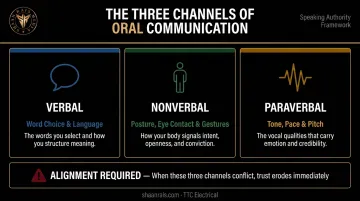
Three components work together to create the full message:
Verbal Communication
The words you choose shape how listeners perceive both the message and the speaker. Word choice signals expertise, clarity, and intent before any judgment about tone or body language kicks in.
A quick example: telling a client "we'll handle the positioning and messaging rollout" reads as competent and specific. Saying "we'll figure out the branding stuff" signals the opposite — even if the underlying work is identical.
Nonverbal Communication
Facial expressions, posture, gestures, and eye contact can reinforce or directly contradict what's being said. Listeners rely on these cues when assessing credibility, particularly when meeting someone for the first time.
A few signals that consistently affect perception:
- Forward-leaning posture and steady eye contact build trust and signal engagement
- Crossed arms and averted eyes often read as defensiveness or disengagement
- Mismatched expressions (smiling while delivering bad news) create confusion about intent
Paraverbal Communication
Tone, pitch, pace, and volume carry the emotional weight of a message. A flat, rushed delivery can undermine even well-prepared instructions. Speaking at a measured, confident pace tells listeners the speaker knows the material — and means what they're saying.
All three components need to be aligned. When a manager says "great work" in a monotone voice while checking their phone, the nonverbal and paraverbal signals override the words. Misalignment between these layers creates confusion — and erodes trust fast.
The Four Types of Oral Communication
Not all spoken communication demands the same skill set. Recognizing which context you're in helps you prepare appropriately.
| Type | Setting | Key Skill Demands |
|---|---|---|
| Public Speaking | Keynotes, all-hands meetings, safety briefings | Structure, vocal variety, audience reading |
| Interpersonal | One-on-ones, mentoring, performance reviews | Active listening, empathy, real-time adaptation |
| Group/Team | Project huddles, crew briefings, collaborative decisions | Turn management, summarizing agreement, staying on topic |
| Formal Presentational | Client proposals, board presentations, contractor briefings | Logical sequencing, credible evidence, Q&A handling |
Public Speaking
Public speaking is purposeful, prepared delivery to a broad audience. Without the immediate feedback loop of a one-on-one conversation, maintaining clarity and engagement takes deliberate effort. Strong structure, deliberate pacing, and physical presence matter more here than in any other context.
Interpersonal Communication
One-on-ones are the foundation of professional relationships — client check-ins, mentoring sessions, difficult performance conversations. Active listening and empathy are non-negotiable. The measure of success is whether the other person leaves feeling genuinely heard.
Group and Team Communication
Add two more people to a conversation and the dynamics shift fast. Skilled group communicators manage turn-taking, keep discussions on track, and synthesize competing perspectives into a shared direction. They also give and receive constructive feedback without derailing the conversation.
Formal Presentational Communication
Formal presentational communication targets a specific business decision — a contractor briefing, a client proposal, a board update. Preparation and logical sequencing are required entry points. The real differentiator is handling unexpected questions with confidence and adjusting when the room shifts direction mid-presentation.
Why Oral Communication Skills Matter in the Workplace
The NACE data cited earlier establishes the hiring case. But communication skills matter beyond the resume.
A survey by FMI and PlanGrid of nearly 600 construction leaders found that poor project data and miscommunication jointly accounted for 48% of rework — worth $31.3 billion annually in the US construction sector alone. While that figure spans communication broadly, the implication for verbal coordination on job sites is direct: when field teams can't clearly confirm instructions, errors compound.
In client-facing environments — where teams coordinate across engagements, report on brand positioning, and align on project scope — unclear verbal communication doesn't just slow things down. It creates genuine risk. A structured pre-engagement briefing, a clear instruction confirmed out loud by the receiver, a team member who flags a concern early: these are the communication acts that prevent costly missteps.
Trust Is Built Through Consistent Communication
Safety is one side of the equation. The other is trust. Companies that communicate transparently — not just when it's convenient, but as a consistent practice — earn the kind of client trust that generates repeat work and referrals.
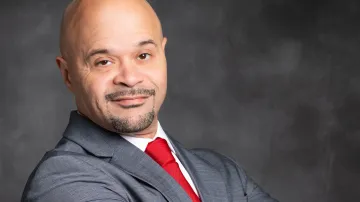
Shaan Rais Media, a personal-branding and positioning practice, reflects this principle directly. Founder Shaan Rais built the company's identity around honesty, positioning, and Perception Engineering — values that shape how the team talks with clients and collaborators alike.
That posture isn't accidental. Rais spent 22+ years as a volunteer firefighter, where unclear communication in high-stakes moments carries consequences that aren't recoverable. That experience informs how Shaan Rais Media operates: straightforward, direct, and safety-first.
Active Listening as a Two-Way Requirement
A 2024 meta-analysis covering 155,143 people across 122 studies found that perceived listening correlated .44 with work outcomes across the full dataset. Effective communicators don't just speak well — they demonstrate they've heard and understood, which reduces misalignment, increases accountability, and builds team trust over time.
The 5 C's of Oral Communication
The 5 C's aren't a formally validated academic model, but they function as a useful and memorable checklist for evaluating spoken communication in any professional context.
| C | What It Means | Operational Test |
|---|---|---|
| Clear | Unambiguous language the listener can follow | Can they state the point and required action back to you? |
| Concise | No unnecessary filler or tangents | Is every sentence earning its place? |
| Confident | Steady tone, appropriate pace, conviction in delivery | Are you controlling the pace or letting anxiety control it? |
| Courteous | Respectful tone that acknowledges the listener | Are you creating space for the other person to respond? |
| Complete | All necessary information included, no critical gaps | Does the listener know the what, when, who, and why? |
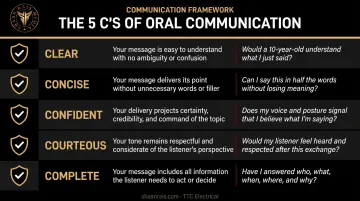
Each one plays out differently depending on context:
- In a safety briefing, clarity means replacing "be careful around the panel area" with "no one enters the switchgear room without confirming the breaker is locked out — confirm you've heard that."
- On a client call, a two-minute project update beats an eight-minute one covering the same ground — every extra minute costs attention.
- During a contractor briefing, steady eye contact, measured pace, and direct language signal command of the project, even when uncertainties exist.
- In a team huddle, asking "does anyone see a problem with this approach before we commit?" surfaces issues before they become expensive — and shows you respect the crew's experience.
- At a shift handoff, completeness means stating what's done, what's in progress, what's unresolved, and who owns each open item.
Best Practices for Stronger Oral Communication
Know Your Audience First
Before saying a word, consider who you're speaking to: their background, what they already know, and what they need from the conversation. A facility manager needs operational clarity. A crew member on a first-day orientation needs simpler vocabulary and more repetition. Generic messaging fails everyone because it's built for an imaginary average listener.
Prepare and Practice Out Loud
Preparation isn't just for keynote speeches. Structuring your thoughts before a difficult client conversation or a performance discussion reduces filler language, sharpens your delivery, and keeps you from losing the thread mid-sentence. Rehearse out loud, not just in your head. The spoken version of your message is almost always different from what you drafted on paper.
Use Structure Deliberately
Open with a clear purpose. Present information in a logical sequence. Close with a summary or a specific next step. Structure keeps the listener oriented and the message cohesive — and it makes you sound more prepared than speakers who start talking and figure it out as they go.
Build Active Listening Habits
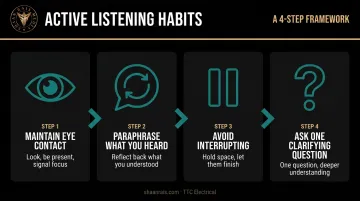
Strong communicators listen at least as much as they speak. Specific habits that make a measurable difference:
- Maintain eye contact without staring
- Paraphrase what you've heard before responding ("So what I'm hearing is...")
- Avoid interrupting, even when you already know where the sentence is going
- Ask one clarifying question before assuming you understood
Paraphrasing, in particular, has research support. In controlled studies, it makes speakers feel significantly more understood than simple acknowledgments — a meaningful difference when trust or alignment is on the line.
Manage Nonverbal and Paraverbal Signals
Record yourself during practice sessions. Most people are unaware of their own filler habits, pacing issues, or closed body language until they see it played back. Once you can see the gaps, the fixes become obvious: open posture, deliberate pacing, and a tone matched to your intent — whether that's instructing, encouraging, or correcting — all signal that you're in control.
Common Challenges and How to Overcome Them
Communication Apprehension
Nervousness before speaking is common across all experience levels. The PRCA-24 scale, the established measure of communication apprehension, shows meaningful variation across dyadic, group, and public-speaking contexts — which means anxiety in one setting doesn't predict it in another.
The most effective approach is graduated exposure:
- Start with low-stakes one-on-one conversations before moving to small groups
- Build toward larger audiences only after confidence stabilizes in mid-size settings
- Track which contexts trigger the most anxiety so you can prioritize practice there
Miscommunication and Retention
Spoken words can be misunderstood or forgotten, especially without visual reinforcement. Practical solutions:
- Follow verbal instructions with a written summary for complex tasks
- Use visual aids during presentations to anchor key points
- Confirm understanding by asking the listener to repeat back the key action or decision — not "does that make sense?" (which rarely surfaces confusion) but "can you walk me through what you're doing first?"
Cross-Functional and Diverse Teams
Different professional backgrounds and communication styles create gaps that polished speakers often miss. An engineer briefing a facilities crew needs different language than one addressing a board. Practical adjustments:
- Slow the pace when addressing unfamiliar audiences
- Define technical terms the first time you use them
- Create deliberate space for questions — don't just invite them, wait for them
Research on toolbox talks in construction found that adding a brief incident narrative and discussion questions significantly outperformed information-only briefings. When listeners are invited into the conversation rather than talked at, retention and compliance both improve.
Frequently Asked Questions
What is oral communication skill?
Oral communication skill is the ability to share and receive information clearly through spoken language. It includes active listening, conversational fluency, and the use of appropriate tone, pace, and nonverbal cues so your message lands as intended.
What are the four types of oral communication?
The four types are public speaking, interpersonal (one-on-one) communication, group/team communication, and formal presentational communication. Each differs in audience size, feedback immediacy, and the specific skills required to communicate effectively.
What are the 5 C's of oral communication?
The 5 C's are Clear, Concise, Confident, Courteous, and Complete. They serve as a practical checklist for evaluating spoken communication in any professional setting, useful for self-assessment and for coaching others toward stronger delivery.
What are examples of oral communication?
Examples include job site safety briefings, client presentations, team project huddles, job interviews, phone calls, performance reviews, contractor briefings, and one-on-one mentoring conversations.
How is oral communication different from written communication?
Oral communication is real-time and interactive, allowing immediate feedback, adjustment, and clarification through tone, pace, and nonverbal cues. Written communication is documented and more deliberate, but it lacks the live vocal signals that shape meaning in spoken exchange.
How can I improve my oral communication skills?
Practice regularly in progressively demanding settings, prepare your message in advance, build active listening habits, and record yourself to catch delivery patterns you'd otherwise miss. Seeking specific, targeted feedback speeds up improvement more reliably than solo practice alone.