That wiring has a name: DiSC. It's a framework that explains why some leaders default to speed and directness while others lead through relationships, stability, or precision.
Understanding your DiSC leadership type won't hand you a new personality. But it will show you why certain rooms respond to you instantly, and why others need something you're not naturally giving them. This article breaks down the four DiSC leadership styles, what separates them, and how to use that awareness to grow — not just as a manager, but as a leader people recognize and trust.
Key Takeaways
- No single DiSC style is objectively "best" for leadership
- DiSC measures four behavioral dimensions: how you decide, communicate, support others, and manage detail
- Knowing your style reveals blind spots and helps you adapt to your team
- Most leaders are a blend of two styles, not a single "pure" type
What Is a DiSC Leadership Style?
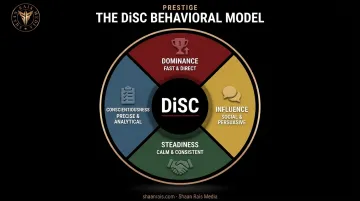
DiSC is a behavioral framework, not a personality label. It measures how people prefer to act, decide, and interact — both under normal conditions and under pressure. According to Wiley's Everything DiSC model, D, i, S, and C are behavioral tendencies, not fixed labels — every person is a blend of all four, positioned somewhere on a circular map rather than locked into a single box.
A "DiSC leadership style" is simply how your dominant traits show up when you lead. That includes:
- How you set goals and communicate direction
- How you delegate and check in on progress
- How you handle conflict or pushback
- How you respond when a decision has to be made fast, with limited information
This isn't abstract psychology. Coaches, HR teams, and executive development programs use DiSC as a practical, observable tool — something you can watch play out in a single meeting, not something buried in a clinical report.
Why Understanding Your DiSC Leadership Style Matters
Leaders who never examine their natural tendencies tend to default to one mode in every situation. A results-driven leader pushes for speed even when the team needs reassurance. A relationship-focused leader keeps building consensus when the moment calls for a hard call. Neither notices the mismatch. They only notice the friction it causes.
Self-awareness closes that gap. Research backs this up directly:
- A study of 134 high-performing and 470 average-performing managers found that high performers showed significantly greater agreement between how they rated themselves and how their direct reports rated them — meaning they had a more accurate read on their own behavior Church, Journal of Applied Psychology, 1997
- A separate study of 48 leaders and 222 followers found that leader self-awareness was directly tied to leadership effectiveness and follower satisfaction Tekleab et al.
The pattern is clear: leaders who know how they come across make fewer unforced errors. They don't accidentally alienate the half of their team that needs a different approach.
Style Shapes Perception, Not Just Outcomes
Those same unforced errors show up outside the team, too. Boards, investors, and clients don't just evaluate results. They form impressions based on how a leader communicates and shows up in the room. Two leaders can hit the same numbers and walk away with very different levels of trust and credibility.
This is why self-awareness comes first, not last. Before a leader can build credibility the market recognizes, they need clarity on the authentic style driving their decisions and delivery. Knowing your natural DiSC-driven style is the starting point, the raw material a leader works with before ever shaping how that presence reads to a board, an investor, or a market.
The Four DiSC Leadership Types
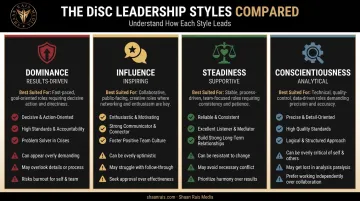
DiSC identifies four primary leadership types. Most leaders operate from one dominant style or a blend of two, and that combination shapes how they set direction, communicate, and make calls under pressure.
Dominance (D): The Results-Driven Leader
D-style leaders are decisive, direct, and competitive. They focus on speed, outcomes, and control, and they're comfortable making fast calls even without complete information.
Best suited for: high-stakes environments, turnarounds, and situations demanding quick, confident decisions.
- Strengths: driving action, taking ownership, pushing teams toward ambitious targets
- Limitations: can overlook team input, come across as impatient or blunt, and burn out teams if left unchecked
TTI's occupational research analyzed 2,370 chief executives and found Dominance was the trait that most distinguished CEOs from other occupations, with an AUC score of .69 — well above chance TTI Success Insights Technical Manual. That doesn't mean most CEOs are D — it means D shows up more strongly among executives than any other trait does.
Influence (I): The Inspiring Leader
Charisma defines the I-style leader. Enthusiastic and sociable by nature, they lead through storytelling and relationship-building, energizing a room rather than commanding it.
Best suited for: environments needing buy-in, culture-building, sales-driven teams, or change that requires enthusiasm to stick.
- Strengths: motivating others, building morale, generating momentum around a vision
- Limitations: may lose focus on details or follow-through, and can overpromise without full planning behind it
Steadiness (S): The Supportive Leader
S-style leaders are calm, patient, and consistent. They lead by building trust and stability over time rather than through urgency or spectacle.
Best suited for: environments needing team cohesion, stability, and steady execution.
- Strengths: reliability, active listening, creating psychological safety for their teams
- Limitations: may avoid necessary conflict, resist sudden change, or delay difficult decisions past the point they should've been made
Conscientiousness (C): The Analytical Leader
Precision drives the C-style leader. Logical and quality-focused, they lead through structure, data, and rigorous standards rather than instinct or charm.
Best suited for: environments requiring accuracy, compliance, complex problem-solving, or long-range planning.
- Strengths: thorough analysis, high-quality outcomes, sound risk assessment
- Limitations: can over-analyze, delay action, or come across as overly critical or detached from the human side of a decision
How to Choose the Right Approach for Developing Your Leadership Style
The goal isn't to become a different DiSC type. It's to identify which behaviors to lean into — or dial back — depending on what the moment actually requires.
Factors to Consider When Developing Your Style
Before defaulting to your natural mode, weigh these:
- The nature of the challenge — does it call for speed and decisiveness (D), buy-in and morale (I), stability and trust (S), or accuracy and planning (C)?
- The makeup of your team — adapt your communication and delegation to the blend of styles on your team, not just your own comfort zone
- Long-term versus short-term goals — some styles win the sprint, others win the marathon
- How you want to be perceived — which behaviors align with the professional reputation and market position you're building, not just what feels natural in the moment
Knowing which factors to weigh is only half the equation — leaders also need to recognize when they're misapplying the framework itself.
Mistakes to Avoid When Interpreting Your DiSC Style
DiSC becomes counterproductive when leaders misuse it. Watch for these traps:
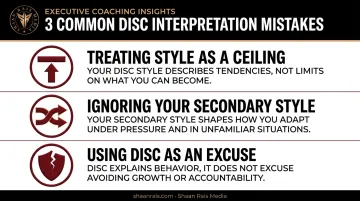
- Treating your dominant style as a ceiling. Your natural style is a starting point for growth, not a permanent limitation.
- Ignoring your secondary style. Most leaders are a blend, and the secondary style often explains why you act differently under pressure than you do in calm conditions.
- Using DiSC as an excuse. "That's just not my style" turns a development tool into a shield against growth. Use it to identify what to stretch into, not what to avoid.
Conclusion
DiSC leadership types explain natural tendencies in decision-making and communication — they're not a ceiling, and they're not a guarantee of success. A D-style leader can build a company culture people love. A C-style leader can move fast when the stakes demand it. The style just tells you where the stretch will feel hardest.
What separates good leaders from great ones is self-awareness paired with the willingness to adapt. Knowing your DiSC style won't rewrite your instincts overnight, but it will tell you exactly which habits to watch and which stretch goals to set. Start there, and the rest of your growth as a leader follows.
Frequently Asked Questions
What are the four DiSC leadership styles?
They are Dominance (results-focused, decisive), Influence (enthusiastic, relationship-driven), Steadiness (stable, supportive), and Conscientiousness (analytical, precision-focused). Each represents a different natural approach to leading a team.
Which DiSC personality type is the rarest?
None, officially. Wiley's Everything DiSC model is normed so that roughly 25% of respondents fall into each quadrant, with no designated "rarest" style, according to Wiley's official DiSC styles overview. Claims online naming a rarest type aren't supported by Wiley's own data.
Which DiSC type do most CEOs have?
Dominance is the trait most strongly associated with the CEO role in occupational data, but there's no verified figure showing most CEOs are D. Effective CEOs come from every DiSC style.
Can your DiSC leadership style change over time?
Your core style tends to stay fairly stable: test-retest reliability studies show consistency of .85 to .88 over two weeks. Still, people can and do develop flexibility to draw on other styles as experience and circumstances demand it.
Is DiSC the same as MBTI or other personality tests?
No. DiSC measures observable workplace behavior, while MBTI focuses more on internal preferences and self-insight, according to Wiley's DiSC vs. MBTI comparison. Neither should be used to predict future performance or for hiring decisions.
How can I find out my DiSC leadership style?
A formal Everything DiSC assessment, typically 15-20 minutes, gives the most accurate read. Short of that, reflect on how you naturally respond to pressure, conflict, and fast decisions. Those patterns offer early, if imperfect, clues.