That's the uncomfortable truth behind every complex deal, every high-ticket close, every client who says "yes" after months of hesitation. Even as AI chatbots and automated funnels handle more of the sales process, the biggest and most complicated deals still close human to human.
This article breaks down what personal selling actually is, the types you'll encounter, the seven-step process top performers follow, and the skills that separate closers from order-takers.
Key Takeaways
- Personal selling relies on direct, adaptable, two-way communication rather than a fixed script
- The 7-step process (prospecting to follow-up) still governs most complex B2B and high-ticket sales
- 80% of consumers buy more readily from personalized experiences (Epsilon)
- Reputation and positioning determine how much trust a seller carries into the first conversation
- Technology now supports personal selling — it hasn't replaced it
What Is Personal Selling?
Personal selling is direct, person-to-person communication (in-person, by phone, or over video) where a sales rep uncovers a prospect's needs and guides them toward a purchase decision. It's a conversation, not a broadcast.
This is the core distinction from mass marketing or advertising. Advertising sends one message to thousands of people at once. Personal selling adapts in real time: the rep asks questions, listens to the answer, and adjusts the pitch based on what they hear.
Personal selling shows up most often in these scenarios:
- High-value purchases (enterprise software, commercial real estate)
- Complex or technical products (industrial equipment, cybersecurity platforms)
- Services requiring trust (insurance, financial consulting, executive coaching)
- Situations with multiple decision-makers who all need convincing
Personal Selling in Marketing
Personal selling is one piece of the promotion mix, sitting alongside advertising, sales promotion, and public relations. Marketing's job is awareness at scale. Personal selling's job is closing the individual relationship once that awareness turns into a real conversation.
This split matters most in high-ticket, positioning-driven sales, where a prospect needs to trust the person before they trust the offer. The two functions work best when they talk to each other. Sales reps hear objections, language patterns, and unspoken hesitations directly from prospects, insight that rarely shows up in a survey.
That qualitative feedback should flow back into marketing:
- Objection patterns reveal gaps in current messaging
- Word choice from prospects sharpens future ad copy
- Hesitation points expose what campaigns fail to address
Messaging starts addressing the actual reasons people hesitate, not the reasons a team assumes they hesitate.
Types of Personal Selling
Not all personal selling looks the same. The approach shifts based on the product, the buyer, and the relationship.
- Retail selling — A store associate helping a customer choose a jacket, in a transactional, quick, low-stakes exchange.
- B2B selling — A sales engineer designing a custom manufacturing solution for a plant manager, requiring a longer cycle and deeper technical knowledge.
- Telemarketing — A rep calling to schedule a demo or renew a service contract, often the first touch in a longer process.
- Direct/door-to-door selling — A representative visiting homes to sell security systems or cookware, in the tradition of companies like Fuller Brush and Avon (Britannica).
- Consultative selling — A financial advisor asking detailed questions about a client's goals before recommending a strategy.
- Relationship selling — An account manager checking in quarterly with a long-term client, building trust that outlasts any single transaction.
- Social selling — A consultant engaging prospects directly through LinkedIn comments and DMs to build rapport before pitching.
Transactional vs. Consultative vs. Strategic Selling
Several of the types above — consultative and relationship selling especially — fall under broader sales models that determine how long a deal takes and how many people need to say yes. The three main models are transactional, consultative, and strategic selling.
| Model | Sales Cycle | Stakeholders | Example |
|---|---|---|---|
| Transactional | Short | Usually one buyer | Retail purchase |
| Consultative | Moderate to long | One to a few | Financial advisory |
| Strategic | Long | Multiple decision-makers | Enterprise software deal |
Upselling and cross-selling aren't separate types of personal selling. They're techniques layered onto an existing relationship — a rep suggesting an add-on service to a client who already trusts them. The type of selling stays the same; the opportunity just expands.
The 7-Step Personal Selling Process
Most sales training programs are built around one core question: what are the seven steps of personal selling? Skipping a step in this sequence is a common reason deals stall.
- Prospecting — Identify leads who have both a genuine need and the ability to buy. Not every interested person is a qualified one.
- Pre-approach — Research the prospect's business, likely pain points, and probable objections before making contact.
- Approach — Make first contact. This is where rapport gets built or lost in the opening thirty seconds.
- Presentation — Demonstrate the product or service, tying specific features directly to the pain points uncovered earlier.
- Handling objections — Hear the concern fully, clarify what's really being asked, then reaffirm the value. Don't dodge it.
- Closing — Ask for the business once buying signals appear. Waiting too long costs deals just as often as rushing does.
- Follow-up — Confirm satisfaction after the sale. This step drives repeat business and referrals more reliably than any prospecting tactic.
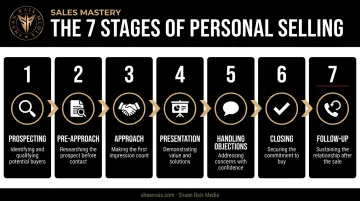
This sequence holds across academic sales training frameworks, from retail environments to complex enterprise B2B deals (OpenStax). In high-ticket sales specifically, steps five and six carry outsized weight — buyers scrutinizing a $50,000+ decision raise more objections and need more confidence before committing.
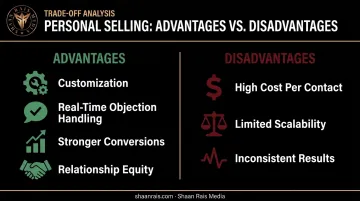
Advantages and Disadvantages of Personal Selling
Advantages
Personal selling wins where mass marketing can't compete: individual attention.
- Customization: every conversation adapts to the specific person in front of you
- Real-time objection handling: concerns get addressed the moment they surface, not days later
- Stronger conversions: 80% of consumers report being more likely to purchase when brands offer personalized experiences (Epsilon)
- Relationship equity: direct contact builds the kind of trust that drives referrals and repeat business for years
Disadvantages
Personal selling comes with real trade-offs in cost and speed.
- High cost per contact: one-on-one attention is expensive compared to a single ad reaching thousands
- Limited scalability: doesn't work well for low-margin, mass-market products where volume matters more than depth
- Inconsistent results: outcomes swing based on individual rep skill and motivation, so one strong closer and one weak one can produce very different numbers on the same offer
Key Skills for Successful Personal Selling
The mechanics of a sales conversation matter. But they're not the whole story.
- Active listening and needs discovery — Ask specific, targeted questions instead of generic ones. RAIN Group's research across more than 700 B2B purchases found that winning sellers consistently understood buyer needs better than the runner-up (RAIN Group)
- Deep product knowledge — Not just knowing features, but translating them into value specific to that buyer's situation
- Confident, authentic communication — Credibility without a pushy pitch
Building Credibility Through Reputation and Positioning
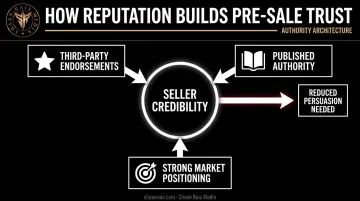
Skill and product knowledge aren't enough on their own. How a prospect perceives a seller before the conversation even starts, including their reputation and personal brand, shapes how much trust and pricing power they carry into the room.
Personal branding strategist Shaan Rais calls this dynamic Perception Engineering: systematically shaping how a market perceives, categorizes, and prices a professional before any pitch happens. A published book, a keynote credit, or an endorsement from a recognized name works the same way in practice.
- Third-party endorsements from recognized figures act as pre-sale credibility
- Published authority, such as a book, keynote, or media feature, shifts how a prospect frames the conversation before it starts
- Strong positioning reduces how much a seller needs to persuade, since some trust already exists
Sellers who build this kind of reputation spend less time convincing and more time confirming fit. That's the practical edge of selling from a position of authority instead of starting from zero each time.
Is Personal Selling Still Effective Today?
Yes — and the data on personalization backs this up directly. McKinsey found that 71% of consumers expect personalized interactions, and 76% get frustrated when they don't receive them (McKinsey). That expectation only grows as deals get bigger and more complex.
Meeting that expectation at scale is exactly where AI and automation come in — not by replacing the human seller, but by expanding what one seller can handle:
- CRM tools track context across every touchpoint
- Conversation intelligence flags objections and coaching moments
- Video calls extend the reach of face-to-face selling beyond geography
Gartner even forecasts that by 2030, 75% of B2B buyers will actively prefer sales experiences that prioritize human interaction over AI (Gartner). For high-value, high-complexity deals, sellers who pair human judgment with these tools will keep winning the room.
Frequently Asked Questions
What is personal selling in marketing?
Personal selling is direct, one-on-one communication between a rep and a prospect within the broader marketing mix. It converts individual buyers through tailored, adaptable conversations rather than mass messaging.
What are the 7 steps of personal selling?
Prospecting, pre-approach, approach, presentation, handling objections, closing, and follow-up. Each step builds on the last, from identifying a qualified lead to securing repeat business after the sale.
Is personal selling still effective?
Yes, especially for high-value and complex sales where trust and customization matter. Technology like CRM and video calls now supports these conversations rather than replacing the human seller.
What is an example of personal selling?
A financial advisor walking a client through investment options based on their specific goals is a classic example. A car salesperson guiding a buyer between models based on stated needs works the same way.
What skills do you need to succeed at personal selling?
Active listening, deep product knowledge, and confident communication top the list. Increasingly, how a seller is perceived before the conversation starts — their reputation and positioning — matters just as much.
How is personal selling different from advertising?
Advertising is one-way, mass communication sent to a broad audience without adapting to any individual. Personal selling is two-way and adjusts in real time based on what the specific buyer says and needs.