That gap between the vision and the plan? It's the whole story of who wins and who stays stuck.
The line "Amateurs talk strategy. Professionals talk logistics" gets tossed around boardrooms and locker rooms alike, usually credited to General Omar Bradley. A similar phrase — "Amateurs talk about tactics, but professionals study logistics" — is attributed to Marine Corps Commandant General Robert H. Barrow in 1980. Neither attribution comes with an airtight paper trail, but the truth inside the quote doesn't need one.
Strategy is exciting. It's the vision board, the mission statement, the big declaration. Logistics is the unglamorous machinery that actually moves the vision forward. Most people — in the military, in business, and especially in personal branding — get stuck talking about the destination while never building the road to get there.
This article breaks down why that gap exists and, more importantly, how to close it.
Key Takeaways
- Strategy sets the destination, but logistics is the disciplined system that actually gets you there
- The amateurs-vs-professionals framing started in military circles but now applies directly to business, IT, and personal branding
- Amateurs chase viral moments; professionals build repeatable positioning systems that compound over time
- Operators who follow a structured protocol get paid at a premium; those relying on raw motivation rarely do
Where This Line of Thinking Comes From
Attribution matters less than the pattern it describes. Historians trace similar sentiment back to Sun Tzu, who wrote extensively about supply wagons, provisioning, and the cost of prolonged campaigns — evidence that logistics thinking predates the modern military by over two thousand years.
The pattern shows up in real conflicts, not just quote books. During the early stages of the Russia-Ukraine war, Ukrainian forces didn't just out-strategize Russian command; they targeted Russian supply routes, ammunition depots, and logistics hubs directly. CNA's analysis of Russian military logistics in the Ukraine war documents how Ukrainian strikes on bridges and supply nodes forced Russian forces to disperse and relocate stockpiles, increasing their transport burden significantly.
Logistics wasn't the only factor in that conflict. But it was the factor most consistently underestimated.
If that logic holds when lives are on the line, it holds when your paycheck or your reputation is on the line too. The same underestimation happens in boardrooms, launches, and client engagements — which is where this gets personal.
Amateurs Talk Strategy: Why Vision Alone Falls Apart
"Talking strategy" sounds like this: big mission statements, grand five-year visions, declarations of intent with zero defined steps behind them. It's intellectually satisfying because it feels like progress without requiring any of the friction of actual execution.
Here's why the appeal is so strong:
- Strategy conversations feel visionary and important
- They let you avoid the discomfort of unglamorous, repetitive work
- They generate excitement without requiring accountability
- They're easy to talk about at dinner parties
Retired Army General Gordon R. Sullivan popularized a phrase that cuts right through this: "Hope is not a method." He started using it in the mid-1970s while commanding a battalion, after a successful tank-gunnery result taught him that one good outcome doesn't guarantee a repeat without doctrine, training, and preparation behind it.
Sullivan later turned the phrase into a 1996 book title, applying the same military logic to business leadership.
The "I Want to Build a Brand" Problem
Someone says, "I want to build a personal brand" or "I want to be known as a thought leader in my industry." Fine goal. But there's no content cadence attached. No positioning statement. No platform plan. Just the wish.
Ambition without infrastructure produces the same result every time: nothing, followed by frustration, followed by abandoning the goal entirely instead of fixing the plan. This is exactly the gap positioning work is meant to close: capability without a system to make it visible rarely converts into recognition or pricing power.
This isn't just anecdotal. Research on implementation intentions — the psychological concept of linking a specific plan to a specific trigger — backs this up. A meta-analysis by Gollwitzer and Sheeran covering 94 independent tests found a medium-to-large effect (d = 0.65) on goal attainment when people built if-then plans instead of relying on vague intentions. Wanting something isn't the problem. Not having a sequenced plan for pursuing it is.
That same lack of sequencing shows up in another way: amateurs also expect fast results. When the vision doesn't materialize in a few weeks, they scrap it instead of adjusting the execution plan underneath it. That's a logistics failure, not a strategy failure.
Professionals Talk Logistics: The Infrastructure Behind Every Win
Logistics is the sequencing, resourcing, and repeating of the unglamorous actions that turn a strategy into something real. It's less exciting to talk about. It's also the entire reason anything gets accomplished.
Historical armies prove this in granular detail. Roman military logistics, documented by historians like Polybius and Josephus, included standardized camp layouts, engineered roads, pre-positioned bridges, and provisions organized well before any battle began. The outcome of most engagements was decided by preparation, not heroics on the day of the fight.
Professionals don't skip strategy. They refuse to stop at it. Strategy is the starting line, not the finish line, and the same principle applies to building a personal brand.
In a positioning or career context, logistics thinking looks like:
- Structuring a content cadence instead of posting whenever inspiration strikes
- Mapping a 120-day rollout instead of chasing "get more visible"
- Tracking input activities (outreach sent, content published, conversations started) instead of hoping for outcomes
- Building repeatable systems that produce output regardless of how motivated you feel that day
The Invisible Work Paradox
Nobody praises a supply chain. Nobody writes case studies about the person who followed up consistently for six months. But that invisible discipline is exactly what makes the visible win, whether it's the keynote booking, the closed deal, or the viral moment, possible in the first place.
Logistics thinking requires patience most people don't want to sit with. It's not sexy. It's just what works.
Applying This to Personal Branding: Positioning Is the New Logistics
In personal branding, the amateur version of this problem sounds like "I want to be known" or "I need more visibility." That's strategy talk. It names a destination without building a road.
The professional version builds the actual infrastructure of perception: how the market categorizes you, positions you, and ultimately prices you.
Shaan Rais, an Industrial-Organizational Psychologist known for his work in branding and positioning, calls this "Perception Engineering": the deliberate, sequenced work of shaping how a market receives and prices a professional, rather than leaving it to algorithm luck or random posting. Rais has applied this methodology with more than 400 operators across 50-plus industries, built on a core belief: you are more valuable than you are visible.
Most capable professionals stay underpriced not because they lack talent. They lack the logistics layer connecting talent to recognition. The table below breaks down what that logistics gap actually looks like in practice.
Amateur vs. Professional Branding Behavior
| Amateur Approach | Professional Approach |
|---|---|
| Posts randomly, chasing algorithm trends | Follows a defined, repeatable content system |
| Mimics competitors' content | Operates from a clear positioning statement |
| Hopes visibility eventually converts to clients | Builds a pricing strategy tied to perceived authority |
| Treats branding as an occasional task | Treats positioning as ongoing infrastructure |
The 120-Day Personal Brand Legacy Protocol is one example of what a true logistics system looks like in personal branding. Rather than a loose collection of tips, it's a structured, sequenced roadmap: diagnosing the positioning gap first, then building a complete conversion system, then crafting the brand identity and narrative, then executing visibility strategies across the right channels, all inside a defined timeframe.
That sequencing matters more than any single tactic. One documented example: Bobby Jackson, a retired Marine and fractional CFO, went through this process and grew revenue 400% year-over-year after moving from undefined services to a clearly packaged, positioned offer built for CEOs.
Another operator generated $250,000 in new business within 72 hours of a single keynote built entirely around positioning language, not motivational content.
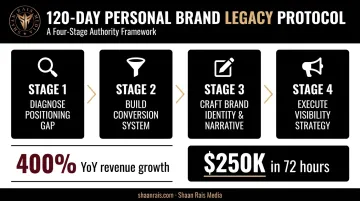
Neither outcome came from more hustle. Both came from a system doing the work that hope alone never could.
Building Your Own Logistics System (Practical Starting Points)
You don't need a 120-day program to start thinking like a logistics professional. You need an honest audit.
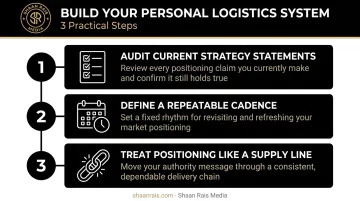
- Audit your current strategy statements. Write down every goal you've stated out loud this year. For each one, ask: is there a defined action plan and timeline attached, or is it just a wish with good intentions?
- Define a repeatable cadence. Instead of "post more content" or "network more," commit to a specific, trackable rhythm — three pieces of content weekly, five outreach touches daily, one positioning-focused conversation per week. Borrow the "deal funnel" logic investors use to build a consistent visibility funnel for your own brand.
- Treat positioning like a supply line. No general wins a battle hoping troops show up fed and ready; positioning works the same way. It's the unseen preparation that determines whether a launch, pitch, or campaign lands.
Most of the time, that gap between where you are and where you want to be traces back to missing systems, not missing talent. Build the audit, the cadence, and the supply line first — the strategy will finally have something to run on.
Frequently Asked Questions
Who actually said "Amateurs talk strategy, professionals talk logistics"?
The quote is most commonly attributed to General Omar Bradley. A nearly identical line is credited to General Robert H. Barrow of the U.S. Marine Corps in 1980 — neither attribution has a confirmed primary source.
What is the difference between strategy and logistics in simple terms?
Strategy is the "what" and "why" — your destination and reasoning. Logistics covers the "how": the sequenced, resourced work of getting there on schedule.
Does this mean strategy doesn't matter?
No. Strategy is still essential as a starting point. Professionals don't abandon it — they simply refuse to stop there and immediately build the execution system behind it.
How does this concept apply to personal branding specifically?
In branding, logistics means having a defined positioning system, a consistent content cadence, and a deliberate perception strategy — instead of randomly posting content and hoping visibility eventually follows.
Why do so many talented professionals stay invisible despite having a clear vision for their brand?
Vision without a structured execution system is the most common reason capable people stay underpriced and unrecognized. It's a positioning gap, not a talent gap.
What's the first step to shifting from "amateur" to "professional" thinking in branding?
Start with an honest audit: does a concrete, sequenced plan exist behind your stated goal? If not, build one before creating more content or setting bigger goals.