Many executives still treat personal branding as a vanity project, something to get to "someday" after the quarter closes. But that delay has a price. Deals stall. Star candidates go quiet. Reporters and AI tools fill the silence with whatever they can find, accurate or not.
This article breaks down why executive branding has moved from a nice-to-have to business infrastructure, what it costs leaders who ignore it, and what actually works when you decide to fix it.
TL;DR
- Executive branding now shapes trust before a single sales call, pitch, or interview happens
- It touches sales cycles, hiring costs, fundraising conversations, and crisis resilience
- Staying silent doesn't mean staying neutral. It means competitors, journalists, or algorithms write your story instead
- Positioning, meaning knowing who you are and what you stand for, has to come before any content calendar or platform strategy
What Is Executive Personal Branding
Executive personal branding is the deliberate, ongoing effort to shape how the market perceives, trusts, and values a leader's expertise and judgment.
It shows up through:
- LinkedIn presence and thought leadership content
- Media and press visibility (interviews, bylines, mentions)
- Speaking engagements at conferences and industry events
- Point-of-view content that stakes out a position, not just reposts industry news
But the visible output isn't the point. It's the outcome of strategic positioning done well beforehand, a distinction Shaan Rais has built an entire methodology around.
Shaan Rais, founder of his eponymous personal-branding practice and creator of the 120-Day Personal Brand Legacy Protocol, calls this "Perception Engineering": systematically architecting how the market receives, categorizes, and prices a professional. His central argument is direct. The most positioned operators, not the most talented ones, command the highest pricing and influence.
That reframes the goal entirely. Executive branding isn't about follower counts or viral posts. It's about influence, trust, and pricing power. A leader with 2,000 highly-targeted LinkedIn connections who consistently shares a sharp point of view often outperforms one with 50,000 followers and no clear positioning.
Why Executive Personal Branding Is No Longer Optional
Three structural shifts explain why this stopped being optional. None of them are passing trends — they're permanent changes in how stakeholders make decisions.
Trust and Buying Behavior Have Shifted to the Individual
Prospects, investors, and partners now vet the leader as closely as they vet the company. An active, credible executive presence pre-sells trust before a pitch deck ever opens.
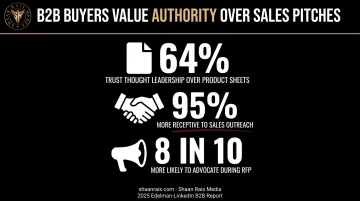
The data backs this up. In the 2025 Edelman-LinkedIn B2B Thought Leadership Impact Report, surveying nearly 2,000 management-level professionals, 64% of buyers trusted thought leadership more than product sheets, and 95% said strong thought leadership made them more receptive to sales outreach. Almost 8 in 10 said it made them more likely to advocate for a vendor during an RFP.
A prior edition of the same annual study found something even more specific: 62% of decision-makers associated the highest-quality thought leadership with content produced by a prominent, respected expert — not an anonymous brand account.
KPIs this affects:
- Sales cycle length
- Deal win rate
- Investor meeting conversion
- Average deal size
Where it matters most: high-consideration B2B sales, fundraising rounds, and enterprise deals — anywhere trust, not price, is the barrier to closing.
Talent Attraction Now Runs Through the Leader, Not Just the Job Post
Job seekers evaluate a leader's visible values and credibility before they ever click "apply." A CEO's content functions as an always-on recruiting asset, whether the company intends it to or not.
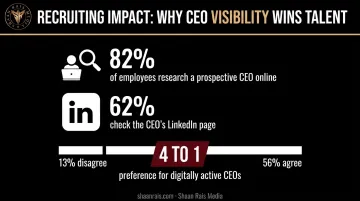
Brunswick Group's 2022 Connected Leadership survey found that 82% of employees researched a prospective CEO online, and 62% specifically checked that CEO's LinkedIn page. More striking: employees preferred working for a digitally active CEO by roughly 4 to 1 — 56% agreed, only 13% disagreed.
That preference translates into real business consequences:
- Stronger candidate pipelines from passive talent who already trust the leader
- Higher offer-acceptance rates when candidates feel they know who they're working for
- Lower cost-per-hire because visibility reduces the need for aggressive recruiter outreach
KPIs this affects: application volume, offer-acceptance rate, cost-per-hire, employee retention.
Where it matters most: competitive talent markets, leadership transitions, and any scaling phase where reputation becomes the tiebreaker between two comparable offers.
Silence Creates a Narrative Vacuum Competitors and Algorithms Will Fill
An invisible executive doesn't avoid perception. The market fills the gap with whatever it can find — old press mentions, a competitor's louder voice, or an AI-generated summary with no nuance.
Google has acknowledged that AI Overviews can misinterpret web content and surface inaccurate information. This risk grows when there's limited source material to draw from — if you haven't shaped what's publicly available about you, you have no say in what fills that void.
This isn't theoretical. Consider how McKinsey describes Mary Barra's handling of the 2014 GM ignition-switch crisis — her visible, transparent presence became a catalyst for restoring trust. Leaders without that established credibility going into a crisis have no reservoir to draw from.
KPIs this affects: brand sentiment, search/AI visibility accuracy, crisis response speed and credibility.
Where it matters most: leadership transitions, funding announcements, public scrutiny moments, or any high-visibility event where journalists and AI tools need a source — and will use whatever's available.
What Happens When Executive Branding Is Missing or Ignored
Capable leaders often assume results speak for themselves. Hit your numbers, close your deals, and recognition follows. It doesn't work that way anymore. The market rewards positioning, not just performance.
Common consequences of skipping this work:
- Inconsistent recognition despite genuinely strong results
- Getting passed over for board seats or speaking invitations that go to more visible peers
- Losing deals to less-qualified but more visible competitors
- Higher recruiting and retention costs because the employer brand carries all the weight alone
These aren't hypothetical risks — they compound over years, showing up as stalled titles, quieter rooms, and revenue left on the table. Rais puts it directly:
"The market isn't missing you because you're not good enough — it's missing you because your positioning hasn't caught up with your capability."
The gap is fixable once you name it correctly. Positioning work, unlike a skills deficit, responds quickly to deliberate effort.
How to Get the Most Value from Executive Branding
Branding efforts only compound when they're built on clear positioning first — not a posting schedule, not a platform choice, not a follower goal.
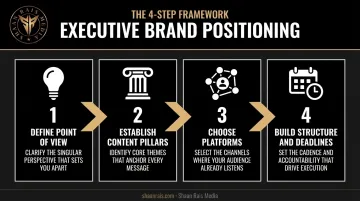
Start with positioning, not tactics:
- Define your point of view — What do you believe about your industry that most people in it won't say out loud?
- Establish 2-3 content pillars — The specific themes you'll be known for, not everything you know
- Choose platforms after positioning is set — LinkedIn, press, speaking; the channel is secondary to the message
- Build in structure and deadlines — Ad hoc posting rarely survives a busy quarter
Structured, time-boxed programs outperform ad hoc effort because they force consistency. Shaan Rais built his 120-Day Personal Brand Legacy Protocol on this exact logic: defined phases, measurable milestones, and a forcing function that keeps the initiative from quietly dying after week three.
The final piece matters most — insight has to convert into visible action. A positioning document sitting in a shared drive changes nothing. Content published, speaking slots booked, media pitched. That's where the value actually gets realized.
Conclusion
Executive visibility now shapes trust, hiring, and competitive standing directly — not just personal reputation on the side. The advantages compound the longer you invest: each piece of content, each speaking slot, each media mention builds on the last.
The costs of neglecting it compound quietly too. A missed board seat here, a lost deal there, a candidate who accepted a competitor's offer instead. None of it shows up as a single dramatic loss. It shows up as a slow erosion of opportunities that should have gone to you.
Positioning, not just talent, determines who gets recognized, hired, and paid at the premium level. The market isn't waiting for you to become more capable — it's waiting for you to become visible.
Frequently Asked Questions
What are the key components of executive personal branding?
The core components are strategic positioning (a clear point of view and area of expertise), consistent digital presence (LinkedIn, media, speaking), and content that reinforces both over time. Positioning always comes first.
Why is executive personal branding considered important now more than ever?
Stakeholders (buyers, investors, candidates) research leaders directly before trusting a company. AI search tools also fill gaps with whatever's available, raising the cost of having no controlled online presence.
How much time should an executive realistically invest in personal branding?
Most executives can maintain a credible presence with a few focused hours weekly. Structured systems or delegated, done-for-you support significantly reduce the direct time an executive needs to spend.
Is executive personal branding different from company branding?
They're complementary, not competing. A strong executive brand typically elevates company credibility rather than detracting from it.
What's the biggest mistake executives make with personal branding?
Posting content without clear positioning first. Inconsistent effort is the second most common failure point, and both undermine the compounding effect that makes branding work.
How long does it take to see results from executive branding efforts?
Meaningful market recognition typically requires sustained effort over several months, with the strongest returns compounding after a year or more of consistent positioning and visibility.