Introduction
Two people sit in the same meeting. The manager says, "I'd like you to use your own judgment on this." One employee walks out energized — finally, some autonomy. The other walks out anxious — was that a setup for failure?
Same words. Completely different experiences — not because one person wasn't listening, but because each person's mental framework filtered what they heard differently.
This is the core insight of Personal Construct Psychology (PCP), a theory George Kelly developed in 1955 to explain how individuals build unique interpretive lenses through which every conversation, relationship, and message passes. Understanding those lenses doesn't just explain why miscommunication happens — it offers a practical path to communicating with more precision and less friction.
This guide covers:
- The origins and core concepts of PCP
- How constructs cause the most common communication failures
- Practical techniques for applying PCP in everyday and professional settings
Key Takeaways
- Every person filters messages through a unique system of bipolar mental categories called personal constructs
- Miscommunication happens in the gap between two people's construct systems — not in the words themselves
- The Sociality Corollary — understanding how someone else organizes meaning — is the foundation of genuine communication
- Core identity-linked constructs resist change; shifting them requires deliberate, sustained effort
- Use contrast questions to uncover hidden constructs faster than direct questioning ever will
What Is Personal Construct Psychology?
George Kelly introduced PCP in his 1955 two-volume work, The Psychology of Personal Constructs (W. W. Norton), as a departure from the dominant models of his era. Where behaviorism treated people as products of conditioning and psychoanalysis located meaning in unconscious drives, Kelly placed the individual as an active meaning-maker.
The Person as Scientist
Kelly described what he called "man-the-scientist" — the idea that every person continuously forms hypotheses about the world, tests them through experience, and revises (or stubbornly maintains) their mental models based on what they observe. His Fundamental Postulate states: "A person's processes are psychologically channelized by the ways in which he anticipates events." What you expect to happen shapes how you behave and what you hear.
Personal Constructs as Bipolar Lenses
Personal constructs are the building blocks of this system — bipolar mental categories like:
- Trustworthy vs. unreliable
- Safe vs. threatening
- Decisive vs. reckless
- Warm vs. cold
These aren't just attitudes. They're the cognitive categories through which people sort every person, event, and message they encounter.
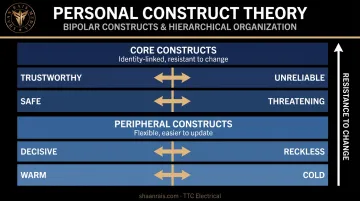
Constructs are organized into personal hierarchies. Core constructs govern a person's sense of identity and resist change even under direct challenge. Peripheral constructs are more flexible — easier to update when new evidence arrives.
Constructive Alternativism
Kelly's philosophy of constructive alternativism holds that no event has only one correct interpretation. Any situation can be construed differently — and people have the capacity to choose alternative constructs. A manager who construes a team member as "resistant" could just as accurately construe them as "cautious" — and that shift in framing changes every conversation that follows. In communication, this principle explains why reframing isn't just rhetorical — it's cognitively real.
Key Principles of PCP and How They Shape Communication
Kelly's 11 corollaries all appear in Volume 1 of his 1955 work. Five are directly relevant to communication.
The Sociality Corollary
Kelly's exact wording: "To the extent that one person construes the construction processes of another, he may play a role in a social process involving the other person."
This is the most important principle for communication. Meaningful interaction requires understanding how another person organizes meaning — not just what they believe. Sociality is not about agreement — it's about comprehension. That distinction determines whether an exchange generates connection or friction.
The Commonality Corollary
When two people use similar construct systems, they experience the world in psychologically similar ways. Communication flows easily. This explains why conversation inside tight-knit teams, families, or professional communities feels effortless — shared constructs create shared shorthand.
The catch: shared vocabulary doesn't guarantee shared construing. Two people can use the word "urgency" while meaning entirely different things, each convinced the other understands them.
The Individuality and Experience Corollaries
Commonality explains shared understanding, but individuality explains its limits. Two related corollaries define this tension:
- Individuality Corollary: Each person's construct system reflects unique lived experience, so no two people interpret the same message identically.
- Experience Corollary: Constructs aren't fixed. Kelly writes that a construction system "varies as he successively construes the replication of events" — meaning constructs shift through active interpretation, not passive exposure.
The Dichotomy Corollary and Communication Blind Spots
Constructs are bipolar. Meaning arises through contrasts, not isolated labels. The instinct to categorize everything as one thing or its opposite — supportive or critical, honest or deceptive — creates communication rigidity. When a message doesn't fit cleanly into either pole, people may force it into the nearest available category, distorting its meaning in the process.
Why People Misunderstand Each Other: The Role of Constructs
Miscommunication in PCP terms comes down to this: both parties are operating through different construct systems simultaneously. What one person intends passes through their constructs; what the other receives passes through theirs. That structural gap — not bad intent — is where misunderstanding originates.
When Words Mean Different Things
A manager who says "I want you to use your judgment" might be expressing genuine trust. One employee construes this through a "autonomy vs. micromanagement" framework and hears empowerment. Another construes it through "support vs. abandonment" and hears neglect.
Same words, entirely different meaning — because the construct systems doing the interpreting are different.
Preemptive Construing
Kelly defined preemptive construing as treating a construct as if it "preempts its elements for exclusive membership in its own realm" — a "nothing but" categorization. In conversation, this shows up as:
- Dismissing feedback before it's finished
- Hearing only the part of a message that confirms existing expectations
- Filtering out evidence that contradicts a fixed view of someone
Think of it as confirmation bias with a structural explanation: the listener isn't choosing to misinterpret — their construct system filters incoming information before conscious evaluation even begins.
PCP Anxiety
Kelly defined anxiety as "the recognition that the events with which one is confronted lie outside the range of convenience of one's construct system." This is a technical term, not a clinical diagnosis — it describes what happens when an event doesn't fit any existing category in a person's construct system.
In conversation, this appears as discomfort with ambiguity, aggressive deflection, or complete shutdown when a discussion moves into unfamiliar emotional or conceptual territory.
Permeability and Rigidity
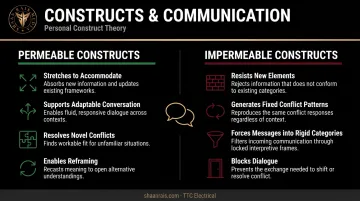
| Construct Type | Communication Impact |
|---|---|
| Permeable | Stretches to accommodate new information; supports adaptable, responsive conversation |
| Impermeable | Resists new elements; fixed categories generate repeated conflict patterns |
People with more permeable constructs can extend their existing mental categories to make sense of novel situations. Those with highly impermeable constructs find it difficult to update their interpretations, which is why some conflicts replay the same pattern regardless of how the words are changed.
Understanding why these patterns repeat is the first step toward breaking them.
How to Apply PCP in Everyday Communication
Practice Sociality Before Responding
In any difficult conversation, pause before replying and ask: How is this person likely construing this situation? What bipolar framework might be active for them right now?
This shifts the response from reactive to curious — and that shift alone changes the quality of what follows.
Use Contrast Questions to Surface Constructs
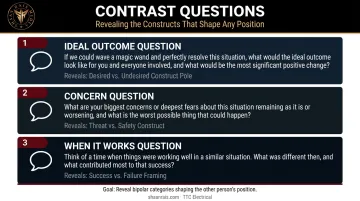
Open-ended contrast questions are among the most effective tools from PCP's repertory grid methodology:
- "What would the ideal outcome look like for you — and what would the opposite of that look like?"
- "What's your biggest concern about this — and what would need to be true for that concern to go away?"
- "When this works well, what does that look like compared to when it doesn't?"
These questions don't just gather information. They reveal the bipolar categories shaping the other person's position, which is where alignment or conflict actually lives.
Challenge Your Own Bipolar Framing
When a conversation feels stuck, identify which bipolar construct you're applying to the other person or situation. Then ask whether that construct is the most useful available frame — or whether a more permeable alternative exists.
This is constructive alternativism in practice. The point isn't interpretation itself — it's whether your current interpretation opens doors or closes them. A more permeable construct often moves things forward when the conversation has stalled.
Reframe Emotional Reactions as Construct Invalidation
When someone reacts with anger, withdrawal, or disproportionate intensity, consider that their core constructs — the ones tied to identity — may have just been challenged. The emotional intensity signals the depth of the construct, not the magnitude of the external event.
Rather than escalating, acknowledge the disruption. Create space for the person to reorient before expecting dialogue to resume. Recognizing construct invalidation lets you respond to what's actually happening — not just what's being said.
PCP in Workplace and Professional Communication
Teams Develop Shared Construct Systems
Over time, teams build shared vocabularies and shared definitions of "quality," "urgency," and "professionalism." When team members have significantly different construct systems — especially around core work values — even well-intentioned communication generates friction. Leaders who surface these differences explicitly, rather than assuming shared meaning exists, avoid months of accumulated misalignment.
A practical approach: Barbara Senior's 1996 study in the Journal of Managerial Psychology used Kelly's repertory grid technique to elicit team-specific performance constructs and create a basis for structured improvement discussion — creating a view "from the inside" rather than prescribing generic competency lists.
The Sociality Corollary in Client-Facing Work
Understanding what "reliability," "safety," or "good service" means to each specific client, rather than projecting your own definitions, is the foundation of trust-based professional relationships. This is not a soft skill. It is a structural difference between transactional service and genuine partnership.
The construct-aware approach starts with asking rather than assuming. What does a client mean when they say they want someone "reliable"? Available at midnight, or consistent about meeting deadlines? The word is the same. The constructs behind it differ entirely.
This gap shows up in every service industry. Shaan Rais of Shaan Rais Media, a personal-branding and positioning practice, builds client relationships by treating words like "positioned," "credible," and "trustworthy" as open questions rather than settled definitions. A client who has been let down by a previous consultant means something different by "reliable" than one with no prior bad experience. Asking — rather than assuming — is what separates a transactional engagement from a long-term working relationship.
The Repertory Grid as a Professional Tool
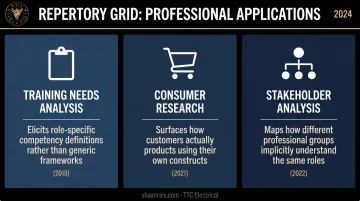
Originally developed by Kelly for clinical assessment, the repertory grid has been adapted across multiple professional contexts:
- Training needs analysis: eliciting role-specific competency definitions rather than applying generic frameworks (Peters, 1994)
- Consumer research: surfacing how customers actually categorize products and services, rather than imposing researcher-defined categories (Marsden & Littler, 2000)
- Stakeholder analysis: Moon and colleagues' 2017 adaptation into "perception matrices" mapped how different professional groups implicitly understood the same organizational roles
The core method: ask participants to compare and contrast elements of their work (for example, "In what way are these two clients similar and different from a third?") to surface hidden assumptions. The technique generates data that structured surveys miss, precisely because it works within the participant's own construct system rather than the researcher's imposed categories.
Is Kelly's Theory Still Relevant Today?
Peer-reviewed work confirms PCP remains active. David Winter's 2026 review in the Journal of Constructivist Psychology — "Personal Construct Psychology — Still Going Strong at 70?" — surveys the theory's continued development and application globally.
That ongoing vitality isn't accidental. PCP has been identified as a precursor to cognitive-behavioral approaches (Ruggiero et al., 2018), yet Winter's review notes that Kelly actively resisted the "cognitive" label — arguing that PCP integrated thought, emotion, and action within a single anticipatory process, not just cognition alone.
Recent applications show how far the framework has traveled from clinical settings:
- Constructivist models of radicalization (Winter & Feixas, 2019)
- Repertory grid studies of identity formation and political polarization
- Research into the psychological structure underlying extremism
The core insight — that people operate from fundamentally different anticipatory frameworks, and that understanding those frameworks is the precondition for meaningful dialogue — is precisely what makes PCP useful in a fragmented communication landscape.
Frequently Asked Questions
What is Kelly's theory of personal construct?
George Kelly's Personal Construct Theory, introduced in 1955, proposes that individuals build unique mental frameworks — called personal constructs — to interpret and anticipate experiences. These constructs are organized as bipolar categories and shape behavior and communication, not objective reality alone.
What is an example of a personal construct?
Someone who grew up in an unpredictable environment might develop a "safe vs. threatening" construct that leads them to interpret firm workplace feedback as aggressive. A colleague with different experiences construes the same feedback as straightforward and helpful — same words, different construct system.
Is Kelly's theory still relevant today?
PCP remains actively researched, with Winter's 2026 review confirming its continued global application. The theory has influenced cognitive-behavioral approaches and constructivist education. Current studies also apply its frameworks to polarization, radicalization, and organizational communication.
How does personal construct psychology affect communication?
PCP shows that every message is both sent and received through personal construct systems. What one person intends and what another receives can differ significantly based on each individual's unique mental frameworks, prior experiences, and core beliefs — regardless of the words chosen.
What is the Sociality Corollary and why does it matter?
The Sociality Corollary holds that meaningful communication requires understanding how another person construes the world — not just agreeing with them. Practicing this perspective-taking enables genuine empathy and productive dialogue, particularly during conflict.
Can personal constructs change over time?
Yes. The Experience Corollary describes how constructs evolve as people interpret new events that confirm or challenge existing frameworks. Core constructs tied to identity, however, tend to be more resistant and may require deliberate reflection — or therapeutic support — to revise.