
This isn't a lucky-break story. It's psychology. Researchers have studied self-presentation for decades, and the findings are consistent: how you're perceived directly shapes how you're treated, trusted, and paid.
This guide breaks down the science behind self-presentation and shows how to apply it deliberately, whether you're building a career, a brand, or a business.
Key Takeaways
- Self-presentation is selective honesty, not deception — most people reveal true traits that fit the situation
- People care more about appearing likable than appearing competent in everyday interactions
- Beyond Jones and Pittman's five core strategies, modesty and self-handicapping add two more tools to your repertoire
- Mixing strategies instead of relying only on self-promotion builds more durable trust
- Digital platforms now demand consistent self-presentation as a core professional skill
What Are Self-Presentation Strategies?
The American Psychological Association defines self-presentation as any behavior intended to convey a particular image of, or particular information about, the self to other people. That covers what you say, how you dress, your posture, and what you post online.
Here's the part people misunderstand: self-presentation isn't lying. Most professionals selectively reveal genuine aspects of themselves that fit the moment. You don't fabricate a personality for a client meeting — you emphasize the parts of your actual expertise that matter most for that room.
Where the Concept Came From
Psychologist William James planted the seed in The Principles of Psychology, observing that a person has "as many social selves as there are individuals who recognize him." You're not one fixed self; you're a collection of selves calibrated to different audiences.
Erving Goffman built on this in his 1959 book, The Presentation of Self in Everyday Life, using a theatrical metaphor. Every social interaction, Goffman argued, is a performance — and performances shape outcomes. People treat you, trust you, and reward you based on the impression you create, not just your underlying reality.
Conscious vs. Unconscious Presentation
Self-presentation happens two ways:
- Conscious: A job interview, a sales pitch, a keynote — moments where you deliberately manage how you come across
- Unconscious: Habitual speech patterns, default posture, the way you dress without thinking about it
Both matter. But which impression do people chase hardest, consciously or not? Research reveals something counterintuitive.
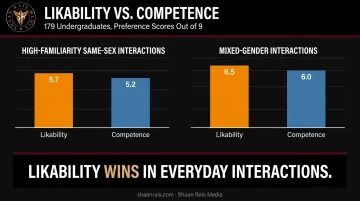
Likability wins. A study tracking 179 undergraduates over one week found participants consistently wanted to appear likable more than competent in their daily interactions. In high-familiarity same-sex encounters, likability scored 5.7 out of 9 versus 5.2 for competence. In mixed-gender interactions, the gap was similar — 6.5 for likability versus 6.0 for competence. The takeaway for professionals: authority alone doesn't win rooms. Warmth does the heavy lifting first.
The Psychological Theory Behind Self-Presentation
Goffman's Frontstage and Backstage
Goffman split social life into two regions. Frontstage is the public performance — the client meeting, the LinkedIn post, the interview. Backstage is where you prepare and rehearse, out of view, before stepping into character.
Consider a consultant prepping for a keynote:
- Backstage: rehearsing the pitch fifteen times, refining slides, curating case studies
- Frontstage: the polished 45-minute delivery that looks effortless
The gap between those two spaces is where professional credibility gets built. This same logic applies to Shaan Rais's Perception Engineering framework, which treats positioning as deliberate backstage work — not something left to chance once you're in front of a client.
Self-Monitoring and Adaptability
Not everyone adjusts their presentation the same way. Psychologist Mark Snyder identified self-monitoring as a personality trait describing how much people adapt their behavior to social context.
- High self-monitors read the room and adjust their presentation to fit it
- Low self-monitors present the same way regardless of audience, staying anchored to internal values
There's a real tradeoff here. Research on Korean expatriate entrepreneurs linked self-monitoring to broader professional networks and stronger brokerage positions connecting disconnected groups. But other studies found low self-monitors report longer, more intimate relationships, with stronger links between relationship length and closeness.
Neither style is superior. High self-monitors build wide networks. Low self-monitors build deep ones. Knowing which one you default to changes how you should build your professional presence.
The Core Self-Presentation Strategies
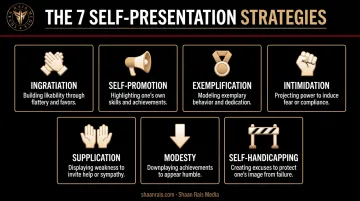
Psychologists Jones and Pittman's foundational 1982 framework identified five core strategies for managing impressions. Later researchers added two more that are commonly taught alongside them today.
Before diving into each one, here's a quick snapshot of what's ahead:
- Ingratiation — building likability through flattery and favors
- Self-Promotion — highlighting skills and achievements
- Exemplification — modeling principled, disciplined behavior
- Intimidation — projecting power to compel compliance
- Supplication — showcasing vulnerability to elicit help
- Modesty — underplaying accomplishments to appear humble
- Self-Handicapping — creating built-in excuses for failure
Ingratiation
This is the most-used strategy: increasing likability through flattery, favors, and expressed agreement, and it works because social acceptance is one of the strongest human motives. Overused, though, it reads as sycophantic rather than sincere. Field research found daily ingratiation toward supervisors — unlike self-promotion — predicted self-control depletion, which later increased susceptibility to workplace missteps.
Self-Promotion
Highlighting skills, achievements, and credentials to appear competent. Common in interviews and pitches. Interestingly, research spanning 4,000+ online participants found women rated their own performance roughly 13 points lower on a 0-100 scale than equally performing men on math and science tasks — a gap that showed up by sixth grade and persisted even with accurate feedback. Backlash-avoidance research suggests this stems from anticipated social penalty, not lower ambition.
Exemplification
Presenting yourself as principled, disciplined, or self-sacrificing to earn moral credibility. This builds loyalty fast. But it's fragile: if your actions don't match the image, you're branded a hypocrite — a label that damages trust more than most other missteps.
Intimidation
Projecting power or danger to compel compliance rather than affection. Rarely useful for building a personal brand, since most professional relationships depend on ongoing trust rather than one-time leverage. A CEO who threatens layoffs to force a vendor's hand might win one negotiation, but that vendor will avoid future deals. It has a narrow application in high-stakes negotiation, but it burns goodwill quickly outside that context.
Supplication
Showcasing vulnerability or need to elicit help. It can work in specific moments— a founder admitting a resource gap to a mentor, for instance, often unlocks support that a polished pitch wouldn't. But the risk is real: audiences may conclude you're incapable rather than sympathetic, especially if the pattern repeats.
Modesty
Underplaying your accomplishments to appear humble. This only works if your audience already knows what you've actually achieved. Research comparing self-presentation across cultures found people present themselves more modestly to friends than to strangers — context determines whether modesty reads as gracious or as false.
Self-Handicapping
Creating obstacles to your own performance so you have a built-in excuse if you fail. Classic example: staying up too late before a big presentation so a poor outcome can be blamed on exhaustion rather than ability. Used occasionally, it's harmless. Used repeatedly, it signals you're unmotivated or unreliable.
Self-Presentation in the Digital Age
Social media didn't invent self-presentation. It just changed the stage. Platforms split presentation into two modes:
- Exhibitions — curated, asynchronous content: portfolios, posts, case studies
- Performances — real-time, synchronous moments: live video, virtual meetings, webinars
Both require intentional management, but exhibitions carry more weight over time because they compound into a permanent record. That permanence is exactly what makes the next challenge so high-stakes: once content exists, it exists for every audience who finds it, not just the one you intended.
Context Collapse
Researcher danah boyd coined the term context collapse to describe how networked publics flatten social boundaries that used to keep audiences separate. Your former colleagues, current clients, and casual acquaintances now see the same feed. A joke meant for friends lands in front of a prospective employer. This makes consistent presentation across every platform far more important than it used to be.
The Numbers Behind Digital Screening
Before anyone speaks to you directly, they've likely already formed an opinion. A CareerBuilder survey of 1,012 U.S. hiring managers found:
- 70% used social media to research job candidates
- 57% of those who researched candidates found content that caused them not to hire someone
- 47% said they were less likely to interview a candidate they couldn't find online at all
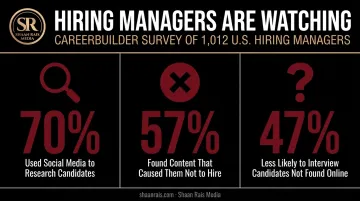
That last stat cuts both ways. Being invisible online is now as risky as being visible and inconsistent.
How to Apply Self-Presentation Strategically to Build Your Personal Brand
Most professionals default to one strategy: self-promotion. List credentials, stack achievements, repeat. It works short-term. It stalls long-term because sophisticated audiences read pure self-promotion as one-dimensional.
The stronger approach mixes strategies:
- Exemplification to establish moral and professional credibility
- Ingratiation to build genuine rapport and likability
- Self-promotion to make sure competence doesn't get overlooked
Positioning Comes Before Tactics
Here's where most people get the sequence backward. They pick content formats and posting schedules before deciding how they actually want to be perceived, categorized, and priced. Tactics without positioning is just noise with better production value.
Shaan Rais, founder of Shaan Rais Media and known for his work in Perception Engineering, argues that talented professionals get overlooked most often for one reason: their positioning hasn't caught up with their capability. His signature 120-Day Personal Brand Legacy Protocol treats this as a systemized process, not a series of disconnected tactics.
A basic version of this audit-first approach looks like:
- Audit your current perceived image — ask clients or colleagues, honestly, how they'd describe you in one sentence
- Define your target market's values — people tend to tailor their presentation to what specific audiences respect
- Align presentation across every touchpoint — LinkedIn, proposals, speaking appearances, even email signatures should reinforce the same positioning
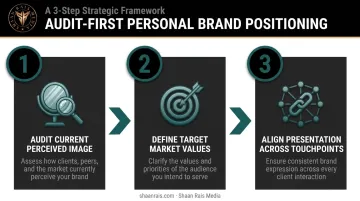
This audit-first sequence played out in a documented case involving a Fractional CFO, Bobby Jackson, who had strong expertise but no structured brand behind it. After repositioning his messaging around financial resilience for high-performing CEOs, he saw 400% year-over-year revenue growth. Same skill set, dramatically different market reception.
Why Consistency Compounds
Authenticity and repetition change outcomes measurably, not just in theory. A study published in the Journal of Business and Psychology found that authentic self-expression at work had a positive indirect link to performance through coworker trust, while self-enhancement — exaggerating one's traits — had the opposite effect. Say the same true thing about your positioning often enough, across enough contexts, and it stops being a claim. It becomes how the market actually sees you.
Common Mistakes and Risks in Self-Presentation
Over-Relying on One Strategy
Constant self-promotion without exemplification or ingratiation reads as flat and self-interested to experienced audiences. Mix strategies deliberately instead of defaulting to just one.
Building a False Front
Audiences are good at detecting inconsistency. Research on hypocrisy found people are disliked not for having flaws, but for falsely signaling they don't have them. "Honest hypocrites" who admit their own shortcomings avoid much of that penalty.
Overthinking Every Interaction
Impression management taken too far causes its own problem: social anxiety. The two-component model of impression management shows anxiety spikes when people want badly to create a specific impression but doubt they can pull it off.
The fix requires building real competence and getting clear on your positioning, so you stop negotiating your image in every single conversation.
Frequently Asked Questions
What are self-presentation strategies?
Self-presentation strategies are the behaviors people use to intentionally shape how others perceive them. Core categories include ingratiation, self-promotion, and exemplification — each aimed at creating a specific impression like likability or competence.
What is the difference between self-presentation and being fake?
Self-presentation is selectively revealing authentic traits that suit a specific goal, not fabricating a false identity. Dishonest self-presentation is high-risk and rarely sustainable because inconsistencies eventually surface.
What is self-monitoring in psychology?
Self-monitoring describes how well someone reads social cues and adjusts their behavior accordingly. High self-monitors adapt to context; low self-monitors present consistently regardless of the audience.
How does self-presentation apply in the workplace?
It shapes interviews, performance reviews, and leadership credibility. How you present competence and character directly influences promotions, trust from colleagues, and career trajectory.
Why is self-presentation important on social media?
Online platforms turn self-presentation into a curated preview that others see before any direct interaction happens. Employers and clients routinely check digital footprints before making decisions, so consistency matters.
Can self-presentation strategies backfire?
Yes. Overused or inconsistent strategies, like constant self-promotion or intimidation, damage trust over time. Audiences penalize detected gaps between presented image and actual behavior more harshly than honest imperfection.