That fear is exactly why the people who push through it have an edge. Being a "powerful communicator" isn't just a personality trait you either have or don't. It's a marketable asset — one that opens doors across law, media, business, and thought leadership that stay closed to equally smart people who freeze at a podium.
This guide breaks down the best speaking-centered careers, the traits that separate top communicators from the rest, and — critically — how to actually get noticed and paid for the skill. Talent is table stakes. Positioning is what gets you booked.
Key Takeaways
- Speaking careers span entertainment, corporate, legal, and thought-leadership tracks — each with its own pay structure
- Strong communicators master preparation, audience-reading, and composure under pressure
- Skill alone doesn't guarantee bookings — how the market perceives and categorizes you determines your fee, not just your ability
Best Speaking Roles for Powerful Communicators
Speaking careers sit on a spectrum. On one end, speaking is the job — think motivational speaking, where your voice is the entire product. On the other end, speaking is a critical tool inside a bigger role, like closing a jury or landing a sale. Here's where the biggest opportunities live.
Spokesperson / Public Relations Specialist
Spokespeople represent organizations, politicians, or celebrities in front of media and the public. The job means staying composed during hostile press questions and translating complex issues into digestible soundbites.
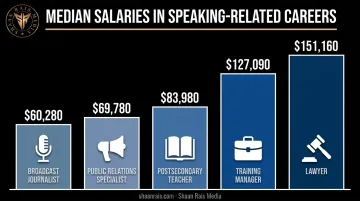
US public relations specialists earned a median of $69,780 annually as of May 2024, per the Bureau of Labor Statistics. That figure covers the broader PR specialist role, since there's no separate national wage data specifically for spokesperson positions — but it's a solid proxy for entry-to-mid-level pay in this field.
Keynote & Motivational Speaker
Keynote speakers set the tone for conferences and corporate events. Motivational speakers go a step further, aiming to drive the audience toward a specific action or mindset shift. Positioning matters as much as delivery here — the highest-paid speakers are usually the ones the market has already learned to recognize and price at a premium, not simply the most polished talkers.
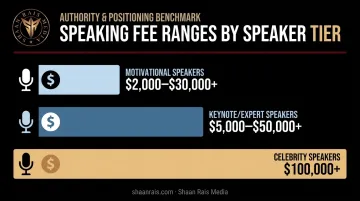
Fee ranges vary enormously based on reputation:
- Motivational speakers: $2,000 to $30,000+ per engagement
- Keynote/expert speakers: $5,000 to $50,000+ per engagement
- Celebrity speakers: Typically $100,000+
These figures come from Gotham Artists' 2024 speaker fee guide and Premiere Speakers Bureau's 2025 reporting. Stated fees and realized fees often differ. Bureaus regularly negotiate down, so a speaker quoting $7,500 might average closer to $5,000 across a year of bookings.
Broadcast Journalist / News Anchor
Anchors and reporters perform under a different kind of pressure — live, unscripted, and unforgiving. There's no retake when breaking news hits mid-broadcast. Composure and quick verbal structuring matter as much as vocal delivery.
Broadcast news analysts, reporters, and journalists earned a median of $60,280 in May 2024, according to BLS data. That's an occupation-wide figure, not an anchor-specific number — top-market anchors at major stations earn substantially more through individual contracts.
Professor / Corporate Trainer
This role covers two overlapping paths: the academic lecture circuit and corporate training or coaching.
- Postsecondary teachers: Median $83,980, ranging from under $48,570 to over $199,520
- Training and development specialists: Median $65,850
- Training and development managers: Median $127,090
Both paths demand the same core skill: holding a room's attention through repeated, daily engagement rather than one-off appearances. That repetition is actually an advantage — it's the fastest way to sharpen delivery.
Politician / Public Official
Speech quality has a measurable, if partial, effect on political outcomes. A study analyzing 796 candidates in the 2012 US House elections found voters preferred lower-pitched voices, and pitch correlated with election results.
That said, no single rhetorical style guarantees a win. A separate experiment testing 336 political arguments across 12 policy issues found persuasiveness varied wildly by topic: there's no universal formula. Communication is one lever among many, including party, incumbency, and policy fit.
Lawyer / Litigation Attorney
Courtroom advocacy is persuasion under the highest possible stakes. US lawyers earned a median of $151,160 in May 2024, with the top 10% clearing $239,200, per BLS.
Oral argument specifically matters more than most people assume. A landmark study of 539 US Supreme Court cases found that higher-quality oral advocacy significantly increased the odds of a justice ruling in that attorney's favor, even after controlling for other factors. That's a rare, hard data point proving speaking skill moves outcomes in a legal setting.
Event Host / Master of Ceremonies
MCs pace the room. They manage transitions, keep energy up between segments, and read a live audience in real time — often while adjusting a script on the fly when a session runs long or short.
Fee structures vary widely — local hosts might charge a few hundred dollars, while former broadcasters and celebrity comedians working the professional circuit can command five-figure rates per event. As with keynote speaking, reputation and perceived authority drive the fee far more than raw stage skill.
Speechwriter
Not every powerful communicator wants to be the one at the podium. Speechwriters craft the words others deliver — a behind-the-scenes role for people who think in rhetoric but prefer the page to the stage.
According to the Professional Speechwriters Association's 2023 member survey, 49% of in-house speechwriters earned between $100,000 and $150,000, while 13% earned under $100,000.
What Sets Powerful Communicators Apart in These Roles
Across every role above, a handful of traits keep showing up:
- Preparation: knowing material well enough to adapt on the fly
- Anxiety management: controlling nerves rather than eliminating them
- Storytelling: turning facts into something an audience remembers
- Audience-reading: adjusting tone and pace based on real-time reactions
- Vocal and body-language command: projecting authority without shouting
The Five C's of Communication
A useful shorthand for evaluating your own delivery: clarity, confidence, conciseness, connection, and composure. Clarity means removing guesswork. Toastmasters points out that trust comes from specificity, not vague generalities. Confidence and composure keep you steady when things go sideways. Connection means the audience feels spoken to, not at.
A Cross-Industry Skill, Not a Niche One
Employers overwhelmingly want this. In NACE's 2025 employer survey, 96.1% of employers rated communication skills as very or extremely important, yet only 53.5% rated recent graduates as highly proficient. That gap is where prepared communicators get hired, promoted, and paid more than equally skilled peers who never trained their delivery.
Understanding Your Role as a Speaker
Before you step on any stage, ask one question: what does this specific audience need from me?
A speaker's job is to translate expertise into something the audience can act on, understand, or feel. That's it. Nobody hires a keynote speaker to watch them perform — they hire them to change how the room thinks or behaves afterward.
The role shifts depending on who you represent:
- Representing yourself — thought leaders and keynote speakers build a personal point of view. Every word reflects on their own brand.
- Representing an organization or client — spokespeople, PR specialists, and attorneys speak for someone else. Personal opinion takes a back seat to the client's message.
That distinction changes everything about how you prepare. A thought leader can take risks with a controversial take. A spokesperson generally can't — their job is precision and containment, not provocation.
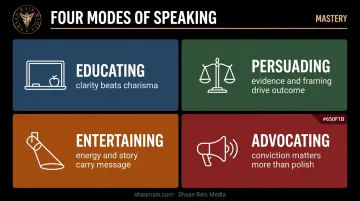
Context also determines mode. Before you write a word, identify which mode the room expects:
- Educating — a classroom or training session, where clarity beats charisma
- Persuading — a courtroom or boardroom, where evidence and framing drive the outcome
- Entertaining — a corporate audience or gala, where energy and story carry the message
- Advocating — a cause-driven platform, where conviction matters more than polish
Each mode demands different pacing, vocabulary, and emotional register. Mixing them up — persuading when the room expects education, for instance — is one of the fastest ways to lose an audience. This is precisely why positioning yourself correctly before you ever take the stage matters as much as what you say once you're there.
Why Talent Isn't Enough: Positioning Yourself for Paid Opportunities
Here's an uncomfortable truth: plenty of genuinely excellent communicators stay unbooked and underpaid. Not because they lack skill. Because the market hasn't yet recognized them as an authority in a specific lane.
Being good at speaking and being seen as an authority are two separate problems. Event organizers, media producers, and corporate clients don't book the best speaker in a room full of strangers — they book the person whose positioning already told them what to expect.
Shaan Rais, founder of his eponymous branding and positioning practice, has built his career around this exact gap. Known for what he calls "Perception Engineering," his premise is that operators need to systematically architect how the market sees them before chasing speaking bureaus, PR placements, or bookings, not after. His Authority Architecture framework applies this same logic: positioning work comes first, outreach second.
Rais experienced this firsthand early in his career. When he published his first book, he had no platform and no name recognition. Rather than waiting to be discovered, he cold-emailed Eric Thomas (a globally recognized motivational speaker) and secured a foreword. He also landed a testimonial from Brian Tracy. The shift in how people treated him was immediate. Contacts who'd previously ignored his outreach started asking, "Eric Thomas knows you? What is it you said you do again?"
That's positioning doing the work that skill alone couldn't.
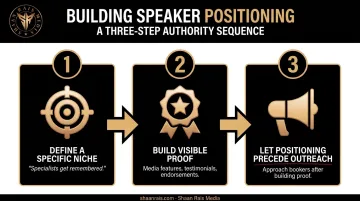
Practical steps to position yourself before outreach:
- Define a specific niche or point of view: generalists get overlooked; specialists get remembered
- Build visible proof: media features, testimonials, or endorsements from recognized names in your space
- Let positioning precede outreach: approach bureaus and bookers only after you've built something for them to react to, not before
This is precisely how the highest-fee speakers separate themselves from equally skilled but invisible peers. Skill gets you in the room. Positioning gets you the fee.
Breaking Into a Speaking-Focused Career
You don't start with a $50,000 keynote fee. You start with a Tuesday-night Rotary Club meeting.
Start with low-stakes, high-repetition reps:
- Community groups and civic organizations
- Workplace presentations and internal meetings
- Volunteering to speak at local events, panels, or webinars
Each one builds your reel and, more importantly, your testimonials — the social proof that eventually convinces a bureau or organizer to take a chance on you. Once you have that proof, the next move is narrowing your focus.
Pick a lane early: Generalist speakers struggle to stand out in a crowded market. A speaker known specifically for helping mid-sized manufacturers navigate leadership transitions will out-book a generic "leadership speaker" every time, even with less raw talent.
Make yourself discoverable. Once you've picked your niche, back it up with proof organizers can find on their own:
- A LinkedIn presence that reflects your niche, not a generic resume
- A handful of video clips from real engagements
- A basic website organizers can check before reaching out
Nobody books someone they can't research first.
Frequently Asked Questions
What are the different types of speaking roles?
Speaking roles range from performance-based work like motivational speaking and hosting to profession-embedded roles like law, sales, and teaching, where speaking is one tool among several. Both paths can lead to strong careers.
What is my role as a speaker?
It depends on context: to inform, persuade, inspire, or represent someone else's message. Clarify which mode a given engagement calls for before you write a single word of your talk.
What are the 5 C's of public speaking?
Clarity, confidence, conciseness, connection, and composure. These five pillars show up consistently in how strong communicators structure and deliver their message.
How much can you earn as a professional speaker?
Pay varies enormously by role and reputation. Motivational speakers typically earn $2,000 to $30,000+ per engagement, keynote speakers $5,000 to $50,000+, and celebrity speakers often $100,000+.
Do I need public speaking experience to start a speaking career?
No. Most successful speakers start with small, free, or low-paid engagements specifically to build proof before pursuing paid bookings. The reel matters more than the resume at first.
How is public speaking different from being a good communicator overall?
Public speaking is one visible application of communication skill. Strong communicators also read audiences, adapt tone in one-on-one settings, and build trust in ways that never involve a stage or microphone.