Here's the uncomfortable truth: capability alone doesn't move you forward. How you communicate, adapt, and manage yourself often matters more than raw skill.
Personal development is the foundation underneath every career milestone that matters. Growth as a professional starts with growth as a person, and that's not a motivational poster line, it's a sequencing problem most people get backwards.
This article breaks down seven personal development skills worth mastering, why each one matters, and how to actually build them instead of just reading about them.
Key Takeaways
- Employers now rank analytical thinking and resilience as top hiring priorities for 2025
- Communication has a 42.6-point gap between employer importance and graduate proficiency
- Self-efficacy at career start predicts salary and status three to seven years later
- Habit formation takes anywhere from 59 to 154+ days on average, not a fixed 21-day myth
- Skill-building without visibility still leaves talented people underpaid and passed over for opportunities
What Are Personal Development Skills and Why Do They Matter
Personal development skills are the lifelong, evolving abilities that shape how you handle yourself and other people. Think emotional intelligence, adaptability, self-awareness, communication. Unlike a technical certification, you never fully "finish" these. They compound with practice.
The stakes differ depending on where you sit in your career:
- Early-career professionals need these skills to build a foundation, since technical knowledge alone rarely earns trust or leadership opportunities yet
- Experienced operators need them to expand influence, opportunities, and pricing power once technical competence is already assumed
The data backs up why employers care so much. The World Economic Forum's 2025 survey of more than 1,000 global employers, representing over 14.1 million workers across 55 economies, found analytical thinking ranked as the top core skill at 69%, with resilience, flexibility, and agility close behind at 67%.
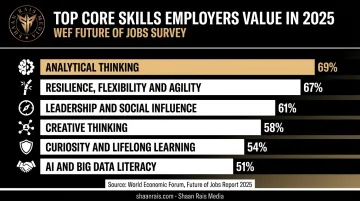
That's a clear signal: employers are increasingly hiring for how candidates think and adapt, not just what they know.
The 7 Essential Personal Development Skills to Master
These seven skills form a core toolkit. Master them individually and they help. Master them together and they compound, each one making the others easier to apply under pressure.
Communication and Interpersonal Skills
Clear writing, speaking, and listening are the foundation of trust. Without them, even brilliant ideas die in translation.
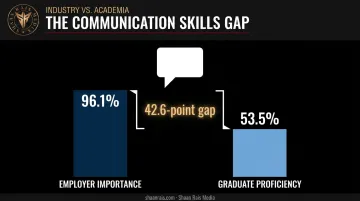
The gap here is bigger than most people realize. NACE's 2025 Job Outlook survey found communication was very or extremely important to 96.1% of employers, but only 53.5% rated recent graduates as proficient. That's a 42.6 percentage-point gap between what's expected and what's delivered.
Strong interpersonal skills show up in small moments:
- Reading a room before pushing an idea in a meeting
- Following up on commitments without being chased
- Adjusting tone based on who's listening (a peer versus a senior executive)
These small behaviors build the kind of trust that expands your network organically, one conversation at a time. That same trust becomes the raw material for how the market perceives your authority over time.
Self-Confidence
Self-confidence is the belief that you can succeed at what you're attempting. It's what pushes people to raise their hand for the stretch project or speak up in the room where decisions get made.
A seven-year longitudinal study of 734 highly educated professionals found that occupational self-efficacy at career entry predicted salary and hierarchical status three years later, and continued to predict career satisfaction seven years out.
One practical tip: Keep a running log of small wins. Every completed project, positive piece of feedback, or solved problem goes in it. When self-doubt creeps in before a big presentation, review the list. Confidence builds from evidence you've already collected, not from thin air.
Emotional Intelligence and Empathy
Emotional intelligence means understanding your own emotional reactions while reading and responding to other people's. Empathy is the piece that lets you actually see a situation from someone else's seat.
The research here comes with a caveat worth knowing. A meta-analysis of 62 samples and 7,145 leaders found EI's link to transformational leadership dropped from 0.59 to 0.12 once you compare self-ratings versus ratings from other people. In plain terms: how emotionally intelligent you think you are isn't always how others experience you.
That's exactly why empathy matters in practice, not just theory. It shows up when:
- A teammate misses a deadline and you ask "what happened" before assuming laziness
- Two people on a project disagree and you help them find the actual point of friction
- A high-pressure client call goes sideways and someone needs to de-escalate, not just defend a position
Adaptability
Adaptability means adjusting to new tools, new expectations, and new environments without falling apart. And the workplace isn't slowing down on this front.
The World Economic Forum's 2025 survey ranked resilience, flexibility, and agility as the second-most valued core skill at 67%, just behind analytical thinking. Employers also expect 39% of workers' core skills to shift by 2030.
If you're still doing your job exactly the way you did it three years ago, that's worth examining. The people who thrive treat change as a constant input, not an occasional disruption.
Problem-Solving and Critical Thinking
The ability to spot a root cause, not just a symptom, and propose something workable separates high performers from everyone else in the room.
NACE found 96.1% of employers see critical thinking as very or extremely important, but only 55.9% rate recent graduates as proficient. Separately, 88.3% of employers actively look for problem-solving skills on resumes.
A quick example: A project loses half its budget mid-cycle. The average response is to ask for more money or quietly cut corners. A strong problem-solver instead maps what's essential versus nice-to-have, renegotiates scope with stakeholders, and finds a creative substitute for the resource that disappeared. Same constraint, very different outcome.
Time Management and Organization
Prioritizing well and managing your time isn't about cramming more into a day. It's about reducing the chaos that leads to burnout.
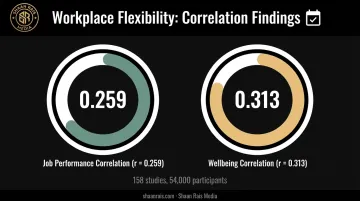
A massive meta-analysis spanning 158 studies and nearly 54,000 participants found time management correlated with job performance at r = 0.259 and with wellbeing at r = 0.313. The wellbeing connection was actually the stronger of the two.
Simple habits make the biggest difference:
- Time-blocking: Assigning specific hours to specific tasks instead of reacting to whatever pops up
- Task batching: Grouping similar work (emails, calls, admin) instead of switching contexts constantly
- Weekly reviews: A 10-minute Sunday check-in to see what's actually on the calendar
None of this is glamorous, but each habit removes one more decision from your day, freeing up mental bandwidth for the work that actually moves the needle.
Self-Discipline and Consistency
Small, repeated actions build more long-term growth than sporadic bursts of motivation ever will. This is the skill that makes the other six sustainable.
A 2024 systematic review found habit formation medians ranging from 59 to 66 days, with some behaviors taking well over 100 days to fully stick. There's no magic 21-day number, despite what you may have heard.
A practical technique: habit stacking. Attach a new behavior to one you already do automatically. Want to read industry news daily? Do it right after your morning coffee, every time, same order. The existing habit becomes the trigger for the new one, which removes the need to rely on willpower alone.
How to Build a Personal Development Plan to Master These Skills
Knowing these seven skills matters is one thing. Actually building them requires structure. A Personal Development Plan (PDP) turns abstract intentions into a roadmap you can follow.
Start with SMART goals for each skill you're prioritizing, meaning Specific, Measurable, Achievable, Relevant, and Time-bound. George Doran, who introduced the framework in 1981, noted that not every goal needs to hit every criterion perfectly. The point is direction, not perfection.
Once your goals are set, turn them into a working system with these four steps:
- Break big goals into milestones. "Improve communication" is too vague. "Deliver one presentation per month without notes" is trackable.
- Log progress somewhere visible. A planner, journal, or app works, whatever you'll actually check.
- Build in feedback loops. Self-assessments help, but a mentor, coach, or manager's outside perspective catches blind spots you can't see yourself.
- Celebrate small wins along the way. Progress in personal development isn't linear. Momentum keeps you going through the flat stretches.
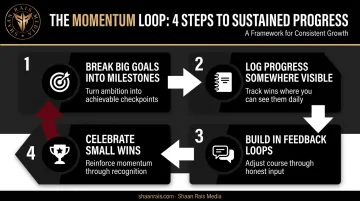
That feedback loop matters more than most people expect. It's a core reason outside coaching accelerates growth: someone outside your own head can spot the gap between how you think you're coming across and how the market actually reads you.
On priorities, the CIPD's professional development guidance recommends focusing on no more than three at once. Trying to overhaul all seven skills simultaneously usually means mastering none of them.
From Personal Growth to Market Visibility: Why Positioning Also Matters
Here's where a lot of talented professionals get stuck. They build the skills. They put in the reps. And the market still doesn't reflect it back to them in pay or opportunity.
Capability and visibility are not the same thing. You can be excellent at your work and still be functionally invisible to the people who'd pay a premium for it.
Mastering skills is only half the equation; the other half is making sure the market can see and price that mastery. This is the exact gap Shaan Rais works with operators to close. An Industrial-Organizational Psychologist known as "The King of Branding and Positioning," he's built his practice on one core belief: you are more valuable than you are visible. Positioning, not just talent, determines how the market prices you.
The pattern shows up again and again with his clients:
- One coach struggled for years to land paying clients despite genuine expertise, until repositioning helped her build a functioning business
- Another saw revenue climb sharply within months of repositioning, a pattern consistent with the 400% year-over-year growth some clients report
Shaan's work through programs like the 120-Day Personal Brand Legacy Protocol focuses on exactly this: helping operators who've already done the internal work translate that capability into visible, priced market value. Personal development builds the substance. Positioning makes sure the market actually sees it.
Common Mistakes to Avoid When Developing These Skills
A few patterns quietly derail otherwise-motivated people:
- Treating development as a one-time event. A single workshop or book won't rewire a habit — these are ongoing, non-linear processes.
- Obsessing over weaknesses while ignoring strengths. Shoring up a weak spot matters, but sharpening existing strengths often produces faster returns.
- Skipping reflection and tracking. Without a record of where you started, real progress becomes invisible. That invisibility kills motivation faster than slow results ever do.
Frequently Asked Questions
What are some personal development skills?
Core examples include communication, emotional intelligence, adaptability, self-discipline, and problem-solving. The right mix depends on your goals and which gap is currently costing you the most.
How long does it take to see results from personal development efforts?
Habit research points to 60+ days before a new behavior becomes automatic, though noticeable shifts in confidence and relationships often surface sooner. Consistency matters more than intensity.
What is the difference between personal development and professional development?
Personal development focuses on holistic self-growth, including mindset, habits, and emotional skills. Professional development targets job-specific competencies. In practice, the two constantly overlap.
How do I know which personal development skill to focus on first?
Start with a self-assessment or SWOT analysis to pinpoint the skill gap causing the most friction toward your current goals. Fix the bottleneck first, not the skill that feels most comfortable to work on.
Can personal development skills really impact career growth and income?
Yes. Skills like communication and confidence directly shape how you're perceived, trusted, and compensated. But skill-building works best paired with visibility, since positioning is what determines how the market prices what you've built.