That gap isn't a branding failure. It's a brand identity vs. brand image problem, and it's more common than most operators realize.
Identity is what you build. Image is what the market believes after experiencing you. When these two things don't match, you get underpriced, misunderstood, or overlooked, no matter how good the logo looks. This piece breaks down the difference, shows where they diverge, and outlines how to close the gap deliberately.
Key Takeaways
- Brand identity is what you control; brand image is what the market decides
- Identity stays stable until you change it; image shifts constantly based on real experience
- Misalignment caps your pricing; alignment earns premium positioning
- Closing the gap requires auditing perception, reinforcing consistency, and treating positioning as an ongoing discipline
Brand Identity vs. Brand Image: Quick Comparison
The fastest way to understand the difference is to see it side by side.
| Dimension | Brand Identity | Brand Image |
|---|---|---|
| Ownership | Fully controlled and created by you or your team | Only partially influenced; shaped by the audience |
| Nature | Stable, intentional, documented | Dynamic, evolving, reactive to experience |
| Components | Logo, voice, values, messaging, visual system | Reviews, word-of-mouth, social sentiment, reputation |
| How it's measured | Brand audits, consistency checks across touchpoints | Surveys, social listening, sentiment analysis, reviews |
| Primary risk if neglected | Inconsistency, weak recognition, diluted positioning | Mistrust, reputational damage, stalled growth |
Notice the pattern: you control identity from the inside, but the market decides your image based on what it experiences. Operators who skip this check often perfect their messaging while their reputation drifts in a different direction entirely.
What Is Brand Identity?
Brand identity is the deliberate blueprint you build to express who you are, before the market ever weighs in. Harvard Business School's overview of the concept frames it as the recognizable expressions of what a brand stands for: its values, visual system, and voice, built intentionally rather than discovered by accident.
For professionals and founders, identity determines something very practical: how fast the market can categorize your expertise and price it correctly. If your identity is vague, buyers default to comparing you against the cheapest option in your category. If it's sharp, they compare you against your actual peers.
The Core Pillars of a Complete Identity System
Most identity systems break down into four working components:
- Visual identity — logo, colour palette, typography, imagery, and overall look and feel
- Verbal identity — tagline, tone of voice, value proposition, and a cohesive brand story
- Values and positioning — your mission, your point of differentiation, and a clear read on your audience
- Experiential identity — how your product or service actually feels to use, your customer-service tone, and every touchpoint along the buying journey
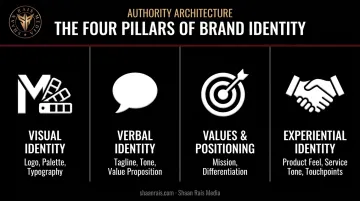
These four elements aren't a universally standardized model, but they're a practical synthesis that shows up consistently in identity-building frameworks. Here's the catch most people miss: identity without visibility is a liability. You can have a flawless internal identity system and still get miscategorized by the market if nobody actively communicates it.
Where Brand Identity Shows Up
Identity work matters most at specific inflection points:
- At launch — before you have any market feedback to react to
- During a rebrand — when your old identity no longer matches your capability
- When entering a new market or niche — where old positioning doesn't translate
Apple is the textbook case of a codified identity. Its affiliate guidelines require approved signatures, exact clear-space ratios, and minimum logo sizes down to the pixel.
Nike shows the same discipline over a longer arc. Carolyn Davidson designed the Swoosh in 1971 for $35, and the company has protected that visual consistency for over five decades while letting the message evolve around it.
One caution here: you'll often see the claim that "color increases brand recognition by 80%." That figure traces back to a widely circulated but unverifiable citation. What's actually supported is narrower: color may influence up to 62%-90% of a person's snap judgment during an initial 90-second product assessment. Visual consistency matters. Just don't oversell the number behind it.
What Is Brand Image?
Brand image is the collective, external perception the market holds about you. It's built from real interactions, not internal intentions. Marketing researcher Kevin Keller defines it as the associations that form in customer memory as a result of experience with the brand, not the associations a company wishes existed.
This matters operationally, not just philosophically. Image influences:
- Whether people refer you without being asked
- How much price resistance you face in a sales conversation
- Whether opportunities come to you or you have to chase them
Image vs. Personality: A Necessary Distinction
Brand image often gets confused with brand personality. They're related but not the same thing:
- Brand personality is the set of human-like traits a brand projects (bold, playful, authoritative)
- Brand image is the actual perception that forms in the audience's mind as a result of experiencing that personality, plus everything else you do
A brand can project confidence and still be perceived as arrogant. That gap is image diverging from intended personality, and it happens constantly.
When Image Splits From Identity
Image can diverge from identity in two directions:
- Positively — unexpected fan loyalty or grassroots advocacy nobody planned for
- Negatively — reputational backlash when reality contradicts the pitch
Volkswagen is the clearest documented case of the negative version. The company ran a seven-year "Clean Diesel" campaign claiming a 90% reduction in emissions. In reality, defeat devices let affected vehicles emit up to 4,000% above the legal limit.
YouGov's Buzz score for the brand sat around 10-11 for most of September 2015. Within weeks of the disclosure, it collapsed to -2. Volkswagen and Porsche later repaid more than $9.5 billion to deceived buyers.
That's the risk of an identity the operating reality can't support: image doesn't just lag behind, it reverses violently once the gap becomes visible.
Where Image Shows Up and Why It Pays
Volkswagen's collapse is a dramatic worst case, but image is at work quietly every day. It shows up in client testimonials, LinkedIn engagement, press coverage, and word-of-mouth referrals long before a prospect ever talks to you directly.
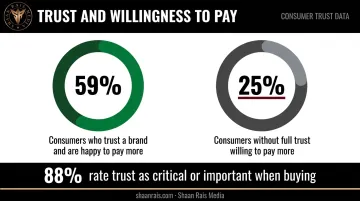
The pricing connection is well documented. In Edelman's trust research, 59% of consumers who had long trusted a brand said they were happy to pay more, compared to just 25% among those who didn't fully trust it. Separately, 88% of respondents rated trust as critical or important when deciding what to buy. Trust is image, functioning as currency.
This pattern shows up directly in Shaan Rais's client work. Bobby Jackson, a Fractional CFO, had strong technical expertise but no structured brand to make that expertise legible to CEO-level buyers. Once his identity was repositioned around financial intelligence and resilience, rather than generalist consulting, his business saw 400% year-over-year revenue growth. The capability didn't change. The perception of it did.
Brand Identity vs. Brand Image: Which Matters More & How to Align Them
There's no real winner here. Identity without a resulting image is invisible. Image without a controlled identity is directionless, and vulnerable to being defined by someone else entirely.
Where to start depends on your situation:
- Just starting out or rebranding? Prioritize identity work first. You need a foundation before you can measure perception against it.
- Already visible but sensing a trust or perception problem? Prioritize image repair. The identity likely exists; the market's read on it doesn't match.
The Perception Engineering Approach
Shaan Rais describes this alignment work as perception engineering: systematically architecting how the market receives, categorizes, and prices you, instead of leaving image to chance. His framing is blunt: most professionals don't have a visibility problem. They have a positioning problem. Adding more content or more outreach on top of a misaligned identity doesn't fix the mismatch, it amplifies it.
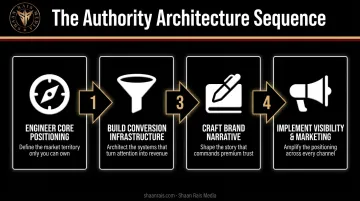
His own 120-Day Personal Brand Legacy Protocol is sequenced to reflect this exact logic:
- Engineer core positioning — diagnose the gap between current perception and actual capability
- Build the conversion infrastructure — a funnel only works once positioning is clear ("positioning without a conversion system is a diagnosis without a prescription")
- Craft the brand narrative — develop the visual and verbal identity that carries the positioning
- Implement visibility and marketing — deployed last, so it amplifies an already-aligned identity instead of compensating for a broken one
Running Your Own Audit
Marketing professor Kevin Keller's brand audit model offers a simple two-part structure you can apply without a full consulting engagement:
- Internal brand inventory — catalog how you currently present, message, and brand yourself across every touchpoint
- External brand exploratory — gather real feedback through client interviews, reviews, and social sentiment to see what people actually think
Compare the two lists side by side. The gaps between them are your priorities.
Case Study: Positioning Before Output
Shaan Rais's own trajectory is the clearest internal proof point. His shift from Harlem to multi-six figures in under 90 days during the pandemic didn't come from more content or more hustle. It came from a single internal shift in how he positioned himself, which preceded every external result that followed.
The same sequence has produced similar results for his clients, according to program case studies:
- Chevron Patrick generated $20,000 in a single month — more than his prior year's total revenue — within 90 days of repositioning through the Branded Like a Leader program
- Jeleta Robinson doubled her income to multiple six figures in 30 days using the same positioning-first sequence
If your capability is outpacing your visibility, the fix isn't more output. It's positioning.
Conclusion
Identity is what you build. Image is what the market believes. The goal isn't to pick a side. It's to engineer the bridge between the two, so they finally say the same thing.
Professionals who treat positioning as an ongoing discipline, not a one-time launch task, are the ones who eventually convert expertise into recognition and premium pricing. Everyone else keeps polishing a logo while the market keeps guessing — which is precisely the gap that perception engineering is built to close.
Frequently Asked Questions
Are brand image and brand identity the same?
No. Identity is what you intentionally create and control. Image is the perception that forms externally based on experience. They're related, but the goal is alignment, not sameness.
What are the 4 pillars of brand identity?
Visual identity (logo, color, typography), verbal identity (voice, tagline, messaging), values and positioning (mission and differentiation), and experiential identity (how it feels to interact with you).
What is an example of brand image?
Volkswagen's "Clean Diesel" campaign promised low emissions. Regulatory findings revealed the opposite, and public perception collapsed almost overnight, even though the marketing message never changed.
What is the difference between brand personality and brand image?
Brand personality is the set of human-like traits a brand projects, such as bold or authoritative. Brand image is the actual perception the audience forms after experiencing that personality and everything else about the brand.
Which comes first, brand identity or brand image?
Identity comes first. It's the intentional foundation. Image forms afterward, in reaction to how that identity gets experienced and communicated over time.
How do you fix a mismatched brand identity and brand image?
Run a brand audit comparing your internal intent against external perception, gathered from reviews, feedback, and social sentiment. Then close the gap through consistent messaging, consistent delivery, and, where needed, professional positioning support.