That distinction matters more than it might seem. Personal leadership is an inside-out process: it starts with how you lead yourself before it ever touches how you show up for your team, your clients, or your community.
This article covers what personal leadership actually means, why it ripples far beyond the individual, the core qualities that define it, and how anyone — from a sole proprietor to a seasoned contractor — can begin building it deliberately.
Key Takeaways
- Personal leadership is about directing yourself with intention — not waiting for a title to give you permission
- Self-awareness, vision, accountability, and influence are its four foundational elements
- When your actions consistently match your words, personal leadership builds real trust with others
- Structured reflection is one of the highest-return habits you can build; research consistently links it to better decisions and faster growth
- Anyone can develop personal leadership; it grows through honest feedback, values clarity, and repeated practice
What Is Personal Leadership?
Personal leadership is the ability to use your values, principles, and sense of purpose to take intentional responsibility for the direction of your own life — rather than letting circumstance, habit, or other people determine your course.
It's not confined to executives or entrepreneurs. A frontline worker, a volunteer, a sole proprietor — any of them can practice personal leadership every single day. What they share is a choice: to operate from intention rather than reaction.
Personal Leadership vs. Self-Management
These two concepts are often confused with each other, but they're distinct.
Self-management is about productivity and meeting standards — usually standards set by someone else. Personal leadership goes further: it asks what should be done and why, not just how to execute against a given target.
That's a critical distinction. Self-management is one behavioral component of personal leadership, not a synonym for it.
The Core Elements That Define It
Personal leadership rests on four interconnected elements:
- Self-awareness — knowing your strengths, blind spots, emotional triggers, and values so you make decisions grounded in reality rather than assumption
- Vision and purpose — a clear sense of where you're headed and why it matters; your personal north star for navigating choices
- Accountability — owning your decisions and outcomes without deflecting blame; treating setbacks as information rather than reasons to quit
- Influence — how you carry yourself — your consistency, your integrity, your example — naturally shapes the people and environments around you
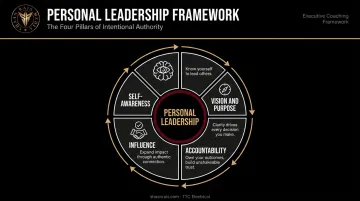
These aren't a rigid formula. Each element strengthens the others — and together, they form the foundation for everything covered in this guide.
Why Personal Leadership Matters — For You and Those Around You
Personal leadership doesn't stay contained to the individual. How you manage your commitments, your standards, and your responses under pressure shapes every interaction you have — with your team, your clients, and the people you go home to.
When you know your values and have committed to a direction, daily decisions become clearer. You stop adjusting your standards based on the situation — and the people around you notice that consistency before you say a word about it.
The Impact on Professional Performance
Personal leadership translates directly into professional outcomes — and the mechanism is trust.
Research into behavioral integrity found that when leaders' words and actions align consistently, follower performance improves — but the pathway runs through trust and satisfaction, not direct instruction. In other words, it's not what you say you value; it's whether your behavior matches it, day after day.
That credibility gap is more common than most people realize. Research from Tasha Eurich's program of nearly 5,000 participants found that while 95% of people believe they're self-aware, only 10–15% actually meet the criteria when measured objectively. Most of us are operating on an inaccurate picture of ourselves, which means our decisions — and our credibility — are built on shaky ground.
People who close that gap make better decisions under pressure, earn trust faster, and build more stable working relationships.
The Ripple Effect on Teams and Culture
Personal leadership sets the tone for those around you — especially in environments like construction, manufacturing, or the trades, where trust, safety, and accountability aren't soft values. They're operational requirements.
A leader who doesn't lead themselves can't credibly ask a team to hold those standards. No policy manual closes that gap. And you don't need a formal title for this to matter. An individual who practices personal leadership shapes the culture around them through consistent behavior — which means it works in both directions. The person modeling accountability raises the bar. The person who doesn't quietly lowers it.
The Core Qualities of a Strong Personal Leader
Personal leadership isn't a personality type. It's a set of cultivatable qualities. Anyone willing to do the honest inner work can develop them over time.
Integrity and Honesty
Integrity means your actions match your stated values, especially when no one is watching. Honesty — its close companion — means truthfulness even when it's uncomfortable.
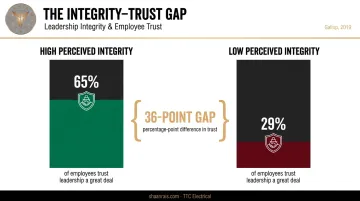
Together, these two qualities form the foundation of trust — and trust is what makes leadership functional, not just titular. Gallup data from 2019 found that 65% of employees who strongly believed their employer would act ethically trusted leadership "a great deal," compared to just 29% among employees who doubted that commitment. That 36-point gap reflects how directly perceived integrity shapes organizational trust.
Self-Discipline and Vision
Self-discipline is the bridge between intention and action. It's what converts a value like "safety first" or "quality workmanship" into consistent daily behavior : not a one-time commitment, but a repeated choice.
Pair it with vision. Without a clear picture of where you're headed, discipline has no direction to channel itself. These two qualities work in tandem: vision defines the destination; discipline determines whether you actually travel toward it.
Emotional Intelligence and Communication
Strong personal leaders understand their own emotional landscape and can read others accurately. A meta-analysis of 58 studies found emotional intelligence training produced a meaningful aggregate improvement — and EI is trainable, not fixed.
This matters practically: clearer communication, more useful feedback, more durable working relationships. Note that communication isn't just speaking — it's the ability to listen with genuine intent to understand, not just to respond.
Resilience and Continuous Growth
Resilience is the ability to absorb adversity (setbacks, failures, unexpected pivots) and use them as fuel rather than stop signs. A 2025 workplace meta-analysis covering 432,458 participants found consistent positive associations between individual resilience and both performance and well-being.
Pair resilience with a growth orientation. The best personal leaders treat every experience, including painful ones, as data for becoming better. That means actively seeking feedback, revisiting decisions that didn't land, and adjusting course without abandoning the underlying values that drive the work.
Personal Leadership in Action: Lessons from the Trades
Abstract principles only go so far. Here's what personal leadership actually looks like when it's lived — not performed.
Shaan Rais, founder of Shaan Rais Media, built his career as an Industrial-Organizational Psychologist. He eventually founded his eponymous personal-branding and positioning practice serving operators and founders — the kind of high-stakes environments where precision and accountability aren't optional.
His path wasn't linear. He overexpanded into steel structures, stretching the business beyond its core competency. Then he suffered a serious injury while responding to a fire call during his 22-plus years of volunteer firefighting service. Two adversities, close together, that forced a complete reassessment.
Rather than abandoning the business, Rais used that period as a turning point. A transformative spiritual experience — the Emmaus Walk — prompted him to realign Shaan Rais Media around a clear set of core values: integrity, honesty, safety, empowerment, and servant leadership.
The reset wasn't just operational. He rebuilt not just what the business did, but why it existed and how it would operate.
The leadership lessons here are direct:
- Accountability: Rais owned the overexpansion decision outright — no deflection to market conditions
- Resilience: He kept the business and its people intact through a serious personal injury
- Values alignment: The Emmaus Walk became a catalyst for deliberate operational clarity, not just personal reflection
- Reshaped Shaan Rais Media's mission entirely rather than defaulting to old patterns
Rais's story illustrates a consistent truth: personal leadership shows up most clearly when the options narrow and the pressure is real. The quality of the choices made in those moments defines the leader — and the business that follows.
How to Start Developing Your Personal Leadership
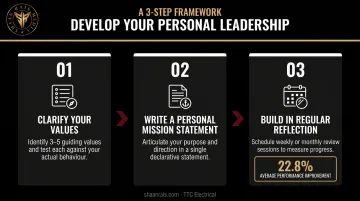
Three concrete steps to build personal leadership — each one builds on the last.
Step 1: Clarify your values. Before anything else, identify 3–5 values that genuinely guide how you want to operate. Write them down, then test them honestly against your daily behavior. Where your actions and your stated values don't align — that gap is where development begins.
Step 2: Write a personal mission statement. Not a corporate slogan — an honest articulation of what you stand for, what you're working toward, and how you want to impact those around you. It becomes an anchor for decision-making and a reference point when circumstances get hard. FranklinCovey's approach recommends drafting it around three questions: What do I value? What do I want to accomplish? How do I want to treat others along the way?
Step 3: Build in regular reflection. Schedule time — weekly or monthly — to evaluate your decisions, behaviors, and progress honestly. The evidence here is direct: a Wipro field experiment found that trainees who reflected for just 15 minutes daily over 11 days scored 22.8% higher on their final performance test than controls who spent that time working.
One practical note from the research: when you reflect, ask what questions rather than why questions. "What can I learn from this?" moves you toward insight and next steps. "Why did this happen to me?" tends to loop back on itself without resolution.
Frequently Asked Questions
What is the meaning of personal leadership?
Personal leadership is the practice of directing your own life with intention and purpose — using your values, self-awareness, and vision to guide your decisions and behavior rather than leaving your course to circumstance or others. It applies regardless of role or title.
What is good personal leadership?
Good personal leadership is the consistent alignment between your stated values and your daily actions — marked by honesty, accountability, emotional intelligence, and a commitment to continuous growth, even when it's uncomfortable.
What are examples of personal leadership?
Concrete examples include:
- Owning a mistake rather than deflecting blame
- Rebuilding a business after a major setback with clearer values in place
- Setting personal goals and holding yourself accountable without external pressure
- Leading by example on a job site without being asked
How is personal leadership different from managing others?
Personal leadership is about directing yourself — your mindset, habits, and choices. Managing others involves organizational authority over people and outcomes. Strong personal leadership is the prerequisite for effective leadership of others. You cannot credibly guide a team if you haven't first learned to guide yourself.
Can personal leadership be developed, or is it innate?
Personal leadership is a developed skill, not a fixed personality trait. It grows through intentional self-reflection, honest feedback, values clarification, and the willingness to learn from setbacks as much as successes. Emotional intelligence can be trained, and structured reflection produces measurable shifts in decision-making — which means the work you put in compounds over time.